
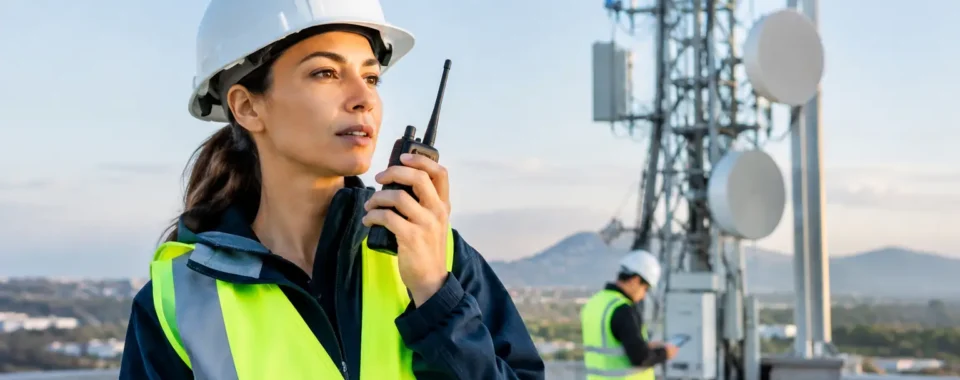

A handheld radio is only as useful as the system behind it. Radio infrastructure is what turns a collection of devices into a dependable communications tool for a construction crew, delivery fleet, hotel staff, farm operation, event team, or emergency response group. When coverage drops at the edge of a property, audio is unclear inside a steel building, or a repeater goes down during a storm, the issue is rarely the radio alone.
The right system starts with the work your team has to perform, the terrain it covers, and the consequences of a missed call. That may mean a simple local radio channel for a small site. It may also mean a licensed DMR system, an on-site repeater, a Push-to-Talk over Cellular deployment, or a combination of technologies designed around real operating conditions.
What Radio Infrastructure Actually Includes
Radio infrastructure is the collection of fixed equipment, network connections, power systems, antennas, and planning that supports radio communications beyond a single radio-to-radio conversation. It determines where people can communicate, how clearly they are heard, and whether the system remains available when conditions are less than ideal.
For a conventional land mobile radio system, the infrastructure may include a base station or repeater, antenna system, feed line, tower or rooftop mounting, grounding, backup power, and properly coordinated frequencies. A digital system can also include controllers, IP connectivity, dispatch consoles, logging, remote monitoring, and interconnection between multiple sites.
Push-to-Talk over Cellular, often called PoC, changes the physical requirements but does not eliminate infrastructure planning. Instead of relying on your own RF coverage across the full operating area, PoC radios use commercial cellular networks and, in some cases, Wi-Fi. The important questions become carrier coverage, device configuration, group setup, data plans, indoor cellular performance, and how users communicate when a network is temporarily unavailable.
The technology is different, but the goal is the same: give the right person a clear, immediate path to the right group at the right time.
Start With the Coverage Problem, Not the Equipment
A common mistake is choosing radios first and trying to solve coverage afterward. A radio that performs well in an open parking lot may struggle in a warehouse full of racking, a concrete facility, a wooded property, or a multi-story hotel. Higher transmitter power can help in some situations, but it is not a cure for poor antenna placement, building attenuation, interference, or terrain shadows.
A practical assessment begins with the operating area. Consider where users work, where they travel, and where communications cannot fail. For a fleet, that may be a regional service territory and major travel corridors. For an industrial site, it may be loading docks, mechanical rooms, stairwells, and exterior yards. For an event operation, it can include temporary command locations, crowded public areas, and parking management zones.
Coverage testing should reflect actual use. Test while moving, inside vehicles, near equipment, and in the furthest parts of the property. A test from one convenient location may produce an overly optimistic result. It also helps to identify whether the need is for basic voice coverage, priority calling, private calling, GPS location, dispatch, emergency alerts, or communication between distant sites.
Choosing Between Local RF and PoC
Local RF systems, including DMR and conventional business radio, are often a strong fit when a team needs independent communications on a defined site or in an area where cellular service is weak. With the proper repeater and antenna design, they can provide immediate group calling without relying on a public carrier network.
PoC is often attractive for organizations that operate across cities, states, or large service areas. A manager in one office can speak to a driver hundreds of miles away using a dedicated radio-style device, provided the device has cellular or Wi-Fi access. It can reduce the need to build and maintain a large RF network, especially for distributed teams.
Neither approach automatically wins. An on-site RF system may involve greater upfront infrastructure costs but gives an organization more direct control over local coverage. PoC can be faster to deploy across a wide region, but its performance depends on network availability at the user’s location. Many operations benefit from using both: local radios for a facility and PoC for supervisors, traveling staff, or communications between sites.
The Parts of Radio Infrastructure That Deserve Attention
A repeater is often the centerpiece of a larger local radio system. It receives a signal on one frequency and retransmits it on another, extending usable range. Its value depends heavily on location. A well-placed repeater with a properly engineered antenna system can outperform a poorly located unit with more advertised power.
Antenna height, type, and placement matter just as much. Antennas need a clear view of the intended coverage area, but they also must be selected for the frequency band, mounted safely, and protected from weather. Feed line loss is another frequently overlooked issue. Long or low-quality coaxial cable runs can reduce the signal reaching the antenna and weaken the system you paid to install.
Power and grounding are not secondary details. A communications system can be technically well designed and still fail when utility power is interrupted or electrical damage occurs. Battery backup, surge protection, proper grounding, and routine inspection help preserve service during the conditions when teams may need it most. The appropriate backup duration depends on the operation. A small retail site may need a modest reserve, while a critical facility may require a more deliberate continuity plan.
For multi-site systems, network design also matters. Linking repeaters or dispatch locations through IP networks can expand coverage and centralize operations. That convenience brings dependencies: internet connectivity, router configuration, cybersecurity practices, and network monitoring all affect reliability. The design should account for what happens when a site loses its connection and how staff will communicate during the outage.
Licensing, Frequency Coordination, and Compliance
Business radio systems in the United States often require FCC licensing. Licensing is not just a paperwork exercise. It establishes authorized frequencies, operating locations, emission types, and technical parameters. Proper frequency coordination reduces the risk of interference with nearby users and helps protect the performance of your own system.
Unlicensed options have a place, particularly for light-duty or personal use. FRS is accessible for short-range family and recreational communications, while GMRS can support wider-area personal and community use when properly licensed. MURS, CB, and amateur radio each have their own permitted uses and operating rules. They are not interchangeable with commercial business systems, especially when an organization needs dedicated channels, controlled access, and predictable coverage.
For commercial users, it is worth addressing licensing before equipment is purchased and installed. A system designed around the wrong band, unauthorized frequency use, or incompatible technical specifications can create avoidable costs later. Experienced guidance is particularly useful when an operation needs a new license, a modification to an existing authorization, or coordination for a repeater installation.
Design for Daily Use, Not Just the Coverage Map
A coverage map can look excellent while the system remains difficult to use. Daily operations depend on channel organization, radio programming, accessories, training, and clear communication procedures. If every department shares one busy channel, important traffic gets buried. If users do not know which talk group to select, advanced features create confusion instead of efficiency.
Start by defining who needs to talk to whom. A hotel may separate housekeeping, maintenance, security, and management while preserving an all-call group for urgent situations. A fleet may need dispatch, individual driver calls, and a supervisor group. A construction site may organize traffic around trades, safety personnel, and project leadership. The answer depends on team size, call volume, and how quickly groups must coordinate.
Durability matters here as well. Field teams may need speaker microphones, noise-reducing earpieces, vehicle chargers, remote mics, intrinsically safe equipment, or radios rated for dust and water exposure. These details directly affect whether users keep the radios on them and can hear calls in noisy environments.
Maintenance Is Part of the System
Radio infrastructure needs periodic attention. Batteries age, antennas can be damaged by weather, connectors loosen, software needs updating, and coverage conditions change as buildings expand or nearby RF activity increases. Waiting for a failure is usually more expensive than finding issues through scheduled checks.
A service plan should include functional testing, inspection of antenna and feed line components, battery backup checks, radio programming control, and a process for adding or replacing users. For larger systems, remote monitoring can provide early warning when a repeater loses power, experiences high temperature, or develops a transmission fault.
Cogent Radios Group approaches these decisions as an operational design problem, not a box-moving exercise. The best equipment is the equipment that fits the coverage requirement, user workflow, regulatory obligations, and available support resources.
A dependable communications system should feel uneventful to the people using it: they press the button, the intended person hears them, and work keeps moving. That outcome comes from thoughtful planning long before the first radio is clipped to a belt.