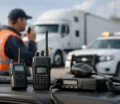


A delivery driver is ten counties away, your warehouse lead is inside a steel building, and your supervisor is heading to a customer site across town. If all three need to talk right now, 4g lte poc radios can do something traditional local radio systems often cannot – keep everyone on the same talk group without depending on repeater range alone.
That is the real appeal of Push-to-Talk over Cellular. It gives businesses radio-style communication with wide-area coverage by using LTE and Wi-Fi data networks instead of only relying on RF coverage from a single site or repeater footprint. For many operations, that changes the conversation from How far will this radio reach to What kind of workflow do we need to support?
What 4G LTE PoC radios actually are
4G LTE PoC radios are handheld or mobile communication devices that work like two-way radios but send voice traffic over cellular data networks and, in many cases, Wi-Fi. Users still get a familiar push-to-talk button, group calling, private calling, and dispatcher features. The difference is in how the audio travels.
With a conventional UHF or VHF system, your coverage depends on terrain, building construction, antenna height, power levels, and whether you have repeaters in place. With PoC, the device communicates through a carrier-backed data connection to a service platform that manages talk groups and users. If the radio has data coverage, it can usually participate in the conversation.
That makes PoC attractive for companies with mobile teams, multi-site operations, regional service territories, or buildings where local radio performance is inconsistent. It also reduces the need for some businesses to build, maintain, and license a traditional wide-area radio system just to connect crews spread across a large footprint.
Where 4g lte poc radios fit best
The best use cases are usually operational, not theoretical. A field service company with technicians moving between cities can use 4g lte poc radios to keep dispatch, supervisors, and road crews connected without handing everyone a phone and hoping calls get answered. A hospitality group can connect valet, security, maintenance, and management across separate properties. An event team can coordinate parking, entry, logistics, and medical staff while keeping communications organized by role.
They are also a strong fit for transportation, agriculture, construction support, private security, property management, and church or school operations that need simple group calling over a broad area. In these settings, speed matters more than app complexity. People want a dedicated device with a push-to-talk button, loud audio, and predictable behavior under pressure.
For families, community groups, and preparedness-minded users, PoC can also make sense when the goal is straightforward regional communication without building out repeaters. But for those users, the main question is usually less about features and more about network dependence.
Why businesses choose PoC over traditional radio
The biggest advantage is coverage. Traditional radio can be excellent within a designed coverage area, especially when the infrastructure is engineered well. But once teams move beyond that area, coverage drops off. PoC changes that by leaning on existing cellular networks.
The second advantage is deployment speed. A conventional business radio system may require frequency coordination, FCC licensing, repeater installation, antenna work, site access, and ongoing maintenance. PoC systems can often be rolled out much faster because the network backbone already exists.
The third advantage is control. Most PoC platforms support user management, over-the-air programming, dispatch integration, GPS location, emergency calling, recording options, and talk group changes without physically touching every radio. That matters to operations managers who do not want communications to become a constant maintenance project.
There is also a training advantage. Staff generally understand push-to-talk faster than smartphone-based communication apps. A purpose-built radio reduces distractions and usually survives field use better than a consumer phone.
The trade-offs you should understand
PoC is not magic, and it is not a direct replacement for every radio system.
The first trade-off is network dependence. If your users are in areas with weak LTE coverage, dead zones inside concrete structures, or remote terrain with little carrier presence, PoC performance will reflect that reality. Some radios can use Wi-Fi to help indoors, but that still depends on the local network being available and configured well.
The second trade-off is latency. Good PoC systems are fast, but they may not feel exactly like direct RF radio traffic. For everyday dispatch and coordination, that delay is often minor. For highly time-sensitive tactical use, it may matter more.
The third trade-off is subscription cost. Many PoC solutions involve recurring service fees for platform access and data connectivity. That can still be cost-effective compared with building and maintaining infrastructure, but it changes the budget model from capital-heavy to ongoing operating expense.
The fourth trade-off is resilience during carrier outages or overloaded networks. Traditional radio systems, especially local simplex or well-managed repeater systems, may continue working when cellular conditions are poor. In some operations, that means PoC is best used alongside DMR or conventional two-way radio rather than as a full replacement.
4G LTE PoC radios vs DMR and conventional two-way radio
This is where it depends on your actual work environment.
If your team works in one facility, campus, plant, or local service area, DMR or conventional UHF/VHF radio may be the better tool. It offers instant local communication, no monthly carrier dependence, and solid performance when infrastructure is properly designed. It is especially effective where you control the site and can support repeater or antenna systems.
If your users travel across multiple cities, counties, or states, PoC often makes more sense. Wide-area communication without building a network is the whole point.
Many organizations land somewhere in the middle. They need dependable building coverage, local direct communication, and broad regional reach. In those cases, a mixed solution can be the smartest path. Some businesses use DMR on-site and PoC for supervisors, drivers, or off-site personnel. Others choose hybrid-capable devices depending on the workflow.
An experienced communications provider will usually ask where people work, how they move, what structures they enter, what level of dispatch visibility is needed, and what happens if a network goes down. Those answers matter more than any single spec sheet.
Features that matter in the field
Buyers often focus on range first, but day-to-day usability is what determines whether a system actually helps the team. Audio quality is high on the list. A radio can have excellent network access and still be frustrating if the speaker is weak in a truck cab, warehouse, or roadside environment.
Battery life matters just as much. Long shifts, split shifts, and standby-heavy use all put pressure on devices. A radio that needs midday charging creates workarounds people will resent.
Device durability is another big factor. Commercial users should pay attention to drop resistance, water resistance, accessory support, and how well the radio handles gloves, dust, and constant vehicle movement. The best feature set on paper does not help if the device fails after routine field use.
Then there is platform support. Good 4G LTE PoC radios should work with a stable service platform that offers talk group management, emergency features, GPS options, and practical dispatch tools. Some buyers get drawn to low-cost hardware and overlook the software ecosystem behind it. That is often where reliability either shows up or falls apart.
How to evaluate whether PoC is right for you
Start with your coverage map, but do not stop there. Look at where your people actually lose communication today. It may be between facilities, inside certain buildings, on rural routes, or during peak activity when staff need to reach multiple groups quickly.
Next, think about workflow. Do you need one talk group for everyone, or separate channels for operations, maintenance, security, and management? Do supervisors need private calling? Does dispatch need to see GPS location? Should temporary staff be easy to add and remove? These are practical questions, and PoC often answers them well.
You should also think through failure points. If cellular service drops in a critical area, what is the backup plan? In some environments, that answer may be a second carrier option, Wi-Fi support, or a companion traditional radio system.
This is where a real-world demo helps. On paper, many devices look similar. In practice, the difference shows up in audio, delay, ergonomics, software stability, and how simple the system is to manage after deployment. Companies like Cogent Radios Group tend to be most useful at this stage because matching the tool to the use case is more valuable than just shipping a radio.
A smart choice when the job is spread out
4G LTE PoC radios are at their best when teams need radio simplicity across a much larger footprint than local RF coverage can easily provide. They are not the right answer for every site or every budget, but they can solve a very real problem for organizations that need fast, direct communication between people who are constantly on the move. If your operation has outgrown the limits of local-only coverage, it may be time to look at communications the same way your team already works – mobile, distributed, and expected to respond without delay.