
When a warehouse team misses a pickup call, a hotel supervisor cannot reach housekeeping, or a construction foreman has to repeat the same message three times, the problem is rarely the people. More often, it is the communication setup. A dmr radio system for business gives teams a clearer, more organized way to talk in real time without relying on personal cell phones or consumer-grade gear.
For many operations, DMR hits a practical middle ground. It offers better audio quality and more efficient channel use than traditional analog systems, but it does not force every business into a one-size-fits-all model. That matters if you manage drivers, maintenance staff, security teams, event crews, plant workers, or field technicians who need communication to work quickly and consistently.
What a DMR radio system for business actually is
DMR stands for Digital Mobile Radio. In plain terms, it is a digital two-way radio standard used by commercial and professional users. Compared with analog radio, DMR can provide cleaner voice audio, better battery efficiency, and features such as text messaging, radio IDs, call groups, emergency functions, and more structured dispatching.
A business DMR system can be as simple as a few handheld radios talking directly to each other, or as involved as a multi-site repeater system supporting several departments across a large property or service area. The right setup depends on how your team works, how far they need to talk, what obstacles are in the environment, and whether you need private channels, recording, dispatch, or integration with existing operations.
One reason DMR is popular in commercial settings is spectral efficiency. A single licensed 12.5 kHz channel can typically support two time slots, which can act like two separate talk paths. For a business, that can mean better use of available frequencies and more room for separate teams without doubling channel demand.
Why businesses move from analog or cell phones to DMR
The shift usually starts with frustration. Analog radios may still work, but noisy audio, limited features, and channel crowding can slow down communication. Cell phones solve some range issues, but they introduce other problems – monthly costs, app dependence, weak jobsite discipline, delayed group calling, and vulnerability when networks are congested or devices are dropped, lost, or used for everything except work.
DMR is appealing because it is purpose-built. Press the button, talk to the right group, and move on. There is no dialing, waiting, or hoping every team member answers in time. For fast-moving operations, that speed has real value.
That said, DMR is not automatically the best answer for every company. If your crews are spread nationwide and rarely work in the same RF coverage area, a Push-to-Talk over Cellular system may be the better fit. If your operation is local, facility-based, or centered around repeatable routes and sites, DMR often makes more sense because you control the system more directly and are not depending entirely on the public cellular network.
Where a DMR radio system for business works best
DMR performs especially well in environments where teams need immediate group communication and consistent device behavior. Warehouses, manufacturing plants, schools, churches, private security operations, farms, event venues, hotels, and transportation yards are strong candidates.
It also works well when departments need separation without isolation. A hospitality property might keep maintenance, housekeeping, front desk support, and security on separate talk groups while still allowing supervisors to move across groups as needed. A construction company may use one talk path for field crews and another for management or logistics. Those workflow gains matter as much as the audio quality.
The environment still matters. Steel structures, concrete walls, hills, large campuses, and underground areas can all affect radio performance. Digital audio often sounds excellent right up to the edge of coverage, then drops off quickly. Analog tends to fade more gradually. That does not make one better across the board, but it does mean system design matters. A weakly planned DMR system can disappoint just as easily as an outdated analog one.
What to evaluate before you buy
The first question is not brand or model. It is coverage. You need to know where users must talk, not where you hope they will mostly work. Indoor-only coverage for a hotel is different from campus-wide coverage for a school district. A farm with rolling terrain has very different needs from a distribution center with thick walls and loading bays.
The second question is capacity. How many users will be active at once, and how many separate teams need their own talk paths? A small crew may be fine on a basic setup. A larger operation with overlapping departments may need repeaters, dispatch positions, or multiple channels planned from day one.
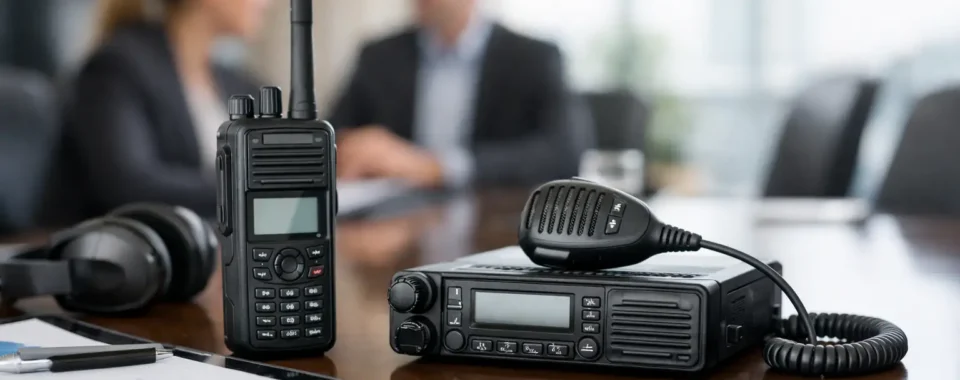
Third is device type. Handheld radios suit mobile workers and supervisors. Mobile radios mounted in trucks or service vehicles offer higher power and stronger performance. Some businesses need both. Accessories matter too. A well-chosen speaker mic, surveillance earpiece, or noise-canceling headset can have as much effect on usability as the radio itself.
Then there is licensing. Many business DMR systems in the US operate on FCC-licensed frequencies. That is usually a good thing because licensed channels provide more control and less interference than trying to squeeze business traffic into services that were never meant for commercial coordination. Licensing takes planning, but it is part of building a system that supports real operations instead of creating new headaches.
Repeaters, direct mode, and system design
Some businesses can operate perfectly well in direct mode, radio to radio, with no repeater at all. This works best for small properties, limited crews, or simple operations where everyone stays fairly close.
Once you need stronger building penetration, longer range, or more reliable coverage across a larger site, a repeater becomes worth serious consideration. A repeater receives and retransmits the signal, extending usable range and often making communication much more dependable. For many business users, the difference between radios that work most of the time and radios people trust every shift comes down to whether the system was properly engineered with repeater coverage in mind.
There are trade-offs. Repeaters add cost, infrastructure needs, installation requirements, and maintenance considerations. They also make more sense when the business plans to stay in the location long enough to justify the investment. A temporary event operation may not need that level of buildout. A manufacturing facility that runs multiple shifts probably does.
Features that matter in the real world
It is easy to get distracted by feature sheets. Most businesses do not need every advanced function available in modern DMR equipment. They need the features that improve response time, accountability, and ease of use.
Call groups are one of the most useful because they let teams communicate without forcing everyone to hear everything. Radio IDs help identify who is transmitting. Emergency alerts can support lone worker or safety-driven operations. Text messaging can be useful in quieter environments or where a short status update is better than a voice call. Recording and dispatch integration may matter for transportation, security, or larger multi-user systems.
GPS can also be valuable, but only if someone will actually use the location data operationally. The same goes for remote disable, telemetry, or advanced control features. They can be excellent tools, but only when they fit the job. Good system design is not about adding features. It is about removing friction.
The cost question most buyers should ask
The right question is not “What does a DMR radio cost?” It is “What will this system cost to own and rely on over the next several years?”
A lower upfront price can be expensive if the radios are fragile, the audio is poor in your environment, batteries fail early, or no one on your team knows how to manage programming, licensing, and service. On the other hand, the most expensive option is not always necessary either. Some businesses need premium hardware because of harsh conditions, long shifts, or safety requirements. Others need a solid mid-tier platform with good support and smart programming.
That is where experienced guidance matters. The best DMR system for a school, shuttle operation, church, farm, or contractor may look very different even if the user count is the same. Cogent Radios Group works with that kind of real-world variation every day, and that hands-on approach is what keeps businesses from overbuying, underbuilding, or choosing a system that looks good on paper but struggles in the field.
When DMR is the right fit and when it is not
DMR is a strong fit when your team needs fast push-to-talk communication, local or regional coverage, durable hardware, department separation, and a system designed around your operation. It is especially useful when communication needs to keep working even when personal phones are impractical, distracting, or inconsistent.
It may not be the best fit if your workforce is widely dispersed with no shared RF footprint, if your sites change constantly, or if you need instant nationwide connectivity without building radio infrastructure. In those cases, PoC may be the better tool. Many businesses end up using both – DMR for local operational control and PoC for broader geographic reach.
The smartest buying decision usually comes from looking at workflow first and technology second. If you start with how your people actually communicate, where they work, and what failure costs you in time or safety, the right system becomes much easier to identify.
A good radio system should feel boring in the best possible way. People key up, the right person hears them, and work keeps moving.