
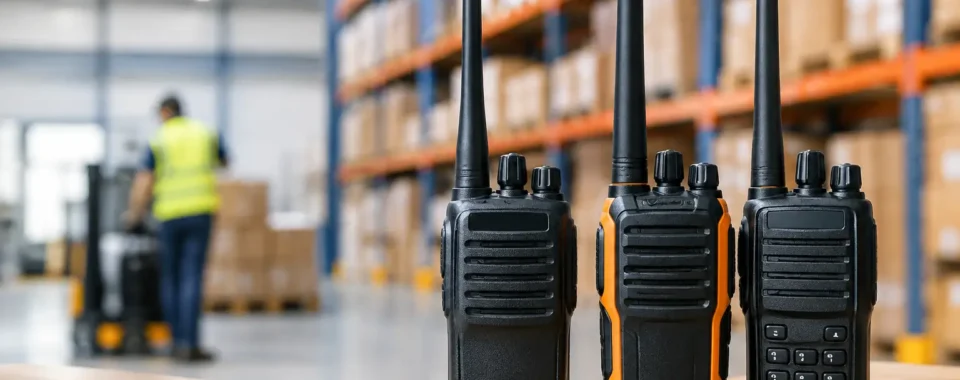

A missed dock call can leave a trailer waiting, a picker walking to find a supervisor, and a customer order sitting still. The best handheld radios for warehouses keep those small delays from multiplying across a shift. But the right choice is rarely the radio with the longest feature list. It is the system that gives your team clear, immediate communication in the actual places they work: behind pallet racks, inside coolers, at loading doors, and across the yard.
For warehouse operations, radio selection starts with the building, the workflow, and the consequences of a missed call. A compact radio may be right for a small fulfillment center. A multi-site distribution operation may need licensed DMR radios, repeaters, or Push-to-Talk over Cellular coverage that follows supervisors beyond the building. Here is how to evaluate the options without buying more system than you need – or less than the operation demands.
What Makes a Warehouse Radio a Good Fit?
Warehouses are difficult radio environments. Steel shelving, concrete walls, refrigeration equipment, conveyor systems, and loaded pallets can block or reflect radio signals. A radio that works well in an open parking lot may have weak audio in the center aisle of a high-bay storage area.
Clear audio is the first requirement. Look for commercial-grade speakers, noise-canceling microphones, and enough volume for workers near conveyors, forklifts, dock equipment, or ventilation systems. Audio accessories also matter. A properly selected remote speaker microphone or surveillance-style earpiece can make calls easier to hear while allowing operators to keep both hands available.
Durability comes next. Warehouse radios get dropped, carried on forklifts, exposed to dust, and used through long shifts. Commercial handhelds generally have stronger housings, better battery retention, and accessories designed for daily service than consumer walkie-talkies. An IP rating for dust and water resistance is useful, but it should be considered alongside the full working environment. A dry inventory warehouse has different needs than a food distribution facility with washdown areas or a cold-storage operation.
Battery performance should support the shift, not just a light day of occasional calls. Real battery life changes with transmit time, signal conditions, screen use, and temperature. A radio rated for a full shift may require spare batteries or charging discipline when used heavily on extended schedules. Multi-unit chargers and assigned charging locations can prevent the familiar problem of radios disappearing at the end of the day with dead batteries.
The Best Handheld Radio Technologies for Warehouses
There is no single best radio category for every warehouse. The right platform depends on coverage requirements, the number of users, and whether communications need to reach beyond the property.
Licensed DMR business radios
For many facilities, licensed DMR handheld radios are the practical workhorse. DMR provides reliable local voice communications, good audio quality, channel flexibility, and support for structured team communications. Separate channels can be assigned to receiving, picking, maintenance, security, management, or shipping, reducing unnecessary chatter during busy periods.
A licensed business frequency also gives an operation more control than shared consumer radio channels. It is especially valuable when privacy, predictable performance, and professional coordination matter. Depending on the facility, an FCC license, frequency coordination, and properly programmed radios may be needed. This is not merely paperwork. Correct frequency planning helps reduce interference and supports a communications system that can grow with the business.
DMR is often the right answer when most conversations happen inside one building or across a defined campus. If coverage is inconsistent in certain aisles, basements, or distant loading areas, a repeater and properly designed antenna system may be a better fix than simply purchasing higher-powered handhelds.
Push-to-Talk over Cellular radios
Push-to-Talk over Cellular, often called PoC, is a strong option for warehouses with multiple sites, traveling managers, delivery fleets, or remote yards. These radios use available cellular and Wi-Fi networks to provide wide-area group calling. A warehouse manager can communicate with a driver several counties away, a service technician at another location, or a team member moving between facilities.
PoC also avoids the need to build a conventional radio repeater system at every site. That can simplify expansion for organizations operating across the United States. Many platforms offer features such as GPS location, group management, emergency alerts, and dispatch tools.
The trade-off is dependency on network availability. Cellular coverage may be poor in some warehouse interiors, underground areas, or remote yards. Wi-Fi can help indoors, but it must be designed and maintained for the coverage area. Before standardizing on PoC, test calls in the back corners, freezer rooms, stairwells, loading bays, and any other places where employees need to communicate.
License-free radios for limited operations
FRS radios can work for very small warehouses with a short communication range, limited interference, and low operational risk. They are easy to deploy and do not require individual FCC licensing. However, their shared channels, limited control, and consumer-oriented hardware make them a poor long-term fit for many professional operations.
They can be useful for temporary inventory events, small teams, or backup communication, but they should not be mistaken for a commercial system. If a delayed call affects safety, shipping schedules, forklift traffic, or customer service, a business-grade platform is usually the better investment.
How to Size Coverage Before Buying Radios
Do not select radios based only on advertised range. Range claims are typically measured in ideal, open conditions and do not represent a rack-filled facility. A warehouse radio assessment should begin with a simple map of the operation: building footprint, rack height, office areas, dock doors, parking areas, yards, freezer rooms, and known dead spots.
Then identify who needs to talk to whom. A picker may only need their zone lead, while a shipping supervisor needs communication with receiving, maintenance, security, and drivers. This helps determine whether the system needs one shared channel, multiple talk groups, a dispatcher, or priority and emergency functions.
Field testing is the most useful step. Test candidate radios at normal working height, with equipment running and during the busiest part of the day. Listen for understandable speech, not just whether a signal indicator appears. Evaluate both directions of the call. A radio may receive clearly from the office but struggle to transmit from a steel-framed aisle.
If one or two areas are weak, antenna placement, repeater design, or a distributed coverage approach may solve the issue. Adding more handheld radios will not correct an infrastructure problem.
Features That Improve Daily Warehouse Operations
A radio system should make work easier, not require employees to become radio technicians. The most useful features are usually straightforward: clearly labeled channels, channel names displayed on screen, simple emergency buttons, programmable side keys, and accessories matched to each role.
For forklift operators, a remote speaker microphone can be more practical than removing a radio from a belt clip. For security or management, a discreet earpiece may be appropriate. For dock personnel in high-noise areas, a heavy-duty microphone with a loud speaker may be the better choice. The accessory should not interfere with personal protective equipment, high-visibility vests, or safe equipment operation.
Consider radio management as well. Programming consistency, labeled assets, spare battery inventory, and a repair process can have as much impact on uptime as the radio model itself. Teams should know where to charge radios, how to report a damaged unit, and which channel to use for urgent operational traffic.
When a Repeater or PoC System Is Worth It
A single-site warehouse with reliable building-wide coverage may only need commercial handheld DMR radios. Once the building becomes larger, rack density increases, outdoor coverage is required, or multiple facilities need to communicate, the economics change.
A repeater can extend local radio coverage and provide a more dependable signal path through a challenging facility. PoC can connect warehouses, field teams, and vehicles without distance limits within available network coverage. Some operations use both: DMR for dependable on-site communications and PoC for managers, fleet coordination, or regional communication.
The right design depends on where calls happen and how critical they are. A qualified radio provider can help assess the environment, handle licensing requirements, program talk groups, and test coverage before a full deployment. That kind of planning avoids costly replacements after the system is already in use.
A warehouse radio should fade into the background of a productive shift: a worker presses one button, the right person hears the message, and the job keeps moving. Start with a coverage test and the real communication paths in your facility, then choose the handheld platform that supports them reliably.