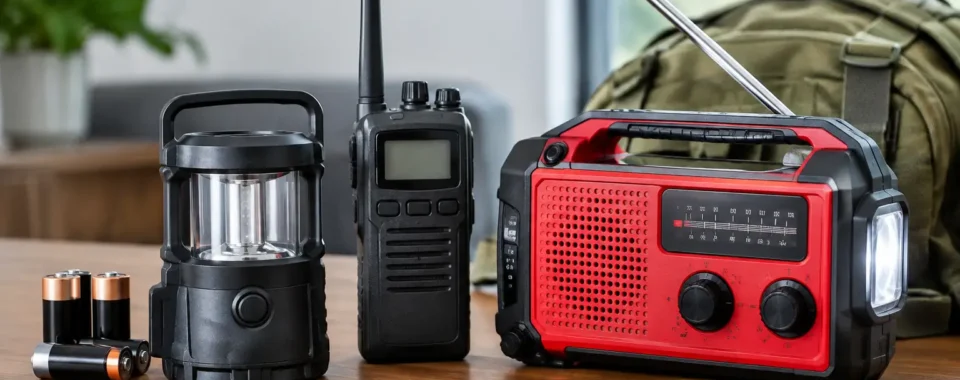

When cell service is overloaded, power is out, or a work crew is spread across a large property, communication needs to keep moving. The best radios for emergency preparedness are not one product category. They are a layered communications plan built around who needs to talk, how far apart they will be, and what infrastructure may still be available.
A family sheltering in place has different needs than a farm, school, event operation, utility contractor, or logistics team. The right answer may include a weather receiver for alerts, license-free handhelds for close-range coordination, and a licensed system for reliable area-wide communications. Choosing the radio first and the plan second is where many preparedness efforts fall short.
Start With the Failure You Are Preparing For
Emergency communications planning starts with realistic scenarios. A thunderstorm that knocks out local power for six hours is different from a wildfire evacuation, a hurricane affecting multiple counties, or a routine operational emergency at a remote job site.
Ask what must happen even when normal communications are impaired. Do people need to receive weather warnings? Coordinate inside a building? Stay in contact across a farm, campus, or convoy? Reach managers in another state? Each requirement points toward a different type of radio.
Distance claims on consumer packaging are rarely a reliable planning number. Hills, dense trees, steel-framed buildings, vehicles, and urban congestion all reduce radio range. A radio that works well across an open field may struggle between floors of a concrete building. Antenna height, radio power, and the availability of a repeater often matter more than the number printed on the box.
Best Radios for Emergency Preparedness by Need
NOAA weather radios: best for receiving official alerts
A dedicated NOAA Weather Radio is not a two-way radio, but it belongs in a serious preparedness plan. It receives National Weather Service broadcasts and can sound an alert for weather and civil emergencies in a programmed area.
Look for SAME alert capability, which allows the receiver to be programmed for specific counties, and select a model with AC power, battery backup, and a clear alert function. Keep it where someone will hear it, not stored in a closet with the rest of the emergency gear. Weather information is most useful before conditions make travel or communication harder.
FRS radios: best for simple close-range coordination
Family Radio Service radios are generally the easiest option for households, volunteer teams, and small groups that need straightforward short-range voice communication. No individual FCC license is required to use FRS radios in the United States, and compatible units are widely available.
They are practical for coordinating around a neighborhood, campsite, shelter, warehouse, or event site, especially when users need a radio they can pick up and operate with minimal training. The trade-off is limited power and range, plus shared channels that may become busy during an emergency. FRS works best as a local coordination tool, not as a guarantee of long-distance contact.
GMRS radios: best for families and property-based teams
General Mobile Radio Service, or GMRS, offers more flexibility than FRS for many preparedness users. A GMRS license is required from the FCC, but no test is required, and the license can cover immediate family members. GMRS supports handheld and mobile radios, higher power on certain channels, and repeater use where available.
That makes GMRS a strong choice for families spread across a rural property, neighborhood preparedness groups, farms, and recreational communities. A vehicle-mounted GMRS radio with an external antenna can provide substantially better performance than a handheld operating from inside a vehicle.
The important limitation is that repeater availability varies by location. Do not assume that a local repeater will be accessible, operating, or suitable for your group during a major event. Build a plan that works radio-to-radio first, then treat repeater coverage as an added capability.
DMR business radios: best for controlled team communications
For organizations with employees, facilities, fleets, or field operations, professional DMR radios are often a better fit than consumer-grade handhelds. Digital Mobile Radio systems can provide clear audio, durable equipment, organized talkgroups, better battery performance, and features such as emergency buttons, GPS, and dispatch integration.
A DMR solution can be designed around a single site, multiple facilities, or a regional operating area. It can also use licensed frequencies, which help an organization establish a more controlled communications environment than shared consumer channels. Licensing, radio programming, coverage testing, and ongoing support are part of the decision, but they are also what turn a box of radios into an operational system.
This option is especially valuable when communication is tied to safety procedures, customer service, incident response, or continuity of operations. A hospitality property coordinating guests during an evacuation and a construction crew working near heavy equipment both need more than theoretical range. They need assigned channels, trained users, charged batteries, and a plan that functions under pressure.
Amateur radio: best for trained long-distance capability
Amateur radio can provide valuable local, regional, and long-distance communications when commercial systems are unavailable. Depending on the band, equipment, antenna setup, operating conditions, and repeater network, licensed amateur operators can communicate far beyond the practical range of typical handheld radios.
It is not an off-the-shelf emergency answer. Operators must earn the appropriate FCC license, learn operating practices, and spend time using the equipment before an incident. Amateur radio works best when it is part of an active local network and supported by operators who understand their equipment, frequencies, and emergency procedures.
For a family or organization, it can be wise to include a licensed amateur operator in the preparedness network. That is different from buying ham equipment during an emergency and expecting immediate results.
Push-to-Talk over Cellular: best for wide-area operations
Push-to-Talk over Cellular, often called PoC, uses cellular data and Wi-Fi to provide radio-style group calling over a broad geographic area. For fleets, distributed teams, and organizations with employees in multiple cities or states, PoC can be one of the most effective ways to coordinate daily operations and emergency response.
Its major advantage is coverage. A driver, supervisor, and office team can often communicate in one talkgroup even when they are hundreds of miles apart. Many devices also support location tracking, dispatch tools, and priority group communications.
The trade-off is clear: PoC depends on cellular or Wi-Fi connectivity. It should be part of a layered plan, not the only plan. During widespread outages or extreme network congestion, local RF radios, satellite communications, or other backup methods may be necessary.
Build Redundancy Into the Radio Plan
Preparedness is not about finding a single radio that does everything. It is about avoiding one point of failure. A practical plan may pair NOAA alerts with local FRS or GMRS radios, then use PoC or a licensed DMR system for routine and wide-area coordination.
Power deserves the same attention as radio selection. Keep spare battery packs, charging cradles, vehicle chargers, and a way to recharge from a generator, vehicle, or properly sized portable power station. For professional teams, standardized batteries and charging locations reduce confusion when equipment has to be issued quickly.
Accessories also change real-world usability. Speaker microphones allow users to keep a radio accessible while working. Earpieces can help in noisy environments or shelters. A quality external antenna can make a mobile radio far more useful than increasing transmitter power alone. Weather-resistant cases and properly rated radios matter for outdoor crews, but no device should be assumed waterproof unless its rating supports the intended exposure.
Program, Label, and Practice Before You Need It
A radio plan fails when users do not know which channel to select, whom to call, or what to say. Every radio should be programmed consistently, labeled clearly, and assigned to a simple communications procedure. Identify a primary channel, a backup channel, call signs or unit names, check-in times, and the person responsible for escalation.
For licensed business systems, work with a qualified provider on frequency coordination, FCC licensing, programming, coverage expectations, and system maintenance. For GMRS and amateur radio, follow FCC rules and use the equipment regularly enough to understand its limits.
Run a short drill. Test radios from the loading dock, the far end of the property, inside the building, in vehicles, and at likely gathering points. You will learn more in one 20-minute test than from a range claim or online review. If coverage is weak where it matters most, address the antenna, placement, repeater, or system design before it becomes an emergency.
The right radio is the one your people can operate confidently, recharge reliably, and depend on in the places they actually work and live. A well-designed communications plan gives every user a clear next step when normal channels go quiet.