
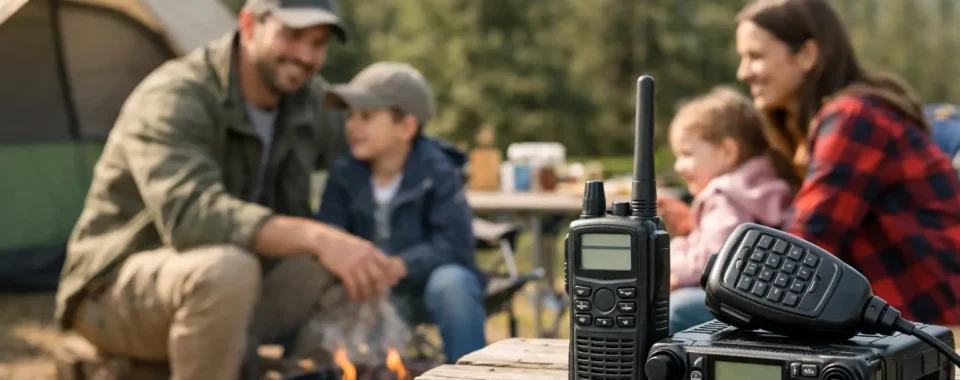

A family hike goes sideways faster than most people expect. One person stops to tie a boot, another keeps walking, cell service drops to one bar, and suddenly simple coordination turns into yelling across a trail or sending texts that never go through. That is exactly where gmrs radios for families make sense. They give you direct, push-to-talk communication without depending on a crowded cellular network, and they are often a better fit than basic bubble-pack walkie-talkies when you need more range, clearer audio, and more dependable performance.
Why GMRS makes sense for families
GMRS, or General Mobile Radio Service, sits in a useful middle ground. It is more capable than FRS for many real-world situations, but it is still approachable for everyday users who do not want to get into amateur radio. For families, that matters. You want something simple enough for a teenager, reliable enough for a campground, and flexible enough to use on road trips, at large events, around a neighborhood, or on rural property.
The biggest advantage is practical communication. Press the button, speak, and the other person hears you right away. There is no app to open, no need to check whether someone has signal, and no lag from a busy mobile network. In a family setting, that can reduce stress fast. Parents can keep in touch with kids at a fair, two cars can coordinate during travel, and relatives on a large piece of land can check in without chasing down each other by phone.
GMRS also gives families room to grow. Some people start with handhelds and stop there, which is perfectly fine. Others add a mobile radio in a vehicle or use repeater-capable equipment for wider coverage. That scalability is part of why GMRS has stayed popular.
What to look for in GMRS radios for families
The best radio for a family is not always the one with the biggest range claim on the box. In fact, advertised range numbers are often the least useful part of the package. Real range depends on terrain, building density, antenna quality, and how the radio is being used.
What matters more is whether the radio is easy to operate under normal conditions. Clear audio should be near the top of the list. If a radio sounds thin, distorted, or weak in moderate noise, it will frustrate people quickly. Families do better with radios that have strong speaker output, simple channel selection, and controls that are hard to trigger by accident.
Battery performance is another factor people tend to underestimate. A radio that lasts through a long day at an amusement park or an afternoon of trail riding is far more useful than one that needs constant charging. For some families, rechargeable battery packs are the easiest option. For others, especially those thinking about emergency use, the ability to swap in common backup batteries can be a real advantage.
Durability matters too. Many family users do not need a heavy commercial unit, but they do need something that can survive a drop, light rain, dust, and the general abuse that comes with travel, camping, and kids. A radio can have every feature in the world and still be the wrong choice if it is too fragile for normal use.
Ease of use beats feature overload
A lot of consumer radios look attractive because they promise weather alerts, flashlight functions, dozens of menu items, and extra channels. Some of those features are useful. Many are rarely used. If the radio becomes confusing, family members will avoid it or use it incorrectly.
For most households, a straightforward interface is the better investment. Large buttons, a readable display, good volume control, and easy channel naming or programming will matter more than gimmicks. This is especially true if the radios will be shared between adults, teens, grandparents, or occasional users.
Privacy codes help, but they are not private
This is one of the most common misunderstandings. GMRS radios often include tone settings, sometimes called privacy codes. These do not make your conversation private. They simply help reduce unwanted chatter from other users on the same channel by keeping your radio muted unless the correct tone is present.
That can be very helpful at campgrounds, events, or busy recreation areas, but families should understand the trade-off. Other people can still hear traffic if they are on the same frequency without your tone settings. If privacy is a major concern, radio may not be the right tool for that particular use.
Licensing is part of the decision
GMRS in the US does require an FCC license, and that is actually not a bad thing. The license covers a family group, which makes it practical for household use. You do not need to take an exam for a GMRS license, but you do need to apply properly and follow the applicable rules.
For many families, this is the point where they compare GMRS with FRS. If you want the simplest possible option with no licensing step, FRS may be enough for short-range use around a neighborhood, park, or local outing. If you want better power options, removable antennas on certain equipment types, mobile radio possibilities, and repeater capability, GMRS is usually the stronger choice.
That does not mean every family needs GMRS. It depends on how and where you plan to use the radios. A family on several wooded acres or one that travels often by vehicle will usually get more value from GMRS than a family that only wants occasional short-range radios for the kids.
Handheld or mobile radios?
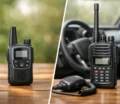
Most families start with handhelds, and that is usually the right move. Handheld GMRS radios are portable, relatively affordable, and easy to hand to different family members. They work well for hikes, events, neighborhood use, and campground communication.
Mobile GMRS radios installed in a vehicle are different. They typically offer higher power, better external antennas, and stronger performance over distance. For caravan travel, off-road groups, farm use, or families managing a large rural property, mobile radios can be a major upgrade. The trade-off is cost, installation, and less portability.
Some families end up using both. A mobile unit in the lead vehicle and handhelds for everyone else can be a very practical setup. That kind of mixed system often works better than trying to force one radio type into every role.
Range claims versus real-world performance
If one lesson matters most, it is this: terrain wins. Flat open space may allow surprisingly good communication, while hills, dense woods, urban buildings, or even large venues can cut range down quickly. A radio advertised for 30 miles will not reliably do that in typical suburban or wooded conditions.
A better way to evaluate range is to think in scenarios. Around a neighborhood, inside a campground, across a sports field complex, or between vehicles on a road trip are all realistic use cases. If your family needs communication over several miles in broken terrain, repeater access may be the real solution, not just buying a stronger handheld.
This is one reason experienced radio suppliers are helpful. Matching equipment to use case saves money and avoids disappointment. A family that wants reliable communication on acreage has different needs than one buying radios for a vacation.
When GMRS is the right fit and when it is not
GMRS is a strong fit for families who need dependable local communication, want better performance than entry-level walkie-talkies, and are comfortable handling the licensing step. It is especially useful for camping, travel convoys, outdoor recreation, community events, and property coordination.
It may be the wrong fit if your main need is nationwide communication, private one-to-one calling over long distances, or guaranteed indoor coverage across widely separated locations. In those cases, a cellular-based push-to-talk system or another communications approach may make more sense. Good communications planning is less about brand hype and more about choosing the right tool for the actual job.
A smart buying approach for family users
The most practical way to buy GMRS radios is to start with your real use pattern. Ask where the radios will be used, who will carry them, how often they will be charged, and whether vehicle use matters. Then look at audio quality, battery options, durability, and ease of operation before worrying about marketing claims.
For many families, two common mistakes show up early. The first is buying the cheapest radios available and expecting them to perform in difficult terrain. The second is overbuying complicated equipment that no one else in the household wants to learn. The sweet spot is usually a dependable, easy-to-use radio with enough capability to handle your most common situations well.
If you are unsure, it helps to work with a supplier that understands both family and field use, not just consumer packaging. A company like Cogent Radios Group can often help translate the technical side into plain language so you get equipment that fits your environment instead of chasing unrealistic specs.
The best family radio is the one that gets used confidently when it matters, whether that is keeping track of kids at a crowded event or staying connected when phones stop being convenient. Choose for the conditions you actually face, and the radios will earn their place fast.