

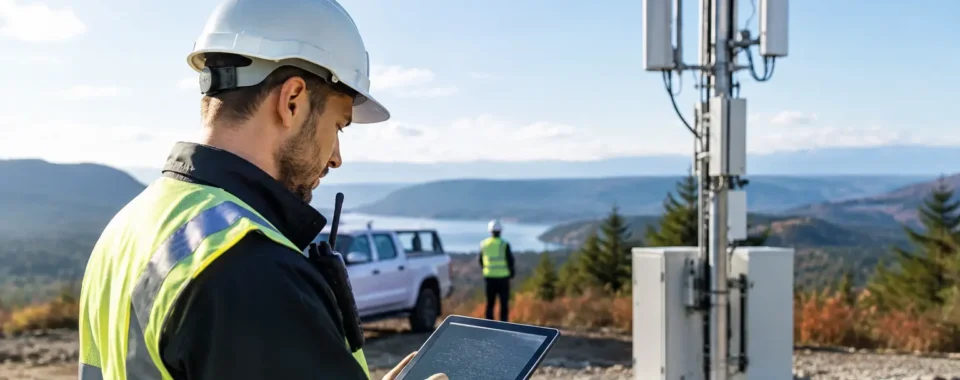

A loading yard at the edge of town, a large manufacturing floor, a remote utility site, or a campus with thick concrete walls can expose the limits of ordinary cellular service. Private LTE gives an organization the ability to build and manage its own cellular coverage for the people, devices, and applications that must work in those places.
For operations teams, the appeal is straightforward: dependable voice and data in a defined area, more control over users and devices, and fewer unknowns than relying entirely on public carrier coverage. But private LTE is not a universal replacement for two-way radio or carrier-based Push-to-Talk over Cellular (PoC). The right choice depends on the coverage problem, the size of the operation, the required applications, and how much infrastructure the organization is prepared to own.
Where Private LTE Earns Its Keep
Private LTE is a dedicated cellular network used by a specific organization rather than the general public. It uses LTE technology, SIM-based authentication, and managed radio access points to connect approved devices. Depending on the spectrum arrangement and design, it can serve a single building, a multi-building campus, an industrial property, a port, a mine, a warehouse complex, or a remote work site.
The key difference is control. With a public cellular network, coverage, capacity, upgrades, and priority policies are primarily controlled by the carrier. A private system lets the organization design coverage around its operation. That can mean placing radios where a steel warehouse needs them, extending service across a large property, or dedicating capacity to operational users instead of competing with nearby consumer traffic.
This is particularly valuable when communications support work that cannot wait. A forklift supervisor coordinating dock activity, a maintenance crew responding to an equipment alarm, or a security team working a large venue all need more than a signal indicator on a phone. They need predictable performance where their work actually happens.
Private LTE can support several functions on one network. These may include push-to-talk voice, video from fixed or mobile cameras, work-order tablets, barcode scanners, sensors, vehicle telemetry, and rugged handheld devices. Combining these services can simplify operations, but it also raises the stakes for good network design. Voice traffic, video, and data do not all have the same bandwidth and latency needs.
Private LTE Versus Public Cellular and Two-Way Radio
Private LTE is often discussed as if it automatically replaces every other communication method. In practice, the strongest systems are frequently layered.
Public-network PoC is an excellent fit for organizations whose teams travel across a city, a state, or the country. It provides wide-area communications without requiring the customer to build cellular sites along every route. For fleet operations, field service, delivery teams, and distributed organizations, nationwide PoC coverage can be the practical answer.
Conventional DMR or other land mobile radio systems remain highly effective for immediate group voice within a facility, on a job site, or across a local service area. They are familiar, fast to use, and can continue operating independently of public cellular service when properly designed. In many environments, a dedicated radio system is still the clearest answer for simple, mission-focused voice.
Private LTE fits between those models and sometimes alongside them. It is especially useful when an organization needs local control plus cellular-style capacity for data applications. A distribution center may use private LTE for tablets, scanners, vehicle devices, and PTT-capable handhelds, while its drivers use carrier-based PoC once they leave the property. A utility may use private LTE at a remote facility while retaining conventional radio channels for mutual aid or legacy field operations.
The trade-off is complexity. A private LTE system needs planning, radio-frequency design, backhaul, core-network services, device provisioning, monitoring, and ongoing support. It is more capable than a basic radio deployment in many respects, but it is not a set-it-and-forget-it purchase.
What Makes a Private LTE System Work
A successful deployment begins with the operating problem, not a product list. Before selecting equipment, define who needs service, where they work, what they need to communicate, and what happens if coverage fails.
Coverage testing matters because buildings and terrain behave differently than maps suggest. Metal racks, reinforced concrete, machinery, cooling equipment, hills, trees, and even seasonal changes can affect radio performance. Indoor coverage may require carefully placed small cells or distributed antenna equipment. Outdoor sites may require elevated equipment, engineered antenna placement, and reliable backhaul.
The core components generally include LTE radio equipment, antennas, a cellular core, network transport or internet backhaul, SIM or eSIM management, and compatible user devices. The cellular core handles authentication, policy, device registration, and traffic management. It can be located on site, hosted remotely, or delivered through a managed service model. Each approach has different cost, security, and maintenance implications.
Device selection is equally important. A consumer smartphone may be adequate for occasional data use, but it may not survive dust, vibration, rain, gloves, long shifts, or shared use across multiple crews. Rugged LTE handhelds, vehicle-mounted devices, fixed gateways, tablets, and PTT radios should be selected for the actual work environment and the LTE bands used by the system.
Voice deserves special attention. If push-to-talk is a primary function, the system should be evaluated for call setup time, group call behavior, audio quality in noisy conditions, accessory compatibility, emergency calling, and priority handling. A PTT button is only useful when the complete chain – device, application, network, and user workflow – responds consistently.
Spectrum, Compliance, and Security Considerations
In the United States, many private LTE discussions involve CBRS in the 3.5 GHz band. CBRS allows shared use of spectrum under a managed framework, with different access tiers and coordination through a Spectrum Access System. General Authorized Access can be a practical starting point for many sites, while Priority Access Licenses may be relevant where greater spectrum certainty is needed.
CBRS is not the only option. Some organizations operate private cellular networks using licensed spectrum through a carrier or other authorized arrangement. The right spectrum path depends on location, desired coverage, interference conditions, budget, and the level of control required.
This is one area where assumptions can become expensive. Equipment must be compatible with the selected band, and the deployment must follow applicable FCC rules and spectrum-coordination requirements. A site survey and spectrum review can identify neighboring users, terrain issues, indoor attenuation, and the likely number of radios needed before equipment is ordered.
Security should be planned from the beginning. Private LTE provides SIM-based device identity, which is a meaningful advantage over many unmanaged Wi-Fi environments. Still, it should be paired with clear device policies, role-based access, network segmentation, secure administration, software updates, and monitoring. A private network is only as controlled as the process used to manage it.
Planning a Private LTE Deployment
The best projects start small enough to prove the design but large enough to reflect real operating conditions. A pilot can test coverage at the loading docks, inside the farthest warehouse aisle, in vehicles, and at the points where users have historically lost contact. It should also test busy-period performance, not just a quiet demonstration.
Ask practical questions early. Will the network carry only operational traffic, or will it also support guest access and general IT devices? Does it need to stay operational during a local internet outage? Are there generator, battery, or redundant-backhaul requirements? Who will add users, replace SIMs, troubleshoot devices, and monitor alarms after installation?
Budgeting should account for more than access points and handhelds. Engineering, site preparation, mounting, cabling, power protection, backhaul, core services, spectrum coordination, installation, training, and support all affect the real cost of ownership. In return, a well-designed system can reduce dead zones, improve workflow visibility, and give operations staff a communications platform that grows beyond voice.
For smaller teams with a wide travel footprint, carrier-based PoC may deliver better value with less infrastructure. For a contained, high-activity site with significant coverage gaps or data needs, private LTE can justify the investment. There is no prize for deploying more technology than the job requires.
A communications partner should be willing to say that plainly. At Cogent Radios Group, the goal is to match the system to the work: assess the coverage challenge, select field-ready devices, address licensing and infrastructure needs, and support the people who rely on the system after it is installed.
The most useful next step is to walk the property with the people who work it. Their daily routes, trouble spots, noise levels, and emergency procedures will reveal whether private LTE is the right foundation, or whether a simpler radio or PoC solution will keep the team connected more effectively.