
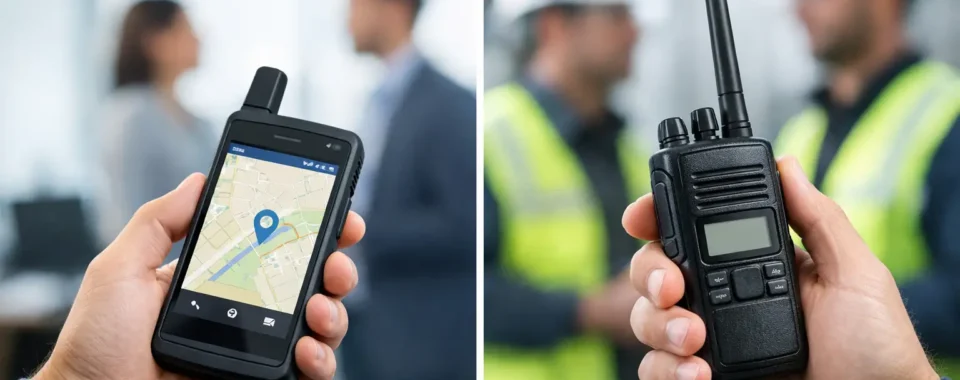

A driver leaves the yard, a supervisor moves between buildings, and a field crew works miles beyond the property line. They all need to talk without dialing numbers, waiting for a callback, or wondering whether a message reached the right person. That is where the choice between PoC vs two way radios becomes operational, not theoretical.
Both systems provide fast push-to-talk communication, but they use very different networks. The right choice depends on where your people work, what happens when coverage fails, how much control you need, and whether your operation extends beyond a single site.
PoC vs Two Way Radios: The Core Difference
Traditional two-way radios communicate over radio frequencies. Depending on the system, radios may talk directly to each other, through a repeater, or through a licensed business radio network. Their coverage is determined by terrain, building construction, antenna height, transmitter power, and the infrastructure supporting the system.
Push-to-Talk over Cellular, commonly called PoC, uses cellular data and, in some cases, Wi-Fi. Pressing the push-to-talk button sends voice through a managed communications platform rather than directly over an RF channel. If a user has usable cellular or Wi-Fi coverage, they can generally communicate with another authorized user across town, across the state, or across the country.
That distinction changes the planning conversation. A conventional radio system is built around local RF coverage. A PoC system is built around available broadband coverage and a service plan.
Neither is automatically better. A campus, warehouse, construction site, transportation fleet, or agricultural operation may have very different requirements even when each needs the same simple outcome: clear, immediate communication.
When PoC Radios Make More Sense
PoC is often the practical answer when a team works over a broad geographic area. A service company with technicians across several counties does not need to build repeater coverage at every location just to maintain group communication. If cellular coverage is dependable in the territories they serve, PoC can provide one talk group for the whole workforce.
This is especially useful for fleet dispatch, delivery operations, mobile maintenance teams, security personnel covering multiple properties, and organizations with regional or nationwide operations. Dispatchers can see user status, manage groups, and communicate with personnel without being limited to the footprint of a local repeater.
PoC also reduces the infrastructure burden. There may be no need to purchase repeaters, lease tower space, install antennas, coordinate frequencies, or maintain a local RF network. For a growing business, that can make deployment faster and more predictable. Adding a new employee may be as straightforward as programming a device and assigning it to the correct talk groups.
The devices themselves are also familiar to many users. A professional PoC radio has a dedicated push-to-talk button, loud audio, a durable housing, and controls designed for field use. It is not simply a phone app asking workers to navigate a touchscreen while wearing gloves or managing equipment.
Still, PoC has a dependency that should be taken seriously: it needs a data path. In a cellular dead zone, a remote canyon, a below-grade area, or a building with poor indoor signal, communication may be limited or unavailable unless Wi-Fi is present and properly designed. Coverage maps are helpful, but they are not a substitute for testing service where work actually occurs.
Where Conventional Two-Way Radios Have the Advantage
Conventional two-way radios remain the stronger choice when local, independent communication is critical. A properly designed DMR or analog business radio system can keep a facility, job site, or campus connected without relying on commercial cellular service.
For a manufacturing plant, distribution center, school campus, hotel, event venue, or industrial site, radios can provide immediate on-site communication with consistent button operation and no monthly cellular service requirement per unit. A repeater can extend coverage across larger properties, while distributed antennas or in-building solutions can address difficult structures.
Radio-to-radio communication can also be valuable when outside infrastructure is unavailable. If cellular networks are congested after a storm, temporarily offline, or absent in a remote work area, conventional radios may continue operating within their designed coverage area. This is why many emergency-minded organizations and rural operations still consider RF communications an essential layer of resilience.
Local radio systems also offer predictable control of the operating environment. A business using properly licensed frequencies can reduce interference compared with unlicensed consumer channels. With the right frequency coordination, licensing, equipment programming, and site design, the organization owns a communications tool built around its actual property and workflow.
The trade-off is that coverage does not appear automatically outside the system footprint. A handheld radio that works perfectly at a facility may not reach a driver 30 miles away. Expanding coverage can require repeaters, taller antennas, additional sites, backhaul, licensing work, and ongoing maintenance.
Coverage Is More Than a Map
The most common mistake in this decision is treating coverage as a simple yes-or-no question. Cellular coverage may be strong outdoors but weak inside a concrete warehouse. A conventional radio may cover an open farm well but struggle behind metal buildings, hills, or dense tree lines.
Start with the places where communication cannot fail: loading docks, mechanical rooms, remote gates, elevators, parking structures, production floors, job trailers, and travel corridors. Then consider what happens if a team member moves beyond those areas.
For PoC, test the intended carrier or multi-network option at peak work times, not just from the parking lot. For conventional radio, conduct a coverage survey and determine whether direct radio-to-radio use is sufficient or whether a repeater, antenna improvement, or in-building system is needed.
A system that is excellent in 90 percent of the work area can still be the wrong system if the missing 10 percent is where safety incidents, deliveries, or critical handoffs occur.
Costs: Upfront Investment vs Ongoing Service
PoC and traditional radio systems distribute costs differently. PoC generally has a lower infrastructure cost at the beginning, but each device typically carries a recurring service charge. This can be easier to budget for mobile teams, particularly when avoiding the capital cost of repeaters, antennas, tower work, and site maintenance.
Conventional radios may require more initial planning and equipment investment, especially when the operation needs a repeater system or wide-area coverage. Once installed, however, local radio communications do not rely on a per-device cellular data plan. There are still costs for licensing, maintenance, programming, repairs, and infrastructure support.
The right financial comparison should look beyond radio purchase price. Include the expected device life, service plans, tower or building requirements, FCC licensing, installation, support, and the cost of downtime. A cheaper device is not less expensive if it creates missed dispatches, delayed response times, or repeated replacement purchases.
Licensing and Control Considerations
Most business conventional radio systems in the United States operate on FCC-licensed frequencies. Licensing is not just paperwork. It helps establish authorized use, supports coordinated frequency selection, and can reduce the likelihood of interference. GMRS, amateur radio, CB, FRS, and MURS each have their own rules and intended uses, so they should not be treated as interchangeable substitutes for a business radio system.
PoC does not require the organization to obtain an FCC business radio license for the voice service itself because it operates through cellular and Wi-Fi networks. That simplicity is attractive, but it also means the organization is relying on third-party network availability. Device management, user permissions, talk group setup, and service-provider support become key parts of the solution.
A Hybrid Approach Often Solves the Real Problem
Many organizations do not have to choose only one technology. A facility may use DMR radios for dependable on-site communication while supervisors, drivers, and mobile technicians use PoC for wide-area dispatch. The two systems can serve different jobs rather than compete for the same one.
A hybrid approach is particularly useful when a team starts and ends its day at a large property but spends working hours on the road. It can also support contingency planning: local radio coverage for an on-site incident and PoC for communication with off-site management or regional teams.
The key is to avoid giving people two devices without a clear operating plan. Define who uses each system, which talk groups are for routine traffic, how emergency calls are handled, and who can assist when equipment or coverage issues arise.
Choose for the Work, Not the Spec Sheet
Choose PoC when your people need wide-area communication and cellular or Wi-Fi coverage is proven where they work. Choose conventional two-way radios when your priority is dependable local coverage, independence from cellular networks, or control over a dedicated RF system. Choose both when your operation needs each strength.
Cogent Radios Group helps organizations evaluate devices, coverage, licensing, and infrastructure as one communications plan. The best starting point is not a catalog comparison. It is a candid look at where your team works, where messages get missed, and what communication must still work when conditions are less than ideal.