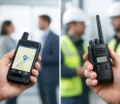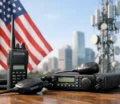
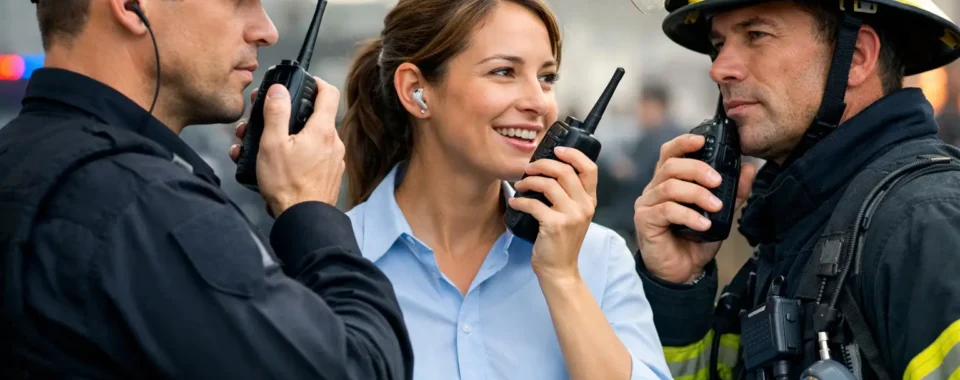

A warehouse crew on DMR, a delivery fleet using Push-to-Talk over Cellular, and a local fire department on a public-safety system may all be working around the same incident. Radio interoperability is what determines whether they can exchange useful information quickly or spend critical minutes relaying messages through separate dispatch points.
For organizations that rely on two-way communications, interoperability is not a feature to add because it sounds advanced. It is a planning decision that affects safety, response time, coverage, security, and the day-to-day workload of the people carrying radios. The right approach depends on who needs to talk, under what conditions, and whether that connection is needed every day or only during an emergency.
What radio interoperability actually means
Radio interoperability is the ability for different users, radio systems, or agencies to communicate and share understandable information when the situation requires it. That can mean direct radio-to-radio voice communication, a dispatcher patching groups together, a gateway connecting different technologies, or a carefully managed procedure for passing traffic between teams.
The definition sounds simple, but the technical reality is not. Two radios may operate on the same frequency band and still be unable to communicate because they use different digital formats, programming, encryption, channel spacing, or access rules. Conversely, systems that have nothing in common at the radio level may be connected through a console, gateway, or broadband application.
Interoperability also does not mean every user should hear every channel. A security team does not need routine housekeeping traffic, and a contractor does not necessarily need access to an organization’s internal operations channels. Good system design creates the necessary communication path without turning every radio into an open microphone for the entire operation.
Where interoperability matters most
The need often appears at the edges of an operation: when a fleet arrives at a facility, when a utility crew works alongside a contractor, when event staff coordinate with security, or when a weather emergency brings multiple local organizations together. Those moments expose the limits of isolated communications systems.
Consider a large event venue. Parking, guest services, security, facilities, medical staff, and outside public-safety responders may each use a different communications method. Staff members need fast, simple coordination during normal operations, but an incident may require a controlled way to pass information to supervisors and responding agencies. The solution may be a designated liaison radio, a dispatch console patch, or an established incident communications procedure. It is rarely wise to permanently combine every group.
Agricultural and rural operations face a different version of the same problem. A farm may use mobile radios across its property, cellular-based PTT for management traveling between sites, and GMRS or amateur radio resources for community preparedness. Coverage, licensing, user training, and the intended purpose of each service all need to be considered before any connection is planned.
The common ways systems are connected
There is no universal interoperability product. The best method is shaped by the systems already in place, the expected traffic volume, the level of control required, and the consequences if communications fail.
Shared channels and common procedures
The simplest option is a preassigned channel or talkgroup available to the users who need to coordinate. This works well when participants use compatible equipment and are authorized to operate on that channel. It is often the clearest choice for organizations with multiple departments on the same licensed DMR system or for teams using a common PoC platform.
Its advantage is speed and simplicity. Its limitation is that all participants must have compatible radios, valid programming, proper permissions, and enough coverage at the time of use. A shared channel is also only useful if everyone knows when to move to it and who is responsible for managing the traffic.
Dispatch console patches
A dispatch console can bridge selected talkgroups or channels when an incident requires coordination. The dispatcher retains control over the patch, which helps prevent unnecessary traffic from crossing between systems. This approach is useful for larger facilities, transportation operations, and organizations with a staffed communications center.
The trade-off is that the connection depends on dispatch availability and console configuration. It may also add a short delay to the conversation. For many operations, that is an acceptable trade for better control and accountability.
Radio gateways and cross-band patches
A gateway can connect otherwise incompatible radio systems, such as analog and digital channels or radios operating in different bands. Depending on the equipment and configuration, it may create a temporary bridge for an incident or support a more permanent connection between groups.
Gateways solve real problems, but they require careful engineering. Audio levels, signaling, priority rules, encryption, identification requirements, and failure behavior all matter. A poorly configured patch can create feedback, repeated traffic, blocked channels, or confusion about who is speaking. It should be tested under realistic operating conditions, not just powered on during an emergency.
Push-to-Talk over Cellular integration
PoC gives organizations broad-area communications without building a conventional radio network at every location. It can be especially valuable for fleets, supervisors, and multi-state operations. When paired with compatible devices and a properly designed workflow, PoC can extend communications between fixed facilities and personnel far beyond the footprint of a local repeater.
However, PoC is not identical to RF radio. It relies on cellular or Wi-Fi connectivity, device management, application configuration, and the policies of the service platform. Connecting PoC users to conventional radio users may be possible through a gateway or dispatch platform, but the design should account for coverage dead zones, network congestion, audio delay, and what happens if the broadband connection is unavailable.
Compatibility is more than frequency
One of the most expensive mistakes is assuming that radios on the same band will work together. Frequency is only one part of compatibility. Digital mode, bandwidth, color code or network access parameters, talkgroup assignments, encryption settings, radio IDs, and programming templates can all determine whether a call goes through.
Licensing and operating authority matter just as much. Business frequencies, public-safety systems, GMRS, amateur radio, and other services operate under different FCC rules and intended uses. A technical bridge does not automatically make a communication arrangement permissible. Organizations should confirm that their licenses, user eligibility, and planned operating practices support the connection they want to create.
Encryption deserves particular attention. It protects sensitive traffic, but it can limit interoperability when partner organizations do not share compatible encryption methods and approved key-management practices. The practical answer is often not to weaken security across an entire system. Instead, establish an authorized interoperable talk path for the specific users and circumstances that require it.
Build the plan around the real incident
Before selecting equipment, define the communication scenario in plain language. Who needs to talk to whom? Is the need routine, occasional, or emergency-only? Does the connection need to work inside a building, across a county, or nationwide? Will there be a dispatcher? Does the information include sensitive details? What is the fallback if one network is unavailable?
Those answers usually point to a practical design faster than starting with a catalog of radios. A hotel may need one liaison channel for security and maintenance, while a logistics company may need a PoC dispatch group linked to a local DMR system at a distribution center. An event organizer may only need a temporary incident communications plan and trained supervisors rather than a permanent, complex network.
Testing is where a design becomes operational. Run a drill with the actual people, vehicles, buildings, and coverage areas involved. Check audio quality, call setup time, user permissions, battery life, labeling, and the process for activating a patch. Just as importantly, listen to users. If the procedure takes too many button presses or depends on instructions nobody remembers under stress, it needs refinement.
Keep the system usable after installation
Interoperability plans need maintenance. Radio programming changes, staff turns over, cellular service evolves, and new partners enter the picture. Document channel names, talkgroup purposes, gateway settings, escalation contacts, and the authority to activate a bridge. Review the plan after drills and actual incidents.
Cogent Radios Group approaches these projects as communications problems first and equipment decisions second. Whether the answer involves DMR, PoC, a repeater, a dispatch position, or a simple shared operating procedure, the goal is to give the right people a dependable way to communicate without adding unnecessary complexity.
The best interoperability plan is often the one that stays quiet until it is needed, then gives trained users one clear path to reach the people who can help.