

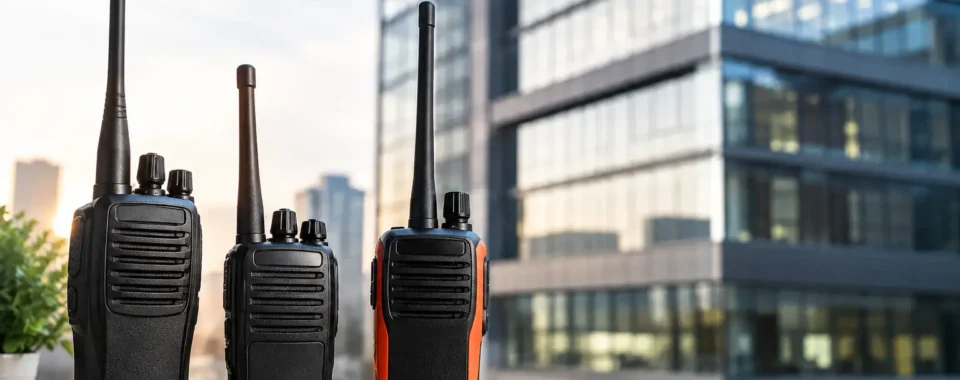

A radio that works perfectly across an open jobsite can become unreliable the moment a crew enters a concrete stairwell, metal warehouse, or lower-level mechanical room. When customers ask which radios penetrate buildings, the honest answer is not a single model or frequency. Indoor performance comes from the right combination of spectrum, power, antenna, building materials, system design, and user expectations.
For a restaurant, hotel, warehouse, school, event venue, or service fleet, the goal is not simply to get a signal through one wall. It is to create communication your staff can depend on at the loading dock, in the elevator lobby, behind refrigeration equipment, and wherever work actually happens.
Which radios penetrate buildings best?
In many conventional two-way radio applications, UHF radios in the 400-500 MHz range are often the practical starting point for indoor coverage. UHF signals generally handle building interiors, floors, and dense work areas better than higher-frequency systems. They are widely used in hospitality, retail, manufacturing, schools, healthcare support, and event operations for that reason.
That does not mean UHF always wins. Lower-frequency VHF radios, typically 150-174 MHz, can travel farther in open terrain and around large outdoor properties. They may be the better choice for agriculture, utilities, campuses with broad outdoor coverage, or rural operations. But their longer wavelengths do not automatically translate into better performance inside every building. In offices, warehouses, and commercial facilities with many rooms or reinforced materials, UHF is frequently easier to design around.
For teams that need broad geographic coverage rather than on-site radio coverage, Push-to-Talk over Cellular (PoC) radios are often the strongest option. A PoC device uses LTE or 5G data networks and Wi-Fi rather than a local radio repeater alone. If cellular and Wi-Fi coverage are available indoors, a team can communicate across multiple floors, sites, or states with a familiar radio-style push-to-talk experience.
The best choice depends on the building and the mission. A single-site warehouse may benefit from a UHF DMR system with a properly placed repeater. A regional delivery fleet may be better served by PoC. A facility with poor cellular service and heavy concrete construction may need dedicated in-building radio infrastructure, not a different handheld radio.
The building itself is part of the radio system
Radio waves lose energy each time they pass through a barrier. Drywall and glass are usually manageable. Brick, concrete, steel, low-emissivity glass, foil-backed insulation, and dense plumbing or electrical infrastructure can cause meaningful signal loss. The more barriers between radios, the less predictable communication becomes.
Metal is especially challenging. Warehouses with pallet racking, manufacturing plants with machinery, elevator shafts, parking garages, and metal-sided buildings can reflect and scatter RF energy. That may create a strange real-world result: a radio works in one aisle, drops out 30 feet away, then works again around the corner. This is multipath propagation, and it cannot be solved simply by buying a radio advertised with more range.
Below-grade areas add another layer of difficulty. Basements, tunnels, underground garages, and interior rooms without windows may have weak cellular service and limited conventional radio coverage. A higher-power portable may provide some improvement, but it cannot overcome every structural barrier. Coverage must be designed from the inside out.
Frequency matters, but it is not the whole answer
A useful rule of thumb is that lower frequencies tend to bend and travel farther, while higher frequencies tend to support shorter-range, line-of-sight communication. Real facilities are more complicated than that rule suggests.
VHF for open properties and outdoor work
VHF is often effective where there is open space, rolling terrain, and relatively few dense obstructions. Farms, ranches, utility operations, and large outdoor campuses may see excellent results with VHF. A VHF radio can also provide usable building coverage in lighter construction, especially when the radio system is supported by a well-located base station or repeater.
Its trade-off is that VHF can be less convenient in dense urban and indoor environments. Long antennas can also be less practical for staff who carry radios all day in hospitality, security, or warehouse roles.
UHF for many indoor commercial environments
UHF is a common choice for building operations because its antennas are manageable and its propagation characteristics often suit dense facilities. A properly engineered UHF system can provide dependable coverage in warehouses, hotels, schools, retail spaces, and industrial sites.
The word “properly” matters. UHF will not magically pass through reinforced concrete, multiple floors, and steel infrastructure from a low-powered handheld at the far edge of a property. When coverage is mission-critical, a repeater, rooftop or elevated antenna, distributed antenna system, or additional indoor antenna points may be necessary.
700/800 MHz systems and public-safety-style coverage
Systems around 700/800 MHz are commonly associated with public safety and larger enterprise networks. These frequencies can work very well when supported by engineered infrastructure, but they are not inherently a shortcut through buildings. Higher frequencies generally experience more loss through obstacles than lower bands, so system design is central.
For most businesses, the question is less about copying a public safety band plan and more about selecting a legal, supportable system with enough coverage for the actual operation. Licensing, available channels, interoperability requirements, and equipment budget all influence the decision.
PoC radios where cellular or Wi-Fi is available
PoC radios change the coverage discussion. Rather than relying on a direct RF path from one handheld to another, they connect through carrier networks and, on many devices, Wi-Fi. This can be an excellent solution for a property manager coordinating several buildings, a transportation team spread across a metro area, or an event organization with staff at separate entrances and staging locations.
However, PoC is only as dependable as its network path. If a basement has no cellular signal and no Wi-Fi, a PoC radio may not work there. For facilities with known dead zones, Wi-Fi planning, carrier testing, or a complementary conventional radio channel may be needed.
Power, antennas, and repeaters make a measurable difference
More transmit power can help, but it is not a cure for poor design. Most portable business radios transmit at a few watts. Moving from a lower-power radio to a higher-power unit may improve a marginal path, but it will not turn a heavily shielded lower level into a dependable coverage area.
A better antenna location often has more impact than additional handheld power. A repeater placed at an appropriate high point can receive weak portable signals and retransmit them from a stronger location. For larger facilities, indoor antennas connected by properly specified cable can extend coverage into areas that a single rooftop antenna cannot reach.
Digital Mobile Radio, or DMR, can provide clear audio and efficient channel use, but digital systems have a different edge-of-coverage behavior than analog. Analog audio often gets progressively noisier as a signal weakens. Digital audio may sound clear until the signal falls below a usable threshold, then become choppy or stop. Neither is automatically better for every weak-signal area. The right answer comes from testing the site and setting realistic coverage criteria.
Do not confuse advertised range with building coverage
Consumer radio packaging often claims range figures based on ideal outdoor conditions, such as mountaintop-to-valley communication. Those figures do not describe what happens through concrete walls, around machinery, or across several floors.
For business planning, ask a more useful question: Can two staff members communicate clearly from the places where they work at the same time? That means testing shipping offices and loading bays, guest corridors and kitchens, gates and maintenance rooms, not just the parking lot.
A simple coverage survey should include the building perimeter, interior work zones, stairwells, elevators where permitted, utility rooms, storage areas, and any location where an employee may need help. Record weak spots, note the materials involved, and test with the radios carried at normal belt or shoulder height. A radio held high in an open hallway is not a realistic test of daily use.
Choose the system before choosing the radio
The radio body is only one component of a communications solution. Before selecting devices, define whether your team needs local building coverage, property-wide outdoor coverage, nationwide communication, dispatch oversight, emergency coverage, or a combination of these needs.
A small operation in one building may be well served by license-free options for basic short-range coordination, provided those services meet the operational need. Organizations requiring more dependable coverage, privacy, higher-capacity operations, or tailored channels should evaluate licensed business radio systems. FCC licensing is part of that process for many commercial configurations, and it should be addressed before equipment is put into service.
For organizations with multiple sites and mobile personnel, PoC can reduce the need to build RF infrastructure at every location. For a single high-demand facility, a conventional DMR system with engineered coverage may deliver more predictable results where cellular service is inconsistent. Many operations use both: PoC for wide-area coordination and local radio channels for on-site work or contingency communication.
The most dependable building coverage starts with a walkthrough and an honest discussion about the places where communication cannot fail. Test those locations first, then build the system around them.