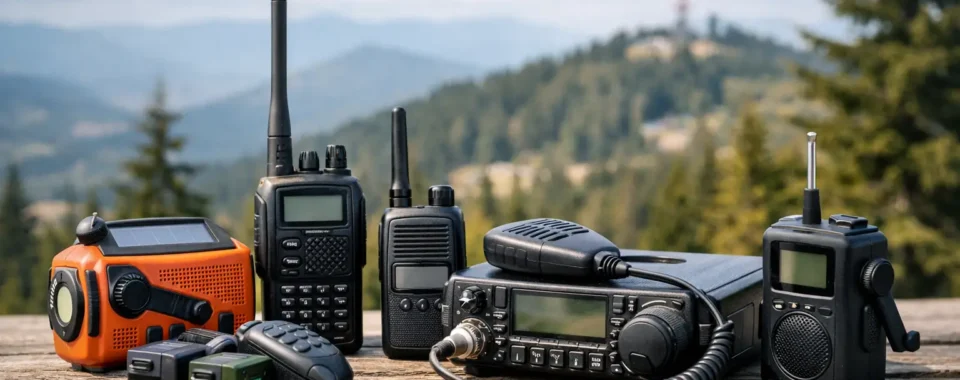

A storm takes down a carrier tower. A work crew moves into a canyon. A festival fills its site with thousands of phones competing for the same network. These are the moments when people ask, what radios work without cell service? The practical answer is any radio that sends voice directly over radio frequency instead of depending on a cellular data connection.
That includes everything from simple family walkie-talkies to licensed business radio systems with repeaters. The right choice depends less on the label on the radio and more on your terrain, team size, operating range, and whether you need communications to stay private and coordinated during daily operations.
What Radios Work Without Cell Service?
FRS, GMRS, CB, MURS, amateur radio, and licensed business two-way radios can all operate without cellular service. They transmit through the air between radios, either directly from unit to unit or through a repeater that receives and retransmits the signal.
That distinction matters. Push-to-Talk over Cellular radios are excellent for nationwide communication when cellular or Wi-Fi data is available, but they are not an off-grid replacement for RF two-way radios. If the cellular network is unavailable and there is no usable Wi-Fi connection, a PoC radio cannot provide its normal wide-area service.
Traditional two-way radios do have limits. Hills, buildings, heavy vegetation, and distance can weaken a signal. A professionally planned radio system addresses those limits with the correct frequency band, antenna placement, vehicle installations, and, when needed, a repeater at a high location. No radio category is automatically “long range” in every environment.
FRS radios for short-range personal use
Family Radio Service, or FRS, radios are the familiar compact walkie-talkies used for close-range communication. No FCC license is required for FRS use in the United States, making them an accessible option for families, small events, parking teams, campgrounds, and short-duration activities.
They work well when users are in the same building, on a job site, around a property, or within sight of each other. Real-world range is often much shorter than the number printed on the package, especially indoors or in dense urban areas. FRS radios also use shared channels, so privacy is limited and channel congestion is possible.
GMRS radios for families, properties, and mobile teams
General Mobile Radio Service, or GMRS, uses many of the same channels as FRS but permits higher power on certain channels and allows repeaters. A single FCC GMRS license can cover an immediate family, which makes it useful for families, farms, ranches, outdoor recreation groups, and property owners.
GMRS can provide considerably better coverage than FRS when paired with quality mobile radios, external vehicle antennas, or a properly located repeater. It is still a shared service, however. It is not designed for exclusive business dispatching, and users should expect other licensed GMRS operators to be on the air.
CB radio for highways and rural travel
Citizens Band radio remains useful where road traffic, trucking, and local travel information matter. CB requires no individual license, and its 40 channels are widely known by truck drivers and off-road groups. Channel 19 remains the common highway channel in many areas.
CB is a practical choice for vehicle-to-vehicle communication, convoy coordination, and receiving local road information. It is less suited to a business that needs controlled, private conversations across a facility. Installation quality makes a major difference: a properly tuned antenna and solid ground plane often matter more than the radio’s advertised power.
MURS for local business and property communications
Multi-Use Radio Service, known as MURS, is a license-free VHF service with five channels. It can be a good fit for local, low-to-moderate range communications on farms, warehouses, nurseries, schools, security posts, and event grounds.
VHF signals can perform well in open terrain and around large outdoor properties. MURS has power and antenna restrictions, and repeaters are not permitted. That makes it a straightforward local tool rather than a solution for extending coverage across a large county or multi-site operation.
Amateur radio for trained operators and emergency capability
Amateur radio can operate without cellular service across local, regional, and even global distances, depending on the band, equipment, antenna, and propagation conditions. It is a valuable resource for technically inclined users, community emergency groups, and volunteer communications organizations.
Every transmitting amateur operator must hold the appropriate FCC license, and amateur frequencies cannot be used for routine business communications. An amateur radio setup may be ideal for a trained individual preparing for emergencies, but it is not the right channel plan for dispatching a paid work crew.
Licensed business two-way radios for mission-critical operations
For organizations that need dependable team communications, licensed business radios are typically the strongest non-cellular option. These systems can use VHF, UHF, or 800/900 MHz spectrum, depending on the environment and available licensing. They may be analog or digital, including DMR systems that support clearer audio, individual calling, talkgroups, text functions, and more efficient channel use.
A business radio system can be designed around the operation instead of forcing the operation to adapt to consumer radios. A warehouse may need UHF for better indoor penetration. A utility crew working across open territory may benefit from VHF. A fleet may need vehicle mobiles, portable radios, and a repeater that covers the service area.
Licensed frequencies also reduce the day-to-day interference and lack of accountability common on shared channels. They do require planning, FCC coordination or licensing support, and equipment programmed for the authorized channels. For a business that cannot afford missed calls during a safety issue, delivery delay, or production stoppage, that work is worthwhile.
Direct Radio-to-Radio vs. Repeaters
The simplest off-grid setup is simplex communication: one radio talks directly to another. It needs no internet, cell tower, or fixed infrastructure. It is also limited by terrain, buildings, antenna height, and power level.
A repeater extends coverage by receiving a signal on one frequency and retransmitting it on another. Repeaters are commonly placed on elevated buildings, towers, or hilltops. They do not require cellular service to pass voice traffic, but they do require power and a functioning site. Critical systems may use battery backup, generators, and professionally maintained antennas to remain available during utility outages.
For a single site, an on-premises repeater may cover a large building or campus. For a broader territory, a high-site repeater can connect field crews across areas where direct portable-to-portable communication would fail. This is where a coverage assessment is more useful than a range claim on a retail box.
How to Choose a Radio That Will Work Where You Work
Start with the actual communication problem. If your family needs contact while hiking within a few miles, FRS or GMRS may be appropriate. If drivers need to coordinate along the highway, CB may have value. If a farm crew needs local coverage without monthly fees, MURS or GMRS may be worth considering.
For organizations, answer a few operational questions before purchasing equipment:
- How far apart will users be, and what sits between them?
- Will radios be used inside metal buildings, across open land, in vehicles, or all three?
- Do you need private channels, dispatch capability, emergency alerts, or individual calls?
- Must the system continue through local carrier outages and power interruptions?
- Are your communications business-related, requiring properly licensed spectrum?
A good radio plan also accounts for batteries, chargers, spare units, speaker microphones, and training. A radio that is technically capable but difficult to use under pressure will not solve a communication problem. Clear channel names, consistent radio programming, and a simple procedure for emergency traffic are often as valuable as extra features.
Cogent Radios Group helps customers match those field realities to practical radio systems, from straightforward local coverage to engineered business networks with repeaters and licensing support.
Cell-Free Does Not Mean Maintenance-Free
The best radios for no-cell-service situations are not always the most expensive ones. They are the ones built for the environment, programmed correctly, and supported by an antenna and coverage plan that fits the job. Test radios at the farthest points of your property, inside problem buildings, and during the busiest part of the day before treating them as a critical system.
When communication matters, plan for the conditions you expect and the failures you do not. A well-chosen RF radio system gives your team a direct path to each other when the cell signal disappears.