

A lot of people start with the same question: when comparing frs vs gmrs radios, what actually matters in day-to-day use? The answer is not just range on the box. It comes down to who is using the radios, where they are operating, how reliable communication needs to be, and whether you want a simple grab-and-go option or room to build a stronger setup.
FRS and GMRS are both part of the UHF family and share some channels, which is why they are often discussed together. On the surface, they can look very similar. In practice, they serve different needs, and choosing the wrong one can leave you with weak coverage, unnecessary licensing confusion, or radios that do not fit the job.
FRS vs GMRS radios at a glance
FRS stands for Family Radio Service. GMRS stands for General Mobile Radio Service. Both are short-range personal radio services used in the US, and both can be useful for simple voice communication without depending on cellular coverage. That is where the similarities start to taper off.
FRS is the simpler option. It is license-free, uses lower power, and is commonly found in consumer walkie-talkies sold for family outings, neighborhood coordination, and light recreational use. If your goal is straightforward communication with minimal setup, FRS makes sense.
GMRS is more capable. It allows higher power on certain channels, supports detachable antennas on approved equipment, and can use repeaters. That changes the conversation quickly. A GMRS setup can provide much better practical coverage than FRS when used correctly, but it also comes with FCC licensing requirements.
The biggest difference is not the label
The biggest real-world difference between FRS and GMRS is system flexibility. FRS is built for convenience. GMRS is built for performance.
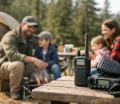
If you are coordinating kids at a park, family members at a campground, or a few people around a property, FRS may be all you need. The radios are usually inexpensive, easy to hand out, and simple enough that nobody needs training beyond push-to-talk basics.
If you are trying to cover a large rural property, stay in touch between vehicles over varying terrain, or improve communication through a local repeater, GMRS becomes the stronger candidate. It gives you more power and more ways to improve coverage, which matters much more than marketing claims about “35-mile range” or similar packaging language.
Range claims vs actual performance
This is where many buyers get frustrated. Radio range is always affected by terrain, buildings, foliage, antenna quality, radio power, and how high the radios are off the ground. Two people standing in a flat open area may get solid results. Move one person behind a steel building or into hilly timber, and the range changes fast.
FRS radios generally work best for short-range communication. Around a neighborhood, event site, parking area, campground, or job area with limited obstruction, they can do the job well enough. Inside dense buildings or around heavy equipment, performance may drop sooner than many users expect.
GMRS has the advantage when you need more distance or more consistent signal penetration. Higher allowed power helps, but power alone is not magic. Better antennas and repeater access often make the real difference. A handheld GMRS radio used simplex still has limits. A properly set up GMRS mobile radio or repeater-supported setup is a different class of performance.
Licensing and compliance
For many users, this is the deciding factor.
FRS does not require an FCC license. That is a major reason it remains popular for casual users and families. You buy the radios, charge them, and start talking on authorized channels.
GMRS does require an FCC license in the US. The good news is that the process is much simpler than getting a business license or amateur radio license. There is no exam. The license is issued to an individual and typically covers immediate family members as allowed by current FCC rules. For many households, off-road groups, and preparedness-minded users, that makes GMRS practical.
For business use, though, this is where buyers need to slow down and choose carefully. FRS and GMRS are not a substitute for every commercial radio need. If your company relies on radio communications for operations, dispatch, job coordination, safety, or wide-area team use, licensed business radio systems or PoC solutions may be the better fit. The right answer depends on coverage needs, user count, compliance, and how critical the communication path is.
Equipment differences that matter
A lot of comparison articles make this sound too simple. It is not just low power versus high power.
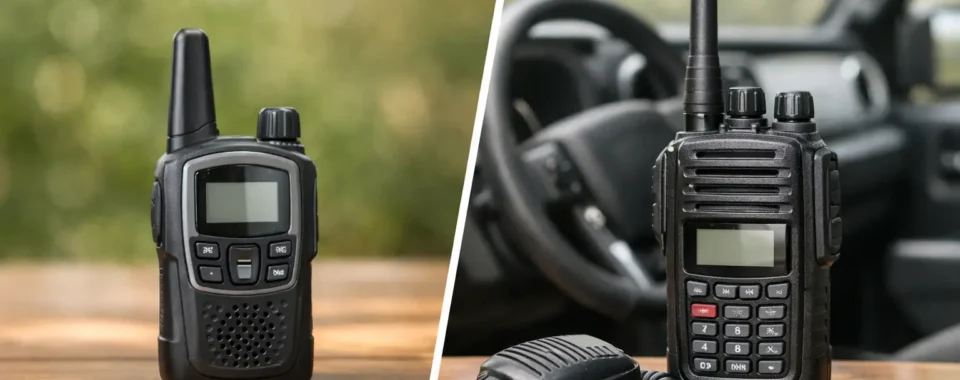
FRS radios are typically fixed-antenna handhelds. That keeps them easy to use and compliant, but it also limits how much you can optimize the system. You are mostly buying a self-contained device and accepting its built-in performance.
GMRS equipment is available in handheld, mobile, and base station formats. Some units support removable antennas, external vehicle antennas, speaker microphones, programming options, and repeater channels. That opens the door to much better performance, especially for vehicle convoys, agricultural operations, larger properties, and community preparedness groups.
This is also where quality matters. Cheap radios often work fine until they do not. Audio quality, battery life, receiver performance, and durability can vary significantly. If the radios are going to live in trucks, utility vehicles, barns, event kits, or go-bags, build quality is worth paying attention to.
FRS vs GMRS radios for common use cases
For family activities, FRS is usually the easiest recommendation. Theme parks, local outings, neighborhood use, short camping trips, and basic travel coordination are all solid fits. The lack of licensing keeps things simple, especially if you are handing radios to several people who just need basic communication.
For road trips and vehicle-to-vehicle travel, GMRS usually has the edge. Mobile-capable radios, better antennas, and higher power improve clarity and consistency, especially once vehicles spread out or encounter rolling terrain.
For farms, ranches, and large private properties, it depends on the size of the area and the importance of reliable coverage. A small property may get by with FRS. Once you start dealing with larger acreage, outbuildings, equipment sheds, wooded sections, or vehicle operations, GMRS is often the more useful tool.
For events, hospitality, and commercial operations, neither service should be chosen just because it is familiar. Communication plans should match the job. If coverage, uptime, and coordination are operational priorities, a commercial radio solution often makes more sense than trying to stretch FRS or GMRS beyond its intended role.
When FRS is the better choice
FRS is the better choice when you value simplicity more than expandability. If you want radios that anyone can use immediately, do not want to deal with licensing, and only need short-range communications, FRS is hard to argue against.
It also makes sense when cost control matters and expectations are realistic. For light-duty use, FRS can be perfectly adequate. The mistake is expecting it to perform like a higher-tier system in difficult RF environments.
When GMRS is worth it
GMRS is worth it when communication reliability matters enough to justify a little more planning. If you want better practical range, stronger mobile use, repeater capability, and more equipment options, GMRS gives you room to grow.
It is especially attractive for users who are between casual family use and full commercial radio infrastructure. That middle ground includes preparedness groups, outdoor users, off-road communities, rural families, and property owners who need more than toy-grade communication but do not necessarily need a full business radio fleet.
That said, GMRS still has limits. It is not a replacement for every dispatch system, every wide-area radio network, or every multi-site commercial deployment. Buyers who need guaranteed coverage over large operational areas should think beyond service labels and look at the full communication requirement.
A practical way to decide
If you are choosing between FRS and GMRS, start with three questions. How far apart will users really be, not ideally but in real conditions? How important is communication when conditions get worse, not when they are perfect? And do you want a simple handheld solution, or a system that can be improved with better antennas, mobiles, or repeaters?
If your answers point to casual, close-range, low-risk communication, FRS is probably enough. If they point to larger areas, more demanding terrain, vehicle use, or stronger reliability expectations, GMRS is usually the better investment.
At Cogent Radios Group, this is the kind of decision we encourage people to make based on use case, not packaging claims. The best radio is the one that fits the environment, the users, and the job without creating unnecessary complexity.
A good radio choice should feel boring in the best possible way – clear audio, dependable coverage, and no surprises when you press the button.