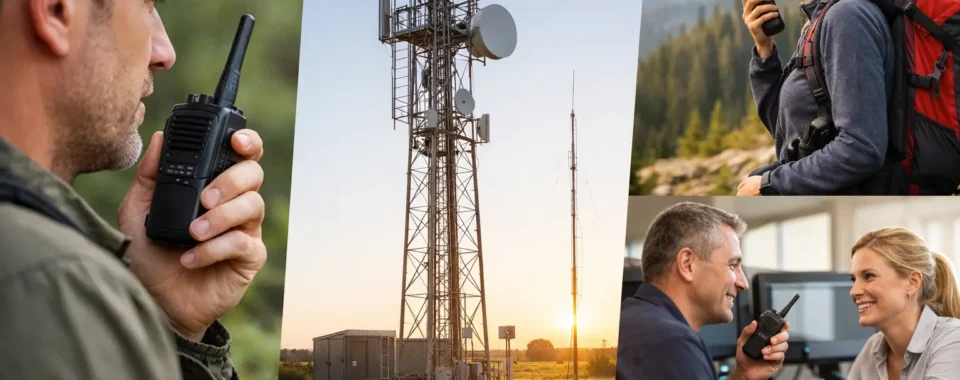

If you have ever looked at business radios and thought, “I need something simpler than a licensed system but more purposeful than a big-box walkie-talkie,” the question usually comes next: what is MURS radio, and is it actually useful in the field? That is the right question, because MURS sits in a very specific lane. It can be a smart fit for some users and a frustrating mismatch for others.
What is MURS radio?
MURS radio stands for Multi-Use Radio Service. It is a license-free, short-range two-way radio service authorized by the FCC in the United States. MURS operates on five VHF frequencies and is intended for personal or business use without the need to apply for an individual FCC license.
That license-free part is what gets most people interested. For small teams, family property use, events, farms, churches, schools, and light business coordination, MURS can offer a practical way to communicate without monthly fees or the paperwork that comes with many licensed business radio systems.
But “license-free” does not mean “anything goes.” MURS still has operating rules, power limits, and equipment requirements. It is also not designed to replace every other radio option. If you need wide-area coverage, repeaters, or large multi-site coordination, MURS may not be the right tool.
How MURS works in plain terms
MURS uses VHF frequencies, which generally do a solid job outdoors and in open areas. Compared with some UHF license-free options, VHF often performs well on farms, campuses, parking lots, job sites with fewer dense structures, and other environments where line-of-sight communication matters.
The service has five designated channels. Radios programmed for MURS use those channels directly, and users can often apply privacy codes to reduce unwanted chatter from hearing other users. That said, privacy codes do not make your conversations private. They simply help your radio ignore transmissions that do not use the same code setting.
MURS is limited to 2 watts transmitter power. It also does not allow repeater operation. Those two facts shape most of its real-world performance. The radios can be very useful across a property, around a facility, or between vehicles and staff in a contained area, but they are not built for county-wide communication.
What makes MURS different from FRS, GMRS, and business radios?
This is where buyers can save themselves time and money. On paper, several radio services can look similar. In practice, they solve different problems.
FRS is also license-free, but it typically targets casual consumer use. Many FRS radios are inexpensive and easy to buy, but the equipment quality and operational flexibility can be limited. For a family outing, that may be fine. For a business that needs durable radios with better accessories and more dependable day-to-day use, MURS often feels more purposeful.
GMRS can offer more capability than MURS, including higher power and repeater use, but it requires an FCC license. For users who need more range and are comfortable with that licensing step, GMRS may be the better fit.
Licensed business radios, including many DMR systems, move into a different class. They can support cleaner channel coordination, more advanced system design, and better scalability for operations that depend on communications every day. If a warehouse, transportation fleet, hotel, manufacturing site, or security team cannot afford communication gaps, licensed business radio is often the safer answer.
So where does MURS fit? Right in the middle. It is more serious than basic recreational radio use, but less capable than a licensed commercial system.
What is MURS radio good for?
MURS works best when you need simple, local voice communication and you want to avoid licensing complexity. A farm owner can use it to stay in touch across barns, equipment sheds, and fields that are reasonably close together. An event team can use it for parking, setup, check-in, and vendor coordination at a single venue. A church, school, or private property team can use it for day-to-day staff communication without building out a larger radio system.
It can also be useful for retail centers, garden centers, maintenance crews, and hospitality support teams with contained coverage needs. In these cases, the appeal is straightforward: decent audio, no monthly carrier plan, no dependence on cellular service, and operation that is usually easier than app-based communications.
For families and preparedness-minded users, MURS can also make sense on rural property or during outdoor activities where cell coverage is inconsistent. Some users like it because it offers a practical middle ground between toy-grade radios and more complex setups.
Where MURS radio falls short
The limitations matter just as much as the benefits.
First, MURS is still short-range radio. Range depends heavily on terrain, buildings, antenna quality, and how the radio is being carried or used. On open land, you may get useful coverage over a respectable distance. Inside steel structures, dense commercial buildings, or hilly terrain, performance can drop fast.
Second, there are only five MURS channels. In quieter areas, that may be enough. In busier environments, channel congestion can become a real issue. If multiple nearby users are on the same channels, you may deal with interference or delays.
Third, no repeater support means no easy way to extend a MURS system across a larger footprint. If you need to connect a campus, multiple facilities, or a spread-out operation, that becomes a major drawback.
Finally, not every radio marketed casually online is worth trusting for real work. Build quality, audio clarity, battery life, and accessory support vary a lot. For operational users, the radio itself matters as much as the service it runs on.
MURS range: what should you realistically expect?
This is one of the most common questions, and the honest answer is: it depends.
In open, flat terrain with good antennas and minimal obstruction, MURS can provide useful communication over several miles. In a busy commercial environment with walls, equipment, vehicles, and metal structures, that can shrink to a fraction of that. Handheld-to-handheld communication is usually the toughest test because both radios are low to the ground and often blocked by the body, vehicles, or buildings.
For most buyers, the right way to think about MURS is not maximum advertised miles. Think in terms of your actual operating area. If your team works on one property, one venue, one parking operation, one farm section, or one compact campus, MURS may cover the job. If your people spread across a metro area or need guaranteed communication in difficult RF conditions, it probably will not.
Is MURS radio legal for business use?
Yes. MURS can be used for both personal and business communications in the United States, as long as users follow FCC rules for the service and use compliant equipment. That is one reason it remains attractive to smaller organizations that want a simple radio solution without going through licensing.
Still, legal use and ideal use are not always the same thing. A business may be allowed to use MURS, but if staff coverage is inconsistent, channels are crowded, or reliability is mission-critical, a licensed business system can still be the better operational choice.
That trade-off is where experienced guidance helps. A radio service may be technically available to you and still not be the best fit for the way your team actually works.
Who should choose MURS radio?
MURS makes the most sense for users who need local, straightforward communication with modest coverage expectations. It is often a good option for light commercial operations, property owners, event staff, volunteer teams, and organizations that want durable radios without stepping into a more complex system design.
It is less suitable for larger fleets, high-rise facilities, heavy industrial sites, multi-building campuses, and teams that need guaranteed coverage over a wide area. In those cases, it usually makes more sense to look at licensed business radio or Push-to-Talk over Cellular, depending on the environment and workflow.
A good rule of thumb is simple: if your communication problem is local and contained, MURS deserves a look. If your problem is broad, high-stakes, or growing fast, start with something more scalable.
Choosing the right MURS setup
If you decide MURS is a fit, focus on the practical details. Radio durability matters if the units will live in trucks, on belts, or in outdoor conditions. Audio quality matters if your team works around engines, crowds, or equipment. Battery performance matters if shifts run long. Earpieces, speaker microphones, and charging options can make a basic radio much more usable in real operations.
It is also worth thinking ahead. Some buyers start with MURS because it is simple, then realize six months later that they need better building penetration, more channels, dispatch support, or communication across multiple sites. That does not mean MURS was a bad choice. It just means the radio plan should match not only today’s needs, but where the operation is headed.
At Cogent Radios Group, that is usually the most useful conversation to have first. Not which radio looks good on a spec sheet, but what your people need to do, where they need to do it, and what happens when communication fails.
MURS can be a very solid answer when the job fits the service. The key is being honest about the job before you buy the radio.