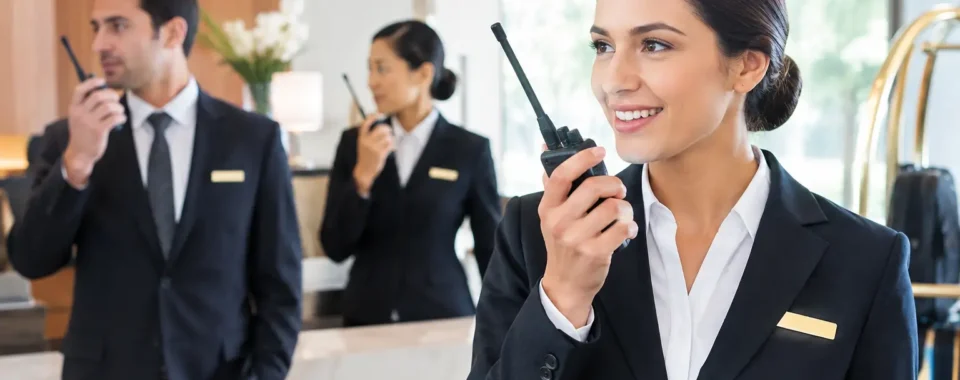

A guest is waiting at the front desk while housekeeping needs help with a room issue, engineering is responding to an HVAC alarm, and security is checking a parking-area concern. In that moment, radios for hotel staff communication are not a convenience. They are the quickest way to get the right person involved without leaving a guest on hold, searching for a phone number, or relying on a text that may not be seen for several minutes.
Hotels run on hundreds of small handoffs each day. A well-planned radio system shortens those handoffs, gives supervisors better awareness of what is happening, and helps employees respond professionally when conditions change. The right solution is rarely just a matter of buying handheld radios. It requires matching coverage, device features, channels, policies, and support to the way the property actually operates.
Why Hotel Radio Communication Still Matters
Mobile phones are useful, but they are not always the best operational tool. An employee may have a phone in a pocket, on silent mode, or charging in a back office. Calling one person at a time also slows down urgent coordination. With a two-way radio, a front desk agent can reach housekeeping, engineering, valet, or a manager with one push of a button.
That speed matters for ordinary service as much as emergency response. A radio call can confirm that a room is ready, request luggage assistance, report a spill, or locate a supervisor before a guest sees a delay. For larger properties, it also gives department leaders a more direct view of activity across the building.
The benefit is not constant chatter. The goal is organized, brief, purposeful communication. When teams know which channel to use and how to make a clear call, radios reduce unnecessary movement and prevent small issues from becoming guest complaints.
Start With the Property, Not the Radio Catalog
A 70-room limited-service hotel has different communication needs than a high-rise convention hotel, resort campus, casino property, or multi-building destination. Before choosing equipment, map the places where staff need to talk, not just where guests spend time.
Check the front desk, guest-room floors, service elevators, loading docks, parking garages, pool areas, laundry rooms, kitchens, mechanical spaces, stairwells, and any detached buildings. Concrete, steel, elevator shafts, low-emissivity glass, and underground areas can weaken traditional radio signals. A radio that works perfectly in the lobby may struggle two floors below in a service corridor.
Also consider who needs immediate access. Housekeeping and engineering may need constant communication during daytime operations, while security and overnight management may require broader coverage after hours. Valet, shuttle, banquet, and event teams may need temporary access for peak periods. Those details determine channel capacity, battery requirements, accessories, and whether a single system can serve the entire operation.
A practical site assessment is worth more than a spec-sheet comparison. It identifies dead zones before equipment is deployed and helps avoid the common mistake of purchasing radios that appear suitable on paper but fail in the places where staff need them most.
Choosing Between PoC and Traditional Business Radios
For many hotel operators, the key decision is whether to use Push-to-Talk over Cellular, traditional on-site business radios, or a combination of both.
Push-to-Talk over Cellular for Wide Coverage
Push-to-Talk over Cellular, often called PoC, uses cellular data and can provide broad coverage wherever a reliable cellular or Wi-Fi connection is available. It is especially useful for hotel groups, resort properties, off-site parking operations, shuttle drivers, regional managers, and security teams that move beyond the main building.
A PoC radio can allow a general manager at one property to speak with managers at another location, or let a shuttle driver remain part of the same conversation while traveling between an airport and hotel. Many systems can support individual calls, department groups, priority groups, and location-related features.
The trade-off is dependence on network availability and recurring service costs. Cellular coverage must be tested in lower levels, concrete garages, back-of-house spaces, and other challenging areas. Wi-Fi can help inside the property, but it must be professionally managed if it will carry operational voice traffic.
DMR Business Radios for Local Control
Digital Mobile Radio, or DMR, is a strong option for hotels that need dependable on-property communications without relying on cellular service. These radios operate on properly licensed business frequencies and can be used with direct radio-to-radio coverage, repeaters, or distributed systems designed around the building.
DMR can provide clear audio, organized channel assignments, private calling options, and better efficiency than older analog systems. With the right design, it is well suited for high-rise hotels, large campuses, and properties where cellular service is inconsistent in critical areas.
The trade-off is infrastructure. A larger or more difficult property may need a repeater, antenna system, or indoor coverage equipment. That requires planning, installation, maintenance, and Federal Communications Commission licensing. In return, the hotel gains a communications system it controls on site.
For some operations, the best answer is hybrid. A DMR system can serve the hotel building and grounds, while PoC radios connect shuttle drivers, off-site teams, or multiple properties. The right choice depends on coverage requirements, staffing patterns, budget, and the level of control the operation needs.
Features That Matter for Hotel Staff Radios
Hotel staff do not need every available radio feature. They need features that make calls easy to hear, easy to answer, and difficult to miss during a busy shift.
Audio quality should be high on the list. Lobby noise, housekeeping carts, kitchen equipment, laundry machinery, and outdoor traffic all compete with radio audio. A device with strong speaker output and effective noise reduction can make a noticeable difference. For discreet roles, an approved earpiece or surveillance-style accessory may be appropriate, but accessories should be comfortable enough for an entire shift.
Battery performance is equally important. A radio that lasts only part of a shift creates a predictable failure point. Hotels with long operating hours should consider multi-unit charging, spare batteries for conventional radios, or managed charging procedures at shift change. For PoC devices, charging cradles and battery-health policies deserve the same attention.
Durability matters because radios are carried, cleaned, dropped, and exposed to demanding back-of-house conditions. Choose commercial-grade devices with practical controls rather than consumer walkie-talkies intended for occasional recreational use. A programmable emergency button can also be valuable for security, maintenance, and lone-worker roles, provided the hotel has a defined procedure for responding to an activation.
Build a Channel Plan Staff Can Follow
More channels do not automatically create better communication. In a hotel, an overly complicated channel plan can cause missed calls and confusion. A smaller property may work well with a general operations channel and a private management or security channel. A larger hotel may separate housekeeping, engineering, security, front office, events, and facilities functions.
The important point is that channel assignments should reflect real workflows. If housekeeping regularly needs engineering support, supervisors need a simple way to bridge that conversation without broadcasting every detail to every department. If security incidents require discretion, those calls should move promptly to an assigned channel or group.
Written radio procedures should cover plain-language calling, when to use emergency functions, who monitors each group, and what information should never be announced over the air. Guest names, room numbers, payment information, medical details, and sensitive security information require careful handling. Radio systems can support privacy features, but employee training remains essential.
Licensing, Installation, and Ongoing Support
A business radio system is not a set-it-and-forget-it purchase. Traditional licensed radios must operate on frequencies authorized for the business, and equipment should be programmed correctly for those frequencies. Using unlicensed consumer radios for daily commercial operations may create interference, privacy, range, and compliance problems.
Installation quality also affects performance. Antenna placement, cable condition, repeater settings, coverage testing, and battery management all have a direct effect on daily usability. A system should be tested during actual operations, when elevators are moving, kitchens are active, and staff are using the areas that create the most signal challenges.
Cogent Radios Group works with organizations that need more than a box of radios. That includes evaluating property coverage, selecting appropriate PoC or business-radio equipment, addressing FCC licensing needs, and supporting the system after deployment. The right technical partner should be able to explain the choices in plain terms and account for the operational realities of the property.
Make Communication Part of the Guest Experience
Guests may never notice the radios clipped to a housekeeper’s uniform or carried by an engineer. They do notice when a room request is handled quickly, a maintenance issue is addressed before it disrupts their stay, or a safety concern receives an immediate response.
The best hotel radio system stays largely in the background. It gives staff a dependable way to coordinate, helps managers act before delays become visible, and lets every department focus on the standard of service guests came to expect.