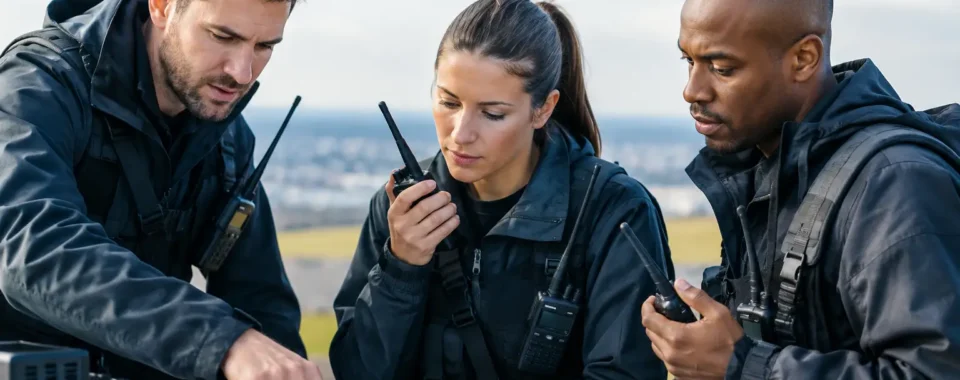

A radio interoperability planning guide should begin where communication failures actually happen: at the handoff between teams, sites, agencies, and technologies. A fleet may use DMR portables, a contractor may arrive with analog radios, and management may rely on Push-to-Talk over Cellular (PoC). If those groups need to coordinate during a busy shift or an emergency, simply having radios is not enough.
Interoperability is the ability for authorized users on different systems to communicate when the situation requires it. It does not always mean putting everyone on one channel. In many operations, the better design keeps normal communications separate and creates controlled paths for shared incidents, dispatch, safety, or mutual-aid traffic.
Start With the Operational Problem
Before selecting radios, repeaters, gateways, or applications, map the people who need to communicate and the circumstances that trigger cross-team coordination. This is more useful than starting with a brand, frequency band, or feature list.
Ask what needs to happen during a routine workday and what changes during an exception. A warehouse team may only need local communications most of the time, but require direct contact with security and delivery drivers after an accident. A construction manager may need separate work groups, then a common emergency channel for all trades. A regional service company may need field personnel in several states to reach dispatch immediately, even when they are far beyond local radio coverage.
Define the communications roles in plain language: who originates the call, who needs to hear it, who can respond, and who has authority to manage the channel. This prevents a common mistake: creating a shared talkgroup that becomes so busy or poorly governed that users stop relying on it.
Separate Daily Traffic From Incident Traffic
Routine operations benefit from focused channels or talkgroups. Incident traffic needs a preassigned path that can be activated quickly. Those needs compete with each other. Putting every department into one large group may seem simple, but it increases chatter, missed calls, and confusion.
A practical plan usually identifies routine workgroups, a dispatch or supervisor group, and one or more interoperable incident groups. The right number depends on team size, geography, and risk. A small venue may need one all-call option; a multi-site manufacturer may need site-specific incident groups plus a corporate coordination group.
Choose the Right Interoperability Method
The technology should follow the operating plan. There is no single approach that fits every organization.
Shared Channels or Talkgroups
The simplest method is a common channel or digital talkgroup available to all approved users. It works well when teams use compatible equipment and are in the same coverage area. For DMR systems, that may mean assigning a shared talkgroup and programming it consistently across authorized radios.
This approach is economical and easy to train, but it relies on compatible radios, correct programming, sufficient capacity, and good channel discipline. It also may not solve a situation where partners use different frequency bands or different radio standards.
Cross-Band and System Gateways
A gateway can connect otherwise separate radio systems, such as VHF, UHF, 700/800 MHz, analog, DMR, or dispatch console resources. It can be a strong fit for facilities, campuses, public safety support functions, industrial sites, and planned events where multiple organizations must coordinate.
Gateways add flexibility, but they also add design responsibility. Audio levels, signaling, priority behavior, delays, and failure modes need testing. A permanent bridge left open without a clear purpose can create feedback, tie up channels, or expose one group to traffic it does not need.
Push-to-Talk Over Cellular
PoC is often the most practical way to connect geographically dispersed teams. With nationwide cellular coverage and Wi-Fi support, users can communicate across cities, states, or an entire service territory without building a wide-area RF network. It is particularly useful for fleets, logistics, hospitality groups, remote supervisors, and organizations that need fast group calling across multiple locations.
PoC can also serve as an interoperability layer when local radio users need a managed connection to dispatch or remote leadership. The trade-off is dependence on cellular or Wi-Fi availability, account administration, and device management. Critical sites should assess carrier coverage indoors, in basements, around loading docks, and in rural travel corridors rather than assuming a coverage map tells the whole story.
Dedicated Infrastructure
A repeater, distributed antenna system, or engineered in-building coverage solution may be necessary when RF coverage inside a facility is weak or when the organization needs local control independent of public networks. This is often the right long-term answer for large campuses, industrial properties, mines, rural operations, and facilities with challenging construction materials.
Infrastructure requires capital investment, frequency coordination, licensing where applicable, preventive maintenance, and a plan for power loss. It can provide highly dependable local service, but it should be designed around measured coverage requirements, not assumptions.
Build a Radio Interoperability Planning Guide Around Talk Paths
A useful plan documents talk paths, not just equipment. A talk path is the complete route a call takes from one user to another. It may include a portable radio, repeater, gateway, dispatch console, PoC platform, and a receiving device hundreds of miles away.
For each shared communications function, document the initiating group, receiving group, technology used, normal operating status, activation authority, and backup method. For example, an emergency talkgroup may normally be monitored by supervisors but only bridged to an outside contractor network when the incident commander requests it.
This level of detail makes the plan usable under pressure. It also reveals weak points early. If a gateway requires a dispatch operator to activate it, the organization needs procedures for nights, weekends, and periods when that desk is unstaffed. If a PoC group is the backup path, users need to know whether their devices are charged, logged in, and assigned to the correct group.
Address Licensing, Security, and Governance
Interoperability can create regulatory and operational problems when it is treated as a technical shortcut. FCC licensing, frequency authorization, and permitted use matter for business radio systems. Do not assume that a partner’s licensed channel can be freely programmed into every radio or that a shared frequency is appropriate for every purpose.
Access control matters as well. Limit shared channels, gateway functions, and PoC groups to users with a defined role. Establish who can add users, change programming, create talkgroups, and authorize temporary communications bridges. These controls reduce accidental transmissions and make troubleshooting far easier.
Governance should also cover language. Decide what counts as emergency traffic, when plain language is required, when a supervisor takes control, and how teams confirm that a message was received. The technology cannot correct unclear procedures.
Test Under Real Conditions
A system is not interoperable because a bench test succeeded. Test it where and when people work: inside buildings, at the far edge of the property, in moving vehicles, during busy cellular periods, and with the actual users who will operate the equipment.
Your acceptance test should verify at least four things:
- Audio is understandable in both directions, including across any gateway or dispatch connection.
- Calls reach the intended groups without unintended users hearing sensitive operational traffic.
- Users can initiate the shared path quickly using controls they understand.
- The fallback method works when a repeater, gateway, cellular connection, or power source is unavailable.
Document the results, correct problems, and retest after programming changes. Scheduled exercises are equally valuable. A quarterly radio check may expose dead batteries, changed staffing, altered building layouts, expired accounts, or equipment that was moved without notice.
Plan for Failure, Not Just Normal Operations
Every interoperability design has limits. A local RF system can lose power or suffer coverage shadows. PoC can be affected by carrier outages or weak signal. A shared channel can become overloaded during a major incident. The answer is not necessarily more technology. It is a clear backup plan.
For some teams, that means a second local channel and spare batteries. For others, it means maintaining both local DMR coverage and PoC devices for wide-area coordination. High-risk operations may need backup power, alternate dispatch locations, redundant connectivity, and staged spare radios. The appropriate level depends on the consequence of a communications failure.
Make the backup method simple enough to use without searching through a manual. Label channels consistently, keep programming templates under change control, and train new personnel before they need the system during a difficult moment.
A well-designed interoperability plan gives each group the communications it needs without turning every radio into a source of noise. If your operation includes mixed radio technologies, multiple sites, or coverage challenges, a communications partner such as Cogent Radios Group can help turn field requirements into a tested, supportable system that your team can use with confidence.