

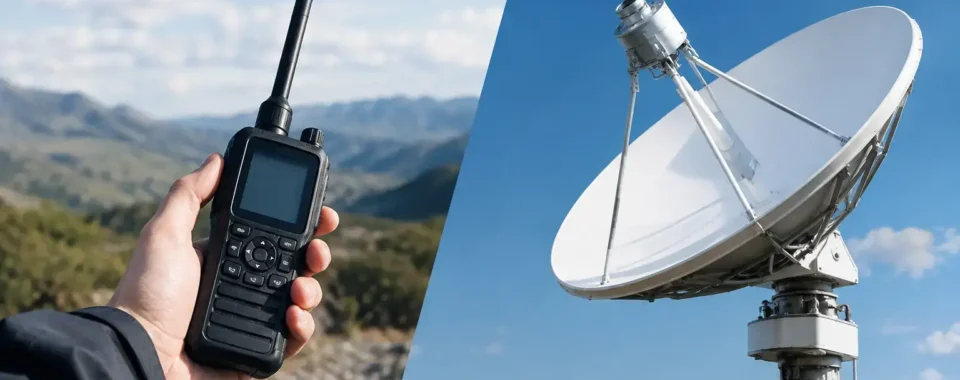

A crew can have excellent radios, trained operators, and a clear dispatch plan, then lose contact the moment it drives beyond cellular coverage. That is the practical question behind PoC versus satellite communication: not which technology sounds more advanced, but which one keeps your people talking where they actually work. For many organizations, Push-to-Talk over Cellular is the better daily operating tool. For others, satellite is the contingency layer that makes remote work possible.
The right answer depends on coverage, calling style, terrain, response expectations, and the cost of a communication failure. A fleet that spends 95% of its time on highways has different needs than a utility crew working beyond the edge of the cellular network.
What separates PoC from satellite communication?
PoC uses commercial cellular networks
Push-to-Talk over Cellular, often called PoC, sends voice over LTE, 5G, and Wi-Fi connections. A PoC radio looks and operates like a professional two-way radio: press the PTT button, select an individual or group, and speak. The difference is that its coverage is tied to the underlying data network rather than a local repeater or direct radio-to-radio range.
That gives PoC a major operational advantage for teams that travel. A dispatcher in one state can talk to drivers, supervisors, or field crews across a wide service area without building and maintaining a radio repeater network. Features such as GPS location, group management, call recording, messaging, and dispatch applications can also be integrated into one system.
PoC performance, however, is only as available as the cellular or Wi-Fi connection at the user’s location. Dead zones, overloaded networks, damaged towers, and remote terrain can all affect service. A professionally configured device and carrier plan can improve day-to-day results, but neither changes the basic coverage requirement.
Satellite communicates beyond the cellular footprint
Satellite communication connects a device to an orbiting satellite rather than a nearby cell site. It is built for places where cellular service is unavailable or unreliable: remote ranches, offshore work, backcountry operations, disaster zones, wilderness travel, and isolated job sites.
Satellite can take several forms. Satellite phones support voice calls, while satellite messengers may focus on location tracking, short messages, and emergency alerts. Satellite Push-to-Talk services are also available for certain operational uses. These services are not interchangeable. A small emergency communicator is valuable for a lone worker, but it is not necessarily a replacement for a fleetwide voice dispatch system.
Satellite devices generally need a reasonably open view of the sky. Deep canyons, dense tree cover, building interiors, parking structures, and urban corridors can block or weaken the satellite path. Voice quality, call setup time, and delay also vary by satellite network and device type.
PoC versus satellite communication at a glance
| Operational factor | PoC radio | Satellite communication | | — | — | — | | Primary coverage | Cellular and Wi-Fi service areas | Areas with a clear view of the satellite network | | Best calling style | Fast group calls, dispatch, and routine team coordination | Remote voice, check-ins, emergency contact, and remote PTT | | Typical user experience | Familiar two-way radio operation with near-immediate group access | Varies by device; may require antenna positioning or connection time | | Infrastructure burden | No private repeater system required | No local towers required, but service plans and device limitations apply | | Main limitation | Cannot operate where usable cellular or Wi-Fi is absent | Sky visibility, device cost, plan cost, and service-specific voice limitations |
The table is a starting point, not a final design. A satellite PTT platform may be the strongest choice for a team that truly operates outside cellular coverage every day. But for a regional contractor, PoC can deliver a more natural and economical workflow for the vast majority of calls.
When PoC is the practical choice
PoC is often the better fit when your staff works across cities, counties, or states but remains within usable cellular coverage. Transportation fleets, security teams, hospitality operations, event staff, field service companies, and multi-site businesses are common examples.
The operational benefit is not simply broad coverage. It is the ability to organize communications around the work. Dispatch can create talk groups for regions, shifts, departments, or incidents. A manager can contact one employee privately without interrupting an entire channel. New locations can be added without coordinating frequencies, repeater sites, or radio coverage studies for every property.
PoC also works well for organizations replacing smartphones used for informal group calling. A purpose-built PoC radio gives personnel a dedicated PTT control, louder audio, better accessory options, and a more controlled communication environment. Workers do not need to unlock a personal phone or search for the correct app while handling a delivery, directing traffic, or responding to a service call.
This does not mean PoC is automatically the best choice for every business with cellular coverage. Indoor coverage can be inconsistent in warehouses, hospitals, large concrete facilities, and basement areas. If your team needs dependable communication inside a specific facility, a DMR system, in-building radio coverage solution, or a mixed radio design may be more appropriate.
When satellite is worth the added cost
Satellite communication earns its place when being outside cellular coverage is normal, not occasional. Consider a survey crew moving through remote land, a natural resources team working in mountainous terrain, or a recovery operation after weather has damaged local infrastructure. In these environments, satellite may be the only practical path back to dispatch or emergency support.
It is also valuable as a continuity tool. A business may rely on PoC for regular communications while assigning satellite devices to supervisors, remote vehicles, or emergency response personnel. That approach avoids paying for satellite service across every user while ensuring key people can still report status and request help when terrestrial networks are unavailable.
The trade-off is that satellite communications require realistic expectations and training. Users need to know when and where to use the device, how to orient an antenna if needed, how to maintain a clear sky view, and what type of message or call the service supports. A device that stays in a truck console until an emergency is not a communication plan unless the team has practiced with it.
Coverage is only one decision factor
Match the system to the conversation
Start by looking at the calls your team makes every day. If dispatch needs to direct multiple crews quickly, change routes, and coordinate routine operations, PoC is usually more efficient. If employees mostly need periodic welfare checks or an emergency contact path from remote locations, satellite messaging or voice may be sufficient.
Ask whether everyone needs the same capability. A regional fleet may need PoC radios in every vehicle, while only the two vehicles assigned to remote work need satellite backup. Designing by job role is usually more cost-effective than issuing identical devices to every employee.
Consider total operating cost
PoC costs commonly include the radio, accessories, cellular service, and platform subscription. Satellite costs can include higher device prices, airtime plans, activation fees, and charges based on minutes, messages, or data use. The least expensive monthly plan is not necessarily the best value if it does not support the calling pattern your staff needs.
Also account for administration. A communication system should make it easy to add users, update talk groups, replace devices, and support employees in the field. The value of a professional-grade system includes the time it saves dispatchers and supervisors during normal operations.
Plan for failure modes
No communication technology is immune to failure. Cellular networks can be congested or unavailable. Satellite signals can be obstructed. Batteries go dead, accessories fail, and users sometimes select the wrong channel or group.
For mission-critical teams, the strongest approach is often layered communications. Use PoC for normal wide-area coordination, satellite for remote or disaster backup, and local licensed radio where direct on-site communication is essential. The goal is not to buy every technology. It is to remove the specific single point of failure that could stop your operation.
Build the system around your real coverage map
Before selecting equipment, review where employees spend their time, not just where your office is located. Identify known cellular dead zones, indoor trouble areas, mountain routes, remote job sites, and locations where crews may need help after hours. Then test candidate devices in those places with real users, vehicles, headsets, and work conditions.
Cogent Radios Group can help organizations evaluate the practical mix of PoC, conventional business radio, and satellite options instead of forcing one technology into every situation. The best system is the one your team can operate confidently when the workday gets difficult – not the one with the longest feature list.