
A radio that works perfectly in the parking lot can fail at the loading dock, behind a concrete stairwell, or five miles into a rural worksite. Knowing how to test radio coverage before issuing radios to a crew prevents missed calls, repeated transmissions, and the operational delays that follow.
The right test is more than looking at signal bars. You need to verify whether real people can hear and understand each other at the places where they actually work, including the locations that are hardest to reach. That process differs slightly for conventional two-way radio, repeater systems, and Push-to-Talk over Cellular (PoC), but the goal is the same: dependable voice communication when it matters.
How to Test Radio Coverage in Real Operating Conditions
Start by defining the communication area, not just the property line. A warehouse may include dock doors, aisles, cold storage, mechanical rooms, offices, and outdoor staging areas. A transportation operation may need coverage inside vehicles, at customer sites, through dispatch, and along common routes. An event team may need reliable communication from the entrance to back-of-house areas and parking.
Mark these areas on a simple site plan or map. Include routine work locations, known trouble spots, emergency egress routes, and places where staff may work alone. If your system supports a repeater or PoC dispatch group, include the office or dispatch position as a test point too.
Test during normal operations whenever possible. A quiet, empty building does not behave exactly like a facility full of people, vehicles, equipment, stacked inventory, and active machinery. Metal shelving, concrete walls, elevators, refrigeration equipment, and terrain can all affect RF performance. Cellular conditions for PoC radios can also change with network loading and building occupancy.
Use the Same Radios, Accessories, and Settings Your Team Will Use
Coverage testing is only useful when the test setup matches the final deployment. Use the intended radio model, approved antennas, batteries, speaker microphones, earpieces, and vehicle installations. A radio held at shoulder height may perform differently than one clipped low on a belt or mounted inside a vehicle.
Confirm that every test radio is programmed correctly before you begin. For conventional radio systems, verify the channel, frequency, power level, bandwidth, color code or PL/DPL setting, and repeater parameters. For PoC radios, confirm the correct talkgroup, active SIM or network connection, account permissions, and dispatch configuration.
Keep battery condition in mind. Low batteries can reduce transmit performance or cause inconsistent operation that looks like a coverage problem. For a fair test, begin with fully charged equipment.
Build a Simple Radio Coverage Test Plan
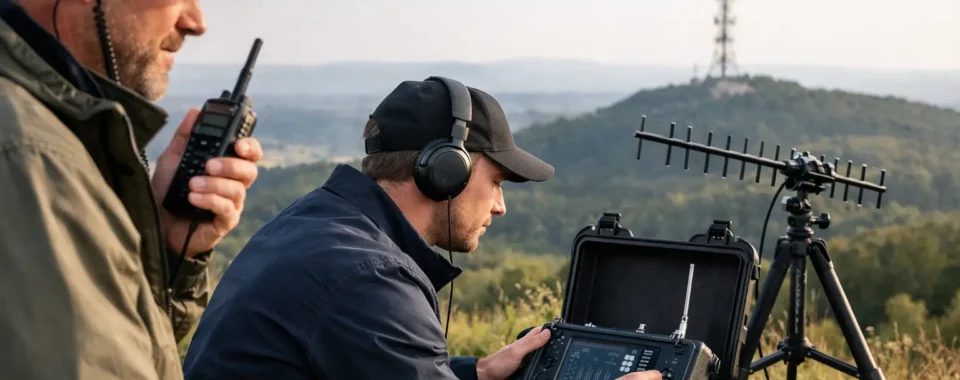
A structured test plan makes results easier to compare and act on. Assign one person to remain at a base point or dispatch position and another to move through the defined test locations. If the operation is large, use multiple testers and record results consistently.
At each point, conduct a short two-way voice exchange. The mobile tester should identify the location, transmit a standard phrase, and wait for a reply. The base tester should repeat the same process back. Testing both directions matters because radio paths are not always equal. A portable radio inside a steel-sided building may hear a repeater well but have trouble reaching it on transmit.
Use a consistent voice test phrase such as: “Coverage test, north loading dock, radio check one-two-three-four-five.” Avoid long conversations. Short, repeatable transmissions make it easier to identify clipping, distortion, delay, or dropped audio.
Record the result for each location. A basic scoring scale works well:
- 5: Loud, clear, and immediately understandable
- 4: Clear with slight noise or occasional repeat needed
- 3: Understandable but unreliable for critical use
- 2: Broken or heavily distorted audio
- 1: No usable communication
Also note the direction of the issue. Was the mobile user unable to hear dispatch? Could dispatch hear the mobile user only intermittently? Did audio begin late or cut off before the message ended? These details point toward different solutions.
Measure What Users Actually Experience
Signal strength is useful, but it is not the final answer. A strong received signal can still produce poor audio if there is interference, a programming mismatch, network congestion, or a problem with the equipment. Conversely, a low signal reading may still produce understandable voice in some conditions.
For conventional analog or DMR systems, experienced technicians may measure received signal strength, noise, bit error rate, and other RF values with appropriate test equipment. Those measurements help diagnose a system, especially when planning a repeater, antenna system, or distributed coverage solution. Field voice testing remains essential because it shows whether the system works for the person using it.
For PoC radios, verify several things at each location: network availability, time from pressing PTT to talk permission, audio quality, talkgroup delivery, and whether calls complete consistently. PoC coverage is based on cellular or Wi-Fi connectivity, so it may be excellent across a wide region while remaining weak in a basement, remote canyon, metal building, or hardened interior room.
Do not judge PoC service solely by the network indicator. Send and receive actual group calls. Check whether a call reaches all intended users, whether audio is delayed, and whether the device reconnects properly after moving through a weak-signal area.
Test the Conditions That Create Problems
A coverage test should include more than standing still in open areas. Have users perform realistic movements and tasks. Walk between aisles, enter vehicles, close doors, move from outdoors to indoors, and test from the operator positions where calls are made.
For fleet and field operations, test vehicles with engines running and equipment operating. For construction, agriculture, and industrial sites, test at the far edge of the work area, near heavy equipment, and behind terrain or structures that may block the signal path. For hospitality and event operations, test kitchens, service corridors, underground parking, stairwells, and crowded spaces.
Pay special attention to emergency scenarios. If a team member falls, encounters a safety issue, or needs immediate assistance, where are they likely to be standing? Those locations deserve the highest coverage standard. A marginal signal may be acceptable for a noncritical update, but it is not acceptable for a lone-worker or safety channel.
Interpret Weak Areas Before Buying More Equipment
A weak area does not always mean you need more radios. First, identify the type of failure. If every radio has trouble in one part of a building, the issue is likely coverage. If only one radio performs poorly, inspect its antenna, battery, programming, and physical condition. If users hear each other but cannot access a repeater reliably, an antenna, feedline, repeater location, or transmit-power issue may be involved.
For conventional two-way radio, possible improvements include repositioning a base or repeater antenna, increasing antenna height, improving feedline quality, adding a properly engineered repeater, or using a distributed antenna system. The best option depends on the frequency band, terrain, facility construction, licensing, and required reliability. More transmit power alone is rarely a complete answer.
For PoC radios, options may include choosing a carrier configuration that performs better in the area, using Wi-Fi where appropriate, improving indoor cellular service, changing device placement, or creating operational procedures for known dead zones. PoC can provide wide-area communication without building a radio network, but it still depends on available data coverage.
Any changes to licensed business radio frequencies, repeater systems, or antenna installations should be planned with applicable FCC requirements in mind. A coverage problem should not be solved by changing frequencies or increasing power without confirming that the system remains properly authorized and engineered.
Retest and Document the Final Coverage Map
After making a change, repeat the same test route and compare the results. A useful final coverage map identifies areas as reliable, acceptable with limitations, or not dependable. Share that information with supervisors and users. If there is a known weak location, the team should know it before a routine call becomes an urgent one.
Coverage is not a one-time acceptance test. Recheck it after a facility expansion, a new warehouse rack layout, a repeater move, major construction, or a change in cellular service. Periodic testing also catches aging batteries, damaged antennas, and programming drift before they disrupt operations.
The practical standard is simple: test where the work happens, test the way people actually use the radios, and treat marginal locations as a design decision rather than a surprise. A well-documented field test gives your team a clear basis for improving the system before communication is put to the test.