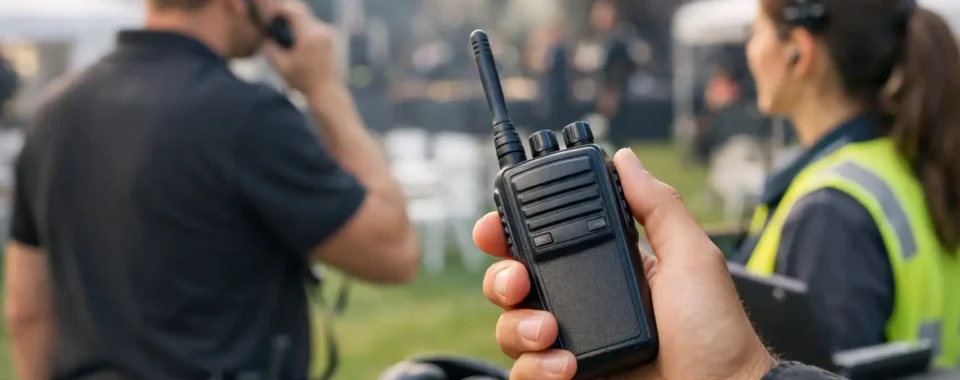

When the head of security needs parking redirected, guest services needs a wheelchair at Gate C, and production is calling for stage access at the same time, phones start to show their limits fast. That is exactly why two way radios for events remain one of the most dependable tools for keeping staff coordinated, responsive, and calm when things get busy.
Events create a communication environment that looks simple on paper and messy in real life. Teams are spread across entrances, loading areas, staging zones, concessions, VIP sections, shuttle routes, and temporary offices. Some staff members need constant communication. Others only need occasional updates. The right radio setup keeps all of that organized without forcing people to stop and dial, wait for someone to answer, or fight weak cell coverage in a crowded venue.
Why two way radios for events still beat phones
Most event teams already carry smartphones, so it is fair to ask why radios are still worth adding. The answer usually comes down to speed, group coordination, and predictability.
A radio call reaches the whole team or a specific group instantly. There is no need to create a group text, check whether someone saw it, or repeat instructions to five different people. In a live event environment, that time matters. A parking backup, medical issue, credential problem, or stage timing change can affect multiple departments in seconds.
There is also the issue of network congestion. At public events, especially concerts, festivals, sporting events, fairs, and conferences, cellular networks can slow down when thousands of attendees are using them at once. Radios do not depend on that same call-and-text workflow. Depending on the system, they either communicate directly over radio frequencies or use managed Push-to-Talk over Cellular service designed specifically for fast voice communications.
That does not mean radios are always the answer in the same way for every event. It depends on the venue, the footprint, the number of teams involved, and whether you need local coverage, nationwide reach, or both.
Start with the event environment
The biggest mistake event planners make is choosing radios based on a marketing range claim instead of the actual working environment. An open fairground behaves very differently than a hotel, convention center, stadium, warehouse venue, or downtown street festival.
In a small indoor venue, a compact business radio may be all you need. In a concrete building with multiple floors, service corridors, loading docks, and stairwells, signal performance becomes more complicated. In a large outdoor event spread across parking, camping, vendor rows, and shuttle staging, distance becomes the issue. If your event team is operating across several sites or moving between cities, Push-to-Talk over Cellular may make more sense than a traditional local radio system.
This is where an experienced communications provider can save you time and money. A system that works perfectly for a hotel banquet team may fail at a motorsports event, and a radio package built for a music festival may be more than a corporate conference actually needs.
Indoor venues
Indoor events usually challenge radios with building materials, not just distance. Concrete, steel, elevators, basements, and back-of-house utility spaces can weaken coverage. If the venue is large or has known dead spots, a business-grade DMR setup may need a repeater, or a PoC solution may perform better if the site has strong cellular data coverage.
Outdoor venues
Outdoor events often look easier because there are fewer physical barriers, but they introduce other problems. Long distances, temporary structures, parking overflow, weather exposure, and moving teams all affect communications. Battery life also matters more because staff may be away from charging locations for an entire shift.
The main radio options for event operations
There is no single best radio category for every event. The right fit comes from matching the system to the operation.
Business DMR radios
DMR radios are a strong choice for many event teams because they offer clear digital audio, dependable local communications, and good control over channels and user groups. They work well for venues, security teams, hospitality staff, maintenance, parking crews, and production support when everyone is operating in the same general area.
They are especially useful when you want dedicated communications that do not rely on public cellular service. The trade-off is coverage planning. If the venue is too large or too complex for direct radio-to-radio use, you may need a repeater or a more engineered system.
Push-to-Talk over Cellular radios
PoC radios are ideal when events span wide areas, multiple sites, or teams on the move. Because they operate over cellular data networks, they can provide very broad coverage without requiring local repeater infrastructure at every site. For regional event companies, transportation teams, and mobile supervisors, that flexibility is hard to ignore.
The trade-off is that PoC performance depends on quality network coverage and service planning. In many cases it works extremely well, but it should still be evaluated against the actual venue conditions and operating goals.
License-free radios
FRS or other license-free options can work for very small, low-risk events with short-range communication needs. They are easy to hand out and simple to use. The problem is that they are often not the best fit for professional operations where audio quality, battery life, channel control, and durability matter.
If the event has security responsibilities, active logistics, heavy guest traffic, or any chance of communication failure creating operational problems, business-grade equipment is usually the better choice.
What event coordinators should evaluate before buying or renting
Coverage comes first, but it is not the only factor. Good event communications depend on how the radios fit the workflow.
Team structure matters. If security, parking, medical, facilities, and guest services all share one channel, traffic gets messy fast. You may need separate talk groups, supervisor channels, or an all-call function for urgent coordination. The more moving parts an event has, the more channel planning matters.
Audio quality matters just as much. Events are noisy. Music, crowds, generators, traffic, and wind can make weak audio almost useless. Speaker microphones, earpieces, noise reduction, and enough volume for real-world use are not extras. They are part of the solution.
Battery life should be evaluated against actual shift length, not brochure claims. A radio that lasts eight hours in light use may not last through a twelve-hour event day with constant traffic. Spare batteries, rapid chargers, and charging discipline can make a major difference.
Durability is another area where event buyers sometimes cut corners. Radios get dropped, clipped onto belts, used in the rain, left in golf carts, and handed from one crew to another. If you are managing recurring events, commercial-grade equipment usually pays off over time.
Don’t overlook compliance and coordination
For business radio systems, licensing and frequency coordination can matter. That is especially true if you are using professional UHF or VHF equipment in a busy metro area or at venues with existing communications systems. Interference, poor channel planning, or unlicensed operation can create avoidable headaches.
This is one reason many organizations work with a supplier that understands FCC licensing, repeater planning, and business radio deployment rather than trying to piece a system together from consumer gear. The radio itself is only part of the job. The programming, setup, accessories, and support all affect whether the system helps or creates more work.
Renting versus owning two way radios for events
If you run one large annual event, renting may make sense. It reduces upfront cost and lets you scale for a specific weekend or venue. Renting is also useful if your communication needs change significantly from one event to the next.
Owning is often the better move for venues, event companies, churches, schools, fairgrounds, and hospitality groups that use radios regularly. You get familiar equipment, consistent programming, and a team that knows how to use it without retraining every time.
There is also a middle ground. Some organizations own a core fleet for daily operations and add rental units during major events. That approach often gives the best balance of cost control and flexibility.
A better way to plan your event radio setup
If you are evaluating radios for an event, start with a few practical questions. How large is the footprint? Are teams indoors, outdoors, or both? How many distinct departments need to talk? Will users stay on one site or move across a city or region? Do you need discreet earpieces for front-of-house staff, louder speaker mics for parking and security, or both?
Once those answers are clear, the right radio category becomes much easier to identify. For some events, a straightforward DMR handheld solution is the right call. For others, PoC radios provide far better flexibility. And for high-demand environments, a mixed approach can make sense.
At Cogent Radios Group, this is where experience tends to matter most. The equipment matters, but the real value comes from choosing a system that fits the event instead of forcing the event to work around the system.
The best event communication setup is usually the one nobody talks about during the show – because every message gets through, every team knows where to go, and the day keeps moving.