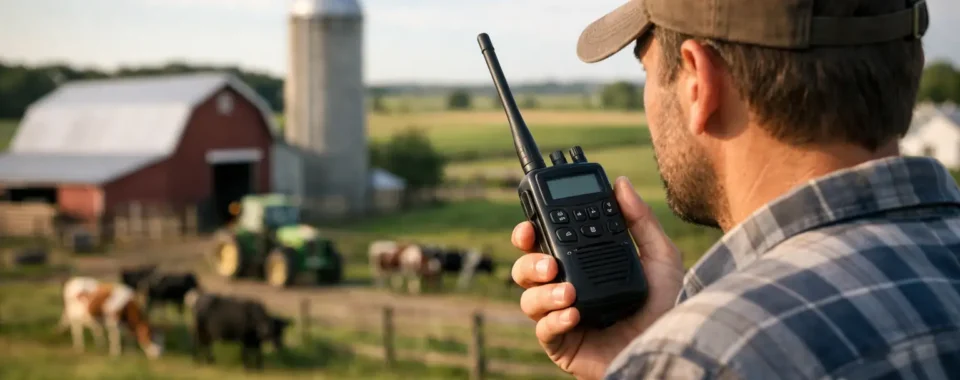

When a tractor is two fields over, a feed delivery is running late, and someone spots a gate down near the back pasture, missed communication turns into lost time fast. Farm radios for rural communication are still one of the most practical tools for keeping crews connected across large properties where cell coverage can be inconsistent, noisy equipment is constant, and quick coordination matters.
Why farm radios still matter in rural operations
A working farm does not run from one building. It stretches across barns, machine sheds, grain bins, access roads, irrigation points, livestock areas, and miles of open ground. That creates a communication problem that smartphones do not always solve well. Calls ring out, batteries drain, group calling is clumsy, and relying on one carrier can leave dead spots exactly where work is happening.
Two-way radio gives you instant voice communication without dialing, waiting for a call to connect, or passing messages through multiple people. For farm owners and operations managers, that speed is not just convenient. It helps with dispatching equipment, moving labor where it is needed, checking in on solo workers, and reducing delays during planting, harvest, and livestock care.
The other reason radios remain relevant is simplicity. A seasonal worker can learn basic push-to-talk use in minutes. During a busy day, that matters more than fancy features. The best systems are the ones people will actually use without hesitation.
Choosing farm radios for rural communication
The right radio setup depends on acreage, terrain, building construction, workforce size, and whether your team stays on one property or travels between sites. There is no single best radio for every farm. There is a best fit for how your operation works.
FRS and GMRS for light-duty use
For small properties or family use, FRS and GMRS can be a reasonable starting point. These radios are simple, widely recognized, and useful for short-range communication around a home site, small acreage, or during events like moving equipment between nearby buildings.
That said, range claims on consumer packaging are often optimistic. Trees, rolling ground, metal buildings, and machinery all affect performance. GMRS can offer more capability than FRS, especially with higher power and repeater options, but it also comes with licensing requirements. For a farm that needs dependable business use every day, these radios may feel limited once the operation gets larger or more complex.
MURS for straightforward on-site coverage
MURS is another option that fits certain rural users well. It can work nicely for local, short-range communication without some of the complexity of business-band systems. On modest properties with a small crew, MURS can be a practical middle ground.
The trade-off is scalability. If your operation grows, adds more users, or needs stronger building penetration and better system planning, MURS may not give you enough room to expand.
DMR business radios for demanding farm use
For many agricultural operations, DMR business radios are where communication starts to feel truly dependable. These radios are built for commercial use, not casual weekend use. They tend to offer better audio, better durability, stronger battery performance, and more controlled system design.
On a farm, that means clearer communication in cab noise, more reliable use during long shifts, and the ability to support larger teams with more structure. You can separate traffic by workgroup, use accessories like speaker mics and headsets, and in some cases build coverage with a repeater if the property is large enough to need it.
DMR also makes sense when farms want a communication tool that can grow with the operation. If you are coordinating shop staff, truck drivers, applicators, irrigation crews, and livestock personnel, a business-class radio system usually pays off in fewer communication breakdowns.
Push-to-Talk over Cellular for wide-area operations
Some farms are not just large. They are spread out across multiple parcels, towns, or counties. In that case, Push-to-Talk over Cellular can be a strong option. PoC radios use cellular data networks to provide wide-area communication, often far beyond what a conventional local radio system can cover on its own.
This is especially useful for operations with mobile supervisors, agronomy staff, field service vehicles, or drivers moving between distant sites. You get the familiar push-to-talk workflow, but with much broader reach where cellular service is available.
The obvious trade-off is dependence on the carrier network. If a specific area has poor cellular performance, PoC will reflect that. For some farms, a hybrid approach works best – business radios for local on-property coverage and PoC for managers or crews working across a wider footprint.
What matters most in a farm radio system
Range gets the most attention, but it is only one part of the decision. In real farm use, audio clarity, battery life, durability, and ease of use matter just as much.
Audio quality is critical because farm work is loud. Diesel engines, combines, dryers, fans, and wind can drown out weak speakers and poor microphones. Radios with strong audio output and noise-handling accessories are often worth the extra cost.
Battery life matters because farm days are long. A radio that performs well for four hours is not enough during planting or harvest. Commercial-grade batteries and charging plans make a real difference.
Durability is another area where cheap radios usually disappoint. Dust, moisture, drops, vibration, and temperature swings are normal farm conditions. A radio used around grain, livestock, mud, and equipment needs to be built for field work, not just occasional use.
Then there is usability. Complicated menus and too many channels can create confusion, especially with part-time or seasonal labor. A well-programmed radio system should feel simple from the user side, even if the system behind it is thoughtfully designed.
Coverage on farms is rarely as simple as “open land”
People often assume farms are easy radio environments because they have wide-open spaces. Sometimes they are. Often they are not.
Machine sheds, grain bins, metal barns, rolling terrain, tree lines, and distance between work areas can all reduce handheld performance. A crew member inside a steel building may have a very different coverage experience from someone in an open field. The same goes for workers near drainage areas, wooded boundaries, or remote outbuildings.
That is why a real coverage assessment matters. You may need mobile radios in vehicles, higher-gain antennas, or a repeater system to cover the entire property consistently. In some cases, the best answer is not a more powerful handheld. It is a better system design.
Licensing, compliance, and getting it right the first time
Rural users are often focused on practical results, which makes sense. But licensing and compliance still matter, especially for business-band systems and GMRS use. The wrong setup can lead to interference, limited performance, or avoidable headaches later.
This is where working with an experienced radio provider helps. Proper frequency coordination, FCC licensing support where needed, programming, and equipment matching are not just paperwork issues. They affect whether the system performs well when the workload is heavy.
A farm should not have to guess its way through channel planning, antenna placement, or repeater decisions. Good guidance saves money by preventing underbuilt systems on one hand and unnecessary overspending on the other.
A practical way to decide
If you are choosing radios for a farm, start with the work, not the product category. Ask how many people need to talk, where they work, how far apart they get, what buildings or terrain interfere, and whether communication stays local or spreads across multiple service areas.
A small family operation may do fine with a simpler license-free or entry-level option. A larger agricultural business with crews, vehicles, and multiple work zones will usually benefit from business-class DMR. A geographically dispersed operation may lean toward PoC, or combine PoC with local radios for the best of both worlds.
The best farm radio system is not the one with the longest advertised range. It is the one that fits your property, your crew, and your daily workflow without adding friction.
For farms that depend on timing, safety, and coordination, communication equipment should be treated like any other critical tool. You expect your trucks to start and your equipment to run. Your radios should meet the same standard, especially on the days when everything depends on quick answers and clear direction.
If your current setup leaves people repeating themselves, missing calls, or relying on luck in dead spots, that is usually a sign the system has been outgrown. A well-matched radio solution brings order back to the workday, and on a farm, that kind of reliability tends to pay for itself quietly, one smoother day at a time.