
A driver who misses a route change, a loader who cannot reach the yard, or a supervisor forced to use personal phones is more than a daily inconvenience. It creates delays, safety concerns, and avoidable confusion. This fleet communication system guide focuses on building a practical voice communication setup that fits how your crews actually work – on the road, at a jobsite, in a warehouse, or across several states.
For most fleet managers, the best system is not the one with the longest feature sheet. It is the one that gives the right people a clear way to reach each other, holds up to field use, and continues working where the team needs it most.
Start the Fleet Communication System Guide With Workflow
Before choosing a radio model or monthly service plan, map the communication paths your operation relies on. A local delivery fleet may need drivers to speak with dispatch and the loading dock. A construction fleet may need separate groups for equipment operators, safety personnel, and supervisors. A regional service company may need crews in multiple cities to communicate with one dispatch office.
The first question is not, “What radio should we buy?” It is, “Who needs to talk to whom, and where?” That answer determines whether you need one shared talk group, multiple department channels, private one-to-one calls, GPS-based location visibility, or a combination of all four.
Also consider the pace of the work. If messages are short and frequent, push-to-talk voice is usually faster and safer than asking employees to stop and type. If dispatchers need to send job details, photos, or route updates, the system should support those functions without making the handheld device difficult to use.
A useful planning conversation should cover these operational details:
- Where vehicles travel, including known cellular dead zones and remote job locations.
- How many users need to communicate at the busiest time, not simply how many employees are on payroll.
- Which teams need open group calling and which communications should remain private.
- Whether dispatch needs vehicle location, message records, emergency alerts, or lone-worker capabilities.
- What happens when a radio is damaged, lost, uncharged, or assigned to a new employee.
These details prevent a common mistake: selecting equipment first, then trying to force the workflow around it.
Choose the Right Radio Technology
Fleet communications generally fall into three practical categories: Push-to-Talk over Cellular, conventional or digital two-way radio, and hybrid systems that use more than one method. Each can be the right choice depending on coverage, budget, operational risk, and the size of the service area.
Push-to-Talk Over Cellular for Wide-Area Fleets
Push-to-Talk over Cellular, often called PoC, uses cellular data networks and Wi-Fi to provide radio-style communication over a wide area. A driver in one city can speak to dispatch in another state by pressing a single button. Teams can be organized into talk groups, and many platforms offer GPS location, messaging, geofencing, dispatch consoles, and emergency functions.
PoC is often a strong fit for delivery companies, mobile service fleets, security teams, event operations, and companies with crews spread across the United States. It avoids the need to build and maintain a private radio repeater network for broad coverage.
The trade-off is straightforward: PoC depends on available cellular or Wi-Fi coverage. It can provide excellent reach in populated areas and along major travel corridors, but it is not the right standalone answer for every remote ranch, mine, mountainous route, or isolated industrial site. A coverage review should be part of the decision, especially when a missed call can affect safety or production.
DMR and Conventional Two-Way Radio for Local Control
Digital Mobile Radio, or DMR, is a professional two-way radio technology commonly used for local operations. It can operate directly between radios over short distances or through repeaters to extend coverage across a facility, campus, community, or operating area.
For warehouses, manufacturing plants, large properties, construction projects, and local fleets, DMR can deliver immediate push-to-talk communication without relying on a public cellular network. Properly designed systems can include licensed business frequencies, repeaters, antenna systems, and features such as individual calling, emergency alerts, and text messaging.
The trade-off is coverage planning and infrastructure. A single handheld radio cannot overcome steel structures, hills, concrete walls, or distance by itself. If reliable communication is needed throughout a large property, the system may require an onsite repeater, carefully placed antennas, and an FCC licensing plan. That investment can be worthwhile when local reliability and control matter more than nationwide reach.
Hybrid Systems for Higher-Risk Operations
Some fleets should not rely on only one path of communication. A utility contractor might use PoC for regional coordination while keeping DMR radios for a remote work zone. A transportation company may use vehicle-mounted radios at a yard and PoC handhelds for interstate drivers.
This approach costs more to plan and support, but it can reduce exposure to a single coverage failure. The right choice depends on the consequence of lost communication. For a routine scheduling update, a delayed call may be manageable. For a crew working around heavy equipment, road hazards, or remote locations, redundancy deserves serious consideration.
Design Talk Groups Around Real Decisions
Talk groups should reflect how decisions happen in the field. One all-company channel sounds simple, but it becomes noisy as a fleet grows. Drivers miss important messages when route updates, maintenance requests, customer arrivals, and supervisor conversations all compete for the same airtime.
A better design might provide a dispatch group for all drivers, separate groups for regions or shifts, a maintenance group, and a supervisor group. Dispatch can still reach the entire fleet when necessary, but day-to-day traffic stays focused.
Avoid creating too many groups, though. If employees must scroll through a long menu to find the correct channel, they will default to the easiest option or use personal phones. Labels should be plain and recognizable, such as “North Dispatch,” “Yard,” or “Service West,” rather than technical channel names that only an administrator understands.
Emergency calling needs its own design. Decide who receives an emergency alert, what location information is available, whether the device emits an audible alarm, and how supervisors are expected to respond. A red emergency button is useful only when the organization has a clear process behind it.
Select Devices for the Job, Not the Desk
A fleet radio needs to survive the environment where it will be used. Drivers may need a compact handheld with a loud speaker, glove-friendly controls, a vehicle charger, and a remote speaker microphone. Forklift operators may need a belt-worn device that stays secure while moving. Outdoor crews may need water and dust resistance, high-capacity batteries, and accessories that work with hearing protection.
Do not overlook audio. Poor audio quality causes repeated transmissions, which wastes time and encourages employees to abandon the system. Test radios in vehicle cabs, near running machinery, outdoors in wind, and inside the noisiest part of your facility. A radio that sounds clear in an office may be difficult to hear at a loading dock.
Battery management deserves the same attention. Establish where radios are charged, who checks spare batteries, and whether each device is assigned to an individual or shared between shifts. For vehicle-based fleets, installed charging solutions reduce the chance that a driver starts a shift with a nearly empty radio.
Give Dispatch the Tools to Manage the Fleet
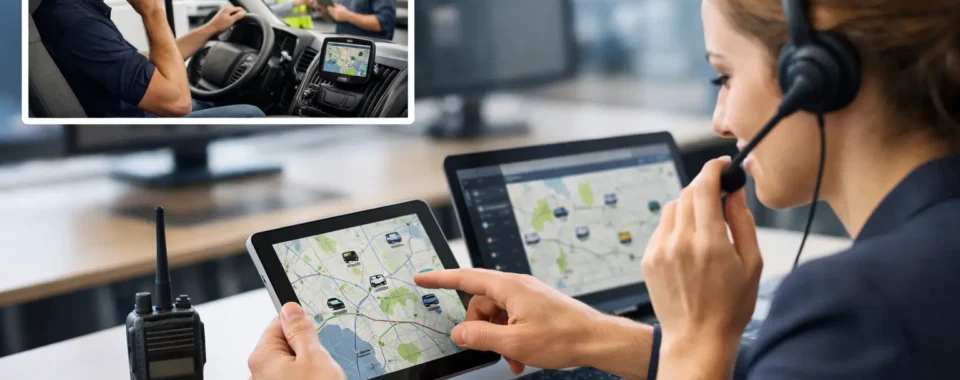
The radios are only one part of the system. Dispatchers need a practical way to monitor and direct work without becoming overwhelmed by technology. A dispatch console can display talk groups, individual users, and locations while allowing office staff to communicate from a computer or dedicated console.
GPS can be valuable for confirming a driver’s proximity to a job, supporting safety checks, and improving route coordination. It should be configured with a purpose, not added simply because it is available. Clear company policies help employees understand when location is collected and how it is used.
Consider whether your operation needs recorded communications. Recording can help with incident review, training, customer disputes, and documentation, but it also creates retention and privacy responsibilities. Discuss those requirements with company leadership before turning the feature on.
Plan Coverage, Licensing, and Support Before Deployment
A communication system is only as dependable as its coverage design and ongoing support. For PoC, test the places your vehicles routinely travel, including warehouses, basements, rural routes, and customer sites. For DMR systems, conduct a coverage assessment and determine whether radios will operate simplex, through an existing repeater, or through new infrastructure.
Commercial radio frequencies may require FCC licensing, coordination, and correct system programming. This is not paperwork to postpone until after the radios arrive. Licensing affects what frequencies can be used, where the system can operate, and how interference risks are managed.
Deployment should include programming standards, user training, a written channel plan, charging procedures, and an escalation path for device problems. A short hands-on training session is usually more effective than handing out radios with a quick verbal explanation. Employees should practice changing talk groups, making an emergency call, charging the device, and reporting a problem.
Cogent Radios Group helps organizations match PoC, DMR, infrastructure, and licensing requirements to real field conditions, rather than treating fleet communication as a one-size-fits-all equipment purchase.
The most useful system will feel uncomplicated to the person holding the radio. When a driver can reach dispatch with one press, a supervisor can coordinate a change quickly, and the team knows what to do when coverage or equipment fails, communication becomes part of the operation instead of another problem to manage.