
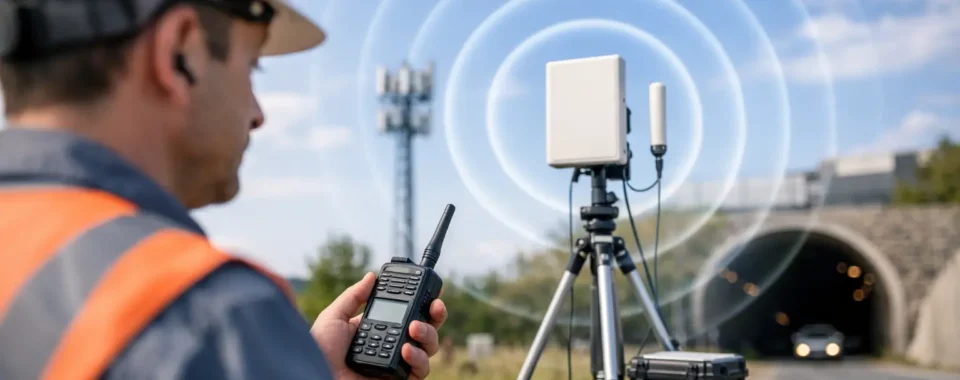

A driver loses contact behind a warehouse. A maintenance technician cannot reach dispatch from the lower level of a hospital. An event team has clear communications at the main gate but nothing on the far side of the grounds. These are not minor inconveniences when work depends on fast decisions. Effective radio dead zone solutions begin by identifying why coverage fails in that particular location, then matching the system to the work being done.
A stronger radio is not always the answer. Dead zones can be caused by terrain, building materials, antenna placement, radio programming, distance from the repeater, or a network limitation. The right fix may be a properly placed repeater, an outdoor antenna system, a different radio band, or Push-to-Talk over Cellular (PoC). The practical answer depends on the site, the users, and how much failure the operation can tolerate.
Start by defining the dead zone
A dead zone is any area where a user cannot reliably send or receive a usable transmission. That definition matters because intermittent coverage can be just as disruptive as no coverage. A radio that works only when a user stands near a window or holds it at a certain angle is not dependable field communication.
Before selecting equipment, map the problem. Ask where communications fail, whether the issue affects transmitting, receiving, or both, and whether it happens at all times of day. Note the radio model, channel, user location, and condition of the signal. A coverage issue affecting every radio in one loading area points to the environment. If only a few units struggle, programming, antennas, batteries, or damaged equipment may be the cause.
For businesses, it is also useful to separate routine inconvenience from mission-critical exposure. A weak signal in a rarely used storage room may call for a simple procedural workaround. A gap along a fleet route, at a school campus emergency exit, or within a plant safety area deserves a system-level correction.
Why radio coverage disappears
Radio frequency signals do not behave the same way in every setting. VHF can travel well over open terrain but may be less effective inside dense steel-and-concrete structures. UHF often performs better around buildings and in urban areas, but its range can still be limited by terrain and obstructions. Neither band is automatically best without understanding the site.
Metal-sided warehouses, elevator shafts, reinforced concrete, low-e glass, underground rooms, hills, heavy tree cover, and large equipment can all weaken or block radio signals. A facility can have excellent coverage in one aisle and poor coverage two aisles away because rack storage and machinery change the signal path.
Antenna height is another common factor. A base antenna mounted too low, too close to metal, or positioned on the wrong side of a building may leave predictable shadow areas. In mobile systems, antenna quality and installation matter as much as the radio itself. A poorly grounded or poorly located vehicle antenna can reduce the useful range of an otherwise capable mobile radio.
Finally, do not overlook system design. Direct radio-to-radio operation has limits. If users are spread across several buildings, large acreage, or hilly roads, simplex communications may simply be the wrong architecture.
Radio dead zone solutions for common operations
The best solution should improve the communication path rather than merely add power. Here are the most common approaches and where they make sense.
Improve the antenna system
An antenna upgrade is often the most efficient first step when the existing system is fundamentally sound. Raising a fixed antenna, moving it to a clearer location, using appropriate low-loss coaxial cable, and selecting an antenna designed for the operating band can make a meaningful difference.
For a fleet, a correctly installed external mobile antenna will generally outperform a handheld radio used inside the cab. For a building-based team, an elevated outdoor antenna connected to a base station or repeater can extend useful coverage far beyond an indoor desktop setup.
There are trade-offs. Long cable runs create signal loss, and higher antenna locations may require structural review, lightning protection, grounding, and professional installation. The goal is not simply to mount an antenna as high as possible. It is to create the clearest practical path between users and the system.
Add a repeater for local radio coverage
A repeater receives a radio transmission and retransmits it from a better location, extending coverage across a property, campus, municipality, or service territory. It is a proven answer for teams that need instant, independent communications without relying on public cellular networks.
A properly designed DMR repeater system can give operations separate talk groups, clearer coverage management, and room to grow. It can be a strong fit for construction sites, manufacturing facilities, farms, schools, hospitality properties, security teams, and local fleets. GMRS repeaters may also serve eligible users and community groups, subject to applicable FCC rules and licensing requirements.
Repeater performance depends heavily on location, antenna height, frequency coordination, filtering, and coverage testing. A repeater installed in the same poor-signal area will not solve the underlying problem. In commercial deployments, FCC licensing and frequency coordination should be addressed early, not after equipment is purchased.
Use distributed coverage inside difficult buildings
Some facilities need more than one antenna point. Large hospitals, multi-level garages, industrial plants, tunnels, and large venues may require a distributed antenna system, bidirectional amplifier system, or carefully engineered in-building radio design. These systems bring the signal closer to where people actually work.
This is not a plug-and-play project. Incorrect amplification can create interference, reduce system performance, or create regulatory problems. A site assessment should consider the building layout, existing radio system, required coverage areas, emergency communications needs, cable paths, and future expansion.
For many organizations, this approach costs more than adding a single repeater, but it can be the right investment where indoor coverage is essential for safety, operations, or code-driven requirements.
Move wide-area teams to PoC radios
Push-to-Talk over Cellular radios use cellular data and Wi-Fi rather than traditional local radio frequency coverage. Where cellular service is available, PoC can connect users across a city, state, or nationwide service area with the familiar one-button simplicity of a two-way radio.
PoC is particularly useful for delivery fleets, field service teams, security operations with multiple sites, event staff, and organizations whose people travel beyond the range of a local repeater. Dispatchers can often see locations, communicate with defined groups, and manage users from a central platform.
The trade-off is straightforward: PoC depends on cellular or Wi-Fi connectivity and an active service plan. It may not be the best standalone choice for remote areas with weak cellular service, disaster scenarios where commercial networks are unavailable, or locations where an independent RF system is required. Many organizations use PoC and conventional radio together, choosing each tool for the coverage environment.
Change the operating plan when the gap is temporary
Not every dead zone requires permanent infrastructure. A short-term construction project, seasonal event, or remote work site may be better served by temporary repeater deployment, vehicle-mounted radios, portable antennas, or a PoC solution. The same is true when a facility is still being renovated and the final layout is not settled.
Temporary coverage should still be tested under actual working conditions. A system that sounds clear during a quiet walkthrough can perform differently when trucks, machinery, crowds, or weather are present.
Test coverage the way your team works
Coverage maps and vendor specifications are useful starting points, but they do not replace real-world testing. Walk or drive the routes your people use. Test from loading docks, stairwells, mechanical rooms, parking areas, elevators, rural roads, and the farthest points of the property. Have users speak normally, not directly into the microphone at close range.
Document both audio quality and reliability. Can dispatch understand the message? Does the user receive a response? Does coverage change when a door is closed, equipment is running, or a vehicle is moving? These details turn a vague complaint into a design requirement.
A professional site survey can prevent expensive guesswork, especially when a proposed system involves licensed frequencies, tower work, repeaters, or in-building coverage. Cogent Radios Group helps organizations evaluate the operating environment before recommending a communications path, because the equipment has to work where the job happens.
Build in room for growth
The right system should solve the current gap without trapping the operation in a limited design. Consider whether the team may add vehicles, buildings, sites, or departments within the next few years. Think about whether users need private channels, dispatcher oversight, GPS, recording, emergency buttons, or interoperability with another team.
That does not mean buying the largest system available. It means selecting a platform that can be expanded intentionally. A small repeater system may be ideal for one property today, while a hybrid approach combining DMR for local operations and PoC for traveling staff may better support a growing organization.
The most useful next step is simple: treat every dead zone as a measurable coverage problem, not a radio-shopping problem. Once you know where communications fail, who must be reached, and what conditions matter most, the right solution becomes much easier to design.