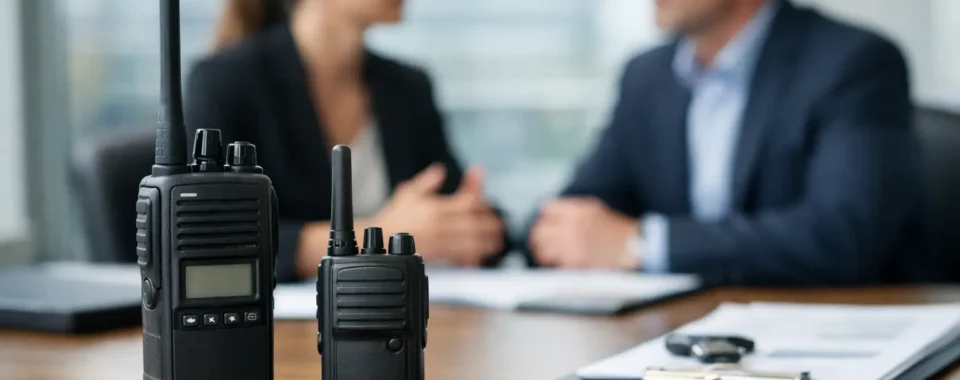

A construction supervisor needs instant contact with equipment operators across a jobsite. A hotel manager needs housekeeping, maintenance, and security on the same channel. A delivery fleet needs dispatch coverage far beyond one building. In each case, the first question should be: do business radios need licensing? The practical answer is that it depends on the radio service, the frequencies being used, and how your organization plans to communicate.
A two-way radio is not automatically licensed or license-free because of its brand, power level, or digital features. The FCC regulates the radio spectrum in the United States, and the rules follow the service behind the radio. Getting that distinction right protects your team from interference, avoids compliance problems, and helps ensure the system will actually work where the work happens.
Do Business Radios Need Licensing? It Depends on the Service
For most organizations that need dedicated local radio channels, repeaters, higher power, or a system built around their operations, the answer is yes. Traditional commercial two-way radio systems generally operate under FCC Part 90 rules and require an FCC license.
That license authorizes a particular business, government entity, or other eligible organization to use specific frequencies, at designated locations or within a defined operating area. It is not simply permission to own a radio. The license needs to match the system configuration, including details such as frequencies, transmitter locations, antenna height, power, emissions, and repeater use when applicable.
However, several radio services can be used without obtaining an individual FCC license. They can be useful for smaller teams, temporary coordination, or operations with modest coverage requirements. The trade-off is that these shared services offer less control and less protection from other users.
Commercial Part 90 radios: licensing is usually required
Part 90 is the primary licensing path for businesses that depend on professional two-way communications. This is common for manufacturing plants, warehouses, security teams, construction companies, schools, municipalities, transportation operations, hospitals, and large event venues.
A Part 90 system can support licensed conventional channels, repeaters, trunked systems, and digital technologies such as DMR. A digital radio does not avoid the licensing requirement. DMR describes a radio technology and air interface, not a license category. A DMR radio programmed for Part 90 business frequencies must operate under the appropriate authorization.
The biggest advantage is operational control. Your system is coordinated around your area and technical needs, rather than relying on a shared channel that may already be busy. Depending on the application, a properly designed licensed system can provide better building coverage, broader outdoor range, repeater access, and clearer accountability for who uses the channels.
Licensing also comes with responsibilities. The radios must be correctly programmed, used within the authorized parameters, and maintained in a way that does not create interference. You cannot legally select a quiet-looking business frequency and begin using it just because a radio can be programmed for that channel.
License-free services: FRS, MURS, and CB
Some businesses can operate effectively on license-free services, but each one has constraints that should be understood before buying radios for a team.
FRS, or Family Radio Service, does not require an individual FCC license. It is useful for short-range, low-complexity communications such as a small retail floor, a community event, or staff working within a limited property. FRS radios are subject to equipment and power restrictions, and users share the channels with the public. If nearby users are active on the same channel, there is no exclusive access.
MURS, or Multi-Use Radio Service, also does not require an individual license and may be used for business communications. It operates on five VHF channels and can be a useful option for farms, nurseries, parking operations, small campuses, and other open-area applications. MURS has power, antenna, and operating-rule limitations, and it is still a shared service. It is not a substitute for a coordinated commercial system when uptime and channel availability are mission-critical.
CB radio does not require an individual license either. It can support business or personal communications, particularly where users already have mobile CB equipment. Its range and consistency can vary widely with terrain, antennas, atmospheric conditions, and local channel traffic. For coordinated fleet operations, CB is usually a different tool than a managed business radio network.
GMRS and Amateur Radio Are Not Business Radio Workarounds
GMRS is often discussed alongside business radios because it can provide useful range with mobile units and repeaters. But a GMRS license is issued to an individual, not a business. It covers the licensee and qualifying family members, and GMRS is not the right choice for a company assigning radios to employees for routine business operations.
Amateur radio also requires an individual license, but its purpose is self-training, technical investigation, and noncommercial communication. It should not be used to carry a company’s day-to-day dispatch, security, delivery, or operational traffic. A licensed amateur operator may be technically skilled, but that does not make amateur frequencies available for business use.
These distinctions matter because a system can appear to work perfectly while still being used outside the rules of its radio service. Compliance should be designed into the communications plan, not treated as an afterthought once radios are already in the field.
What About Push-to-Talk Over Cellular?
Push-to-Talk over Cellular, often called PoC, is different from conventional RF two-way radio. PoC devices use commercial cellular and data networks, often with Wi-Fi as an additional connection option. The cellular carrier holds the spectrum licenses, so a business typically does not need to obtain its own FCC radio license to use a PoC radio service.
That does not mean PoC has no operating costs or planning requirements. Each radio generally needs a service plan, and performance depends on available cellular or Wi-Fi coverage. For teams spread across a city, several states, or the country, that can be a major advantage. Dispatch can reach a driver on the road, a regional manager, and a warehouse team without building a local repeater network.
PoC is often a strong fit for fleets, multi-site operations, property management, mobile service teams, and organizations that need wide-area communications quickly. A licensed Part 90 system may be the better fit where cellular coverage is weak, where communications must remain local during a network outage, or where a dedicated on-site radio channel is essential.
Many organizations use both. For example, a facility may rely on licensed DMR radios inside a plant while supervisors and field crews use PoC for regional coordination. The right answer is based on coverage, reliability requirements, user workflow, and budget, not on one technology being universally better.
How to Determine Whether Your Team Needs a License
Start with the operational problem, not the radio model. Consider where users need coverage, how many people will talk at once, whether communications need to stay private from casual local users, and what happens when a call fails. A landscaping crew coordinating across one property has different needs from a utility contractor dispatching crews across several counties.
For a commercial radio system, the usual process includes selecting the appropriate service, identifying available frequencies, completing frequency coordination when required, filing the FCC application, and programming equipment only after the authorization is in place. If a repeater, rooftop antenna, or tower is involved, the technical design should be part of the licensing discussion from the beginning.
Be careful with radios advertised as “programmable,” “business band,” or “multi-band.” Those descriptions refer to device capability, not permission to transmit everywhere the radio can tune. A compliant installation uses FCC-authorized equipment where required and programming that matches the radio service and your actual authorization.
A practical selection checklist
Before committing to a radio system, answer these questions:
- Do you need communications only on one site, across a metro area, or nationwide?
- Is a shared channel acceptable, or do you need controlled business-only access?
- Will buildings, steel, concrete, terrain, or distance require a repeater or cellular-based coverage?
- Do you need private one-to-one calls, GPS, dispatch functions, text messaging, or emergency alerts?
- Can the team tolerate a monthly service cost, or is a locally owned radio system the better long-term fit?
Those answers usually make the licensing path much clearer. They also prevent a common and expensive mistake: buying consumer radios for an operation that really needs professional coverage and managed channels.
A radio system should remove friction from the workday, not create new uncertainty about coverage, interference, or FCC rules. If your team relies on clear communication to move people, protect property, or keep work on schedule, choose the service first and the radios second. Cogent Radios Group can help evaluate the operating environment, licensing needs, and equipment options so the system fits the way your team actually works.