

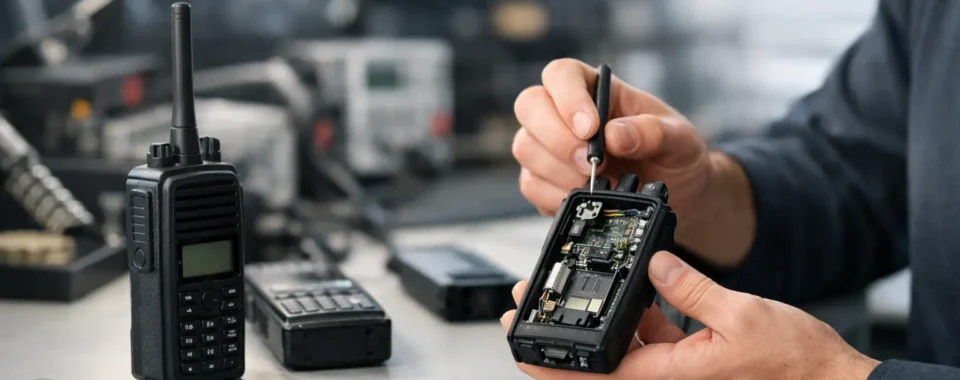

A dead radio at the start of a shift is more than an equipment problem. It can delay a delivery, separate a crew from dispatch, leave a hotel team without coordination, or force a worksite back to cell phone calls that may not work where the job is happening. Commercial two way radio repair is about restoring a dependable communications tool, but the best repair decision starts with understanding why the radio failed and what the full system needs.
For a single handheld, a weak battery or damaged antenna may be the obvious culprit. For a fleet, repeated failures can point to charging practices, water exposure, incompatible accessories, poor programming, or a coverage issue being mistaken for a hardware problem. A qualified technician looks beyond the symptom so the same problem does not return next week.
Start With the Problem, Not the Part
Field users often report that a radio is “not working,” but that description can cover several very different faults. The radio may not power on, may power on but fail to transmit, may receive only intermittently, or may work well in one area and poorly in another. Each condition calls for a different test.
A technician should first confirm whether the issue follows the radio, the battery, the charger, the accessory, or the location. Swapping a known-good battery and antenna can quickly isolate common failures. Testing on a verified working channel determines whether the issue is radio hardware or programming. Comparing performance in multiple parts of a facility helps distinguish a damaged unit from an in-building coverage challenge.
This process matters because replacing parts without diagnosis can waste money. A new speaker microphone will not correct a transmit authorization setting. A replacement battery will not solve an antenna connector damaged by a hard drop. Likewise, a radio that seems weak indoors may be operating normally while the building’s steel, concrete, or layout limits RF coverage.
Common Commercial Radio Failures
Commercial radios are built for demanding work, but daily use is hard on any device. Drops, vibration, dust, moisture, repeated charging, and strain on accessory connectors all add up over time. The most frequent repair requests tend to involve power, audio, transmit, and physical damage.
Power and charging problems
When a radio will not turn on, the battery is a logical first check, but it is not always the answer. Battery contacts can become dirty or worn. Charger cups and power supplies can fail. In older fleets, a battery may show a full charge yet lose voltage quickly under transmit load.
Lithium-ion batteries also have a service life. If several radios in the same fleet have shortened runtime, evaluate the age and condition of the battery inventory rather than troubleshooting each radio in isolation. Using approved chargers and replacing batteries on a planned schedule is less disruptive than waiting for failures during a shift.
Weak, distorted, or missing audio
Poor receive audio may come from a blocked speaker grille, water intrusion, a damaged speaker, or an accessory issue. If audio is clear through the radio’s internal speaker but poor through a speaker microphone or earpiece, the accessory and connector should be inspected before opening the radio.
Transmit audio requires a separate test. Users may hear traffic perfectly but sound muffled or silent to everyone else. That can indicate a microphone failure, debris around the mic port, an accessory with a damaged cable, or a programming configuration that does not match the accessory in use.
Transmit and receive faults
A radio that receives but cannot transmit may have a failed push-to-talk switch, a damaged antenna, a programming restriction, or an issue with the repeater or system authorization. For licensed business radio systems, frequency and emission settings must also be correct. An improper programming change can create operational issues and may create FCC compliance concerns.
A radio that transmits but does not receive deserves careful testing. The problem might be a speaker, but it can also involve receiver components, channel settings, tones, or digital parameters. DMR systems, for example, depend on matching details such as color code, time slot, talkgroup, and frequency configuration. One incorrect value can make a perfectly functional radio appear defective.
Damage to antennas, knobs, ports, and housings
A bent antenna, loose SMA connector, cracked display, missing volume knob, or worn accessory port may look minor, yet these parts affect daily usability and radio performance. Antennas are especially important. Operating with a damaged or incorrect antenna can reduce range and, in some cases, stress the radio’s transmitter.
Physical repairs depend on model availability and the condition of the rest of the unit. Replacing an antenna or knob is usually straightforward. A severely cracked housing may expose the radio to moisture and dust, making a more extensive repair less sensible unless the unit is a higher-tier model with significant remaining service life.
When Repair Makes Financial Sense
The right question is not simply, “Can this radio be repaired?” Many failures can be repaired. The useful question is whether repair returns the radio to dependable service at a reasonable cost compared with replacement.
Repair is often the better choice when a radio is relatively current, the fault is isolated, and replacement parts are available. It can be especially worthwhile for higher-quality commercial handhelds, mobile radios, repeaters, control stations, and equipment that has been programmed for a specific operation. Retaining a compatible radio may also avoid the cost and downtime of reprogramming, labeling, deploying, and training around a different model.
Replacement becomes more attractive when a unit has multiple faults, parts are discontinued, water damage has reached internal components, or repair costs approach a meaningful portion of a new radio’s price. Consider the radio’s role as well. A front-line safety, dispatch, or supervisory radio should not remain in service if its reliability is questionable, even if an inexpensive repair is technically possible.
For fleets with mixed ages and models, standardizing may provide value beyond the price of one replacement unit. A common platform simplifies accessories, batteries, chargers, programming, spares, and user training. The trade-off is the upfront investment, so a phased replacement plan is often the practical middle ground.
A Repair Shop Should Test the Whole Communications Path
Good commercial two way radio repair includes more than replacing a visible broken part. The radio should be function-tested for transmit power, receive sensitivity, modulation or audio quality, frequency accuracy where applicable, battery performance, charging behavior, controls, display operation, and accessory connectivity. The technician should also confirm the programmed channels and system settings match the customer’s authorized configuration.
For mobile and base installations, the surrounding equipment matters just as much. A weak mobile radio may actually have a compromised coaxial cable, corroded mount, poor ground, or damaged vehicle antenna. A repeater-related complaint may involve duplexer tuning, feedline condition, power supply performance, antenna placement, or interference rather than the repeater itself.
Push-to-Talk over Cellular devices require a slightly different approach. A device can have excellent hardware but experience communication problems because of SIM provisioning, account permissions, Wi-Fi behavior, cellular coverage, application configuration, or group assignments. Treating every PoC complaint as a radio repair can lead to the wrong fix. Testing the device, network connection, and platform settings together is the efficient path.
Reduce Failures Before They Affect Operations
The most cost-effective repair is the one your team never needs. Small operating habits have a large effect on fleet life. Assign radios to users or vehicles when possible, keep chargers in clean and ventilated locations, and remove damaged accessories from service quickly. Train users not to carry radios by the antenna or speaker microphone cable, and provide proper clips, holsters, or vehicle mounts.
A simple inspection routine also helps. Check batteries for swelling or damaged contacts, look for worn antennas and cracked housings, test a sample of radios on a known working channel, and review whether every unit still has the correct channel plan. For operations that depend on radios every day, maintaining a small number of programmed spare units can prevent a repair from turning into downtime.
Documentation is valuable, too. Record serial numbers, model numbers, purchase dates, battery age, repair history, and assigned user or vehicle. Patterns become visible quickly. If one crew goes through accessories faster than another, the answer may be a tougher accessory choice or a change in how radios are carried, not repeated replacement purchases.
Get a Clear Repair Recommendation
Before authorizing work, ask for a diagnosis that identifies the failed component or likely cause, the expected repair cost, the condition of related items such as batteries and antennas, and whether the radio has any broader programming or coverage concerns. A clear recommendation should explain the repair-versus-replace trade-off in operational terms, not just provide a parts quote.
Cogent Radios Group approaches service with the same practical focus used to design communications systems: keep the equipment dependable, verify the system around it, and recommend only the work that supports the operation. When a radio is critical to the shift, the goal is not merely to make it power on. It is to put a reliable communications tool back in the hands of the people who need it.