
A driver misses a call while backing into a loading area. A supervisor needs to reach six employees at once. A phone can handle both tasks, but it makes people unlock a screen, find the right thread, and manage interruptions from every other app. That difference is at the center of the PoC radio vs cellular phones decision.
For many organizations, this is not a question of old technology versus new. Push-to-Talk over Cellular, or PoC, uses modern LTE and Wi-Fi networks, but places them behind a purpose-built radio interface. The right choice depends on how often your team communicates, how quickly messages need to move, where people work, and what happens when a device is dropped, wet, or handed between shifts.
PoC Radio vs Cellular Phones: The Core Difference
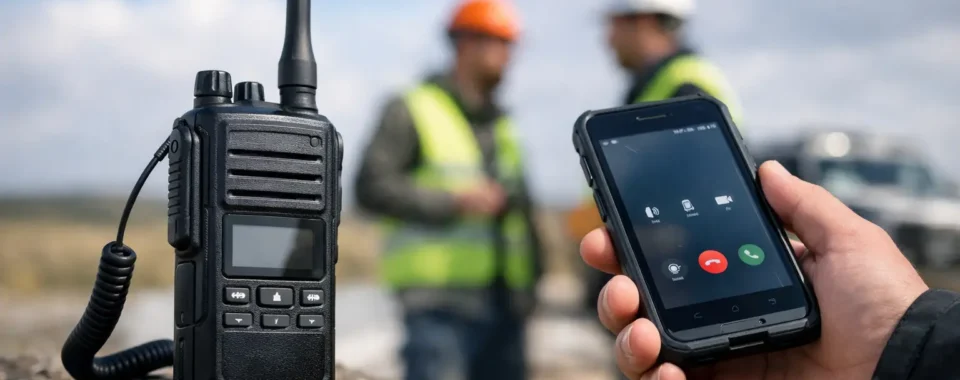
A cellular phone is a general-purpose personal device. It is designed for one-to-one calls, texting, email, apps, video, navigation, and personal communication. Group calling is available through apps, but it is not usually the primary operating model of the device.
A PoC radio is built around instant, managed group voice communication. The user selects a channel or talk group, presses the push-to-talk button, speaks, and releases. Everyone assigned to that group hears the message nearly immediately, whether they are across a jobsite, in another city, or traveling across the country within available cellular or Wi-Fi coverage.
The network underneath may be similar, but the workflow is very different. A phone asks the user to operate a device. A PoC radio lets the user communicate with a team.
Where PoC Radios Have the Advantage
PoC radios work especially well when voice coordination is frequent and messages need to reach groups rather than individuals. Fleet operations, private security, hospitality, construction, event staffing, property management, agriculture, and logistics teams often fit this model.
Instant group communication
A dispatcher can call an entire fleet, a single department, or one employee from a handheld radio, mobile unit, or dispatch console. Employees do not need to scroll through contact lists or create a group call. Talk groups can also be organized by location, role, shift, or incident type.
This matters when a message has operational value only if it is heard quickly. A gate change, delivery delay, safety concern, equipment issue, or customer arrival can be relayed to the appropriate group in seconds.
A device designed for the field
Professional PoC radios typically include a large push-to-talk button, loud speaker, high-capacity battery, and a housing intended for tougher use than a consumer phone. Many models support accessories such as remote speaker microphones, surveillance earpieces, vehicle chargers, and belt clips.
That does not mean every PoC radio is indestructible, or that every phone is fragile. Rugged phones exist. Still, a dedicated radio is easier to operate with gloves, while moving equipment, or when workers need to keep their attention on the task in front of them.
Fewer distractions and clearer accountability
A personal phone brings texts, social media, personal calls, browser notifications, and dozens of applications into the workday. Company-issued phones can be managed, but they still invite users to treat work communications as just another app.
A PoC radio has a narrower job. It can be assigned to a vehicle, employee, or shift, programmed with the needed groups, and returned to a charging station at the end of the day. This simpler operating model can reduce missed messages and make it easier to understand who is responsible for a device.
Nationwide reach without traditional radio infrastructure
Conventional two-way radio systems rely on direct radio range, repeaters, or a private network. PoC extends communications through cellular and Wi-Fi coverage, allowing a local operation to connect with remote drivers, regional sites, and traveling personnel on the same system.
For organizations spread across multiple states, this can avoid the cost and complexity of building radio infrastructure at every location. It is also useful for temporary operations, seasonal crews, and teams that move between properties.
When Cellular Phones Are the Better Tool
A phone remains the better choice when the work requires more than coordinated voice. Sales representatives, executives, service technicians who complete digital forms, and employees who rely heavily on maps, photos, email, or customer-facing applications need the screen and software flexibility a smartphone provides.
Phones are also practical when communication is mostly one-to-one and does not require immediate group awareness. A technician calling a customer, sending an estimate, sharing a photo of an installation, or joining a video meeting is using the phone in the way it was designed to be used.
For a small team with low communication volume, adding a separate PoC device may not be justified. A well-managed smartphone app can provide push-to-talk capability at a lower initial equipment cost. The trade-off is convenience versus a dedicated, field-ready communication tool.
Coverage Is the Deciding Factor More Often Than Device Type
Both PoC radios and cellular phones depend on cellular coverage when they are away from Wi-Fi. If the carrier network is weak at a worksite, a PoC radio using that network will have the same fundamental limitation as a phone on that carrier.
Before selecting equipment, test coverage where the work actually happens: inside warehouses, at loading docks, in parking structures, across rural routes, and at remote job locations. Do not rely only on a coverage map or an employee’s experience outside the building.
This is also where a conventional DMR or other licensed two-way radio system may be the better answer. A local radio system can provide communications in areas where cellular service is poor or unavailable, provided the infrastructure and licensing are planned correctly. Some organizations use both systems: conventional radio for on-site coverage and PoC for vehicles, remote staff, and wide-area coordination.
Dispatch, Safety, and Management Considerations
The strongest PoC systems are more than handheld devices. They can support browser-based dispatch, GPS location reporting, call history, emergency alerts, lone worker functions, and controlled access to talk groups. The exact features vary by device, service plan, and platform, so requirements should be identified before equipment is purchased.
Location tools deserve particular care. GPS can help dispatchers find the nearest driver or confirm whether an asset has arrived, but it should be configured with clear company policies. Workers should understand when location is collected, why it is used, and how it supports operational or safety goals.
Emergency functions are valuable, but they are not a substitute for a safety program. An emergency button is only useful if someone is assigned to monitor alerts, escalation procedures are documented, and employees know what will happen after they activate it.
Cost: Look Beyond the Handset Price
A consumer phone may appear less expensive because many employees already own one. However, bring-your-own-device programs can create issues with app access, data security, inconsistent accessories, battery condition, and employee turnover. A company may also need to reimburse service costs or manage multiple carrier plans.
PoC deployments generally involve a device cost plus a recurring cellular or platform subscription. That predictable monthly expense can be worthwhile when it replaces fragmented phone-based communication with managed groups, assigned equipment, and dispatch visibility.
The most useful comparison is not radio price versus phone price. Compare the total operational cost of missed calls, delayed dispatches, lost devices, downtime, training, support, and the number of separate tools employees need to use during a shift.
Choosing the Right Fit for Your Team
Start with the communication pattern, not the product catalog. If most messages are short, urgent, and intended for groups, PoC radios are usually the more natural fit. If employees spend most of their time using business apps, creating reports, communicating with customers, and handling individual calls, cellular phones may be sufficient.
Many teams benefit from a mixed approach. Dispatchers and field crews use PoC radios for operational voice traffic, while managers and mobile professionals carry phones for email, scheduling, documentation, and customer communication. The systems can complement one another instead of competing for the same role.
A practical evaluation should include a field test with actual users, actual talk groups, and real coverage conditions. Evaluate audio volume in noisy areas, battery life across a full shift, accessory comfort, dispatch workflow, and how easily a new employee can use the device without extensive training.
The best communication system is the one your people will use correctly when the pace picks up. Choose the device around that moment, and the technical details become much easier to get right.