
A radio system can make a crowded event feel controlled, or expose every weak point in an operation. The difference is rarely the radio itself. It is the plan behind it. Knowing how to coordinate event radios means giving each team a clear way to communicate, testing coverage before doors open, and setting rules that keep urgent traffic from getting buried in casual chatter.
For a small community event, that may mean six radios and two channels. For a festival, trade show, sporting venue, or multi-site operation, it may involve security, parking, guest services, medical staff, vendors, production, and management. The scale changes, but the fundamentals do not.
Start With the Event, Not the Radio Model
Before assigning a single channel, map how the event will operate. Identify who needs to talk to whom, where they will be positioned, and what problems they are likely to handle. An operations manager does not need to hear every parking question. Parking staff may need quick access to security, but they do not need to share a working channel with stage production.
Think in terms of communication groups rather than job titles alone. A practical event plan commonly separates operations, security, guest services, parking or transportation, and event leadership. Medical teams may have their own process, depending on local protocols and the communications system in use.
This is also where you decide whether conventional two-way radios, Push-to-Talk over Cellular (PoC) radios, or a combination makes the most sense. Conventional radios work well when your team is concentrated within a venue and local RF coverage has been verified. PoC radios are often a strong fit when staff are spread across a city, multiple parking areas, off-site storage, hotels, or other locations where a local radio system would not reach. The right choice depends on the footprint, building construction, available cellular coverage, staffing pattern, and how much control you need over groups and users.
Build a Channel Plan People Can Actually Use
The best channel plan is simple enough to understand under pressure. Avoid creating more channels than the event needs. Too many options lead to missed calls, accidental channel changes, and staff asking dispatch where they should be.
A typical plan may include a primary operations channel for general coordination, a security channel for incidents and access issues, and a leadership channel for supervisors. If traffic is expected to be heavy, guest services or parking can receive a dedicated channel. Keep one channel or talkgroup available as a backup, especially for larger events.
Give every channel a plain-language label. “Operations,” “Security,” and “Parking” are better than vague labels such as “Channel 3.” If radios support display names, program them before deployment. With PoC devices, create talkgroups that match the event structure and confirm permissions so users only see the groups they need.
There is a trade-off here. Separate channels reduce congestion, but they can isolate teams if there is no clear escalation path. Every staff member should know which channel handles routine work and how to reach a supervisor or security when an issue needs to move up.
Assign a primary channel and an escalation path
Most staff should begin on one assigned working channel. When they need another group, they should not simply scan around and call repeatedly. Establish a simple sequence: contact your lead, have the lead contact the appropriate department, and move to a designated coordination channel only when needed.
For urgent situations, create a clear exception. Staff should know what language to use, who takes control of the radio traffic, and whether emergency services are contacted through 911, venue security, or an established event command process. Do not rely on a radio channel alone as an emergency plan.
Use Clear Call Signs and Short Radio Traffic
A radio is a shared resource. One person holding the push-to-talk button for 30 seconds can delay a safety message, a lost-child report, or a request for assistance. Good radio discipline keeps messages brief, specific, and easy to repeat.
Assign recognizable call signs by role or location, such as “North Gate,” “Parking Lead,” “Security Two,” or “Operations.” Avoid call signs that sound alike. “Gate One” and “Stage One” can be confused in a noisy environment, particularly when staff are rushed.
A reliable radio call follows a simple pattern: identify who you are calling, identify yourself, and state the request. For example: “Operations, this is West Entrance. Need two additional staff for the line.” The receiving party acknowledges the message and confirms the action if necessary.
Train staff to pause for a second after pressing the push-to-talk button. Many handheld radios clip the first word of a transmission when the user speaks too quickly. They should also avoid saying “repeat” if possible, since that term can carry a different meaning in certain emergency communications contexts. “Say again” is clearer.
Keep sensitive information off open channels. Do not broadcast personal medical details, payment information, access codes, or anything that could create a security concern. Move detailed conversations to a supervisor, a phone call, or another approved communications method.
Test Coverage Where People Will Actually Stand
A coverage test from the event office is not a coverage test. Radios need to be checked at gates, loading docks, parking lots, stairwells, basements, kitchens, backstage areas, elevators, and the farthest corners of the venue. Concrete, steel, dense crowds, temporary structures, and equipment can all affect performance.
Walk the site with radios before the event and test every planned channel or talkgroup. Have one person remain at a fixed location while another travels the route staff will use. Listen for weak audio, missed transmissions, delayed connections, and areas where calls fail altogether.
For conventional radio systems, an existing repeater, portable repeater, antenna placement, or higher-power commercial equipment may be needed to cover a challenging site. For PoC radios, test the actual cellular network conditions at the venue and in overflow areas. A nationwide service area does not eliminate local dead spots inside a concrete structure or below ground.
Document any weak areas and give staff a workaround. That could mean moving a few feet to a known coverage point, using a supervisor relay, repositioning a radio user, or assigning a different communications device to that location. A known limitation is manageable. A surprise limitation during an incident is not.
Prepare the Radios Before Check-In
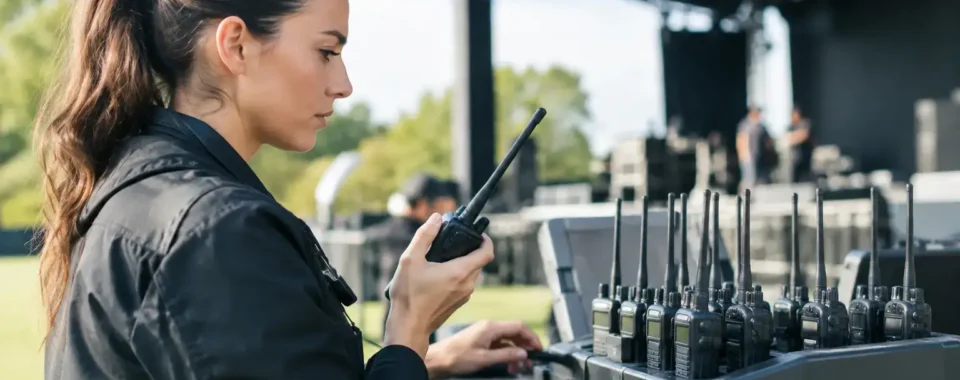
The busiest time to solve a programming issue is not 15 minutes before the gates open. Charge, label, test, and stage radios well in advance. Each unit should have the correct channel plan, the same time setting if applicable, a functioning battery, and an accessory that fits the role.
Earpieces can be useful for security, guest services, and staff working in loud areas, but they should be tested for comfort and intelligibility. A poor-fitting earpiece encourages people to remove it or turn the volume too high. Speaker microphones are often more practical for parking, operations, and teams wearing gloves or outer layers.
At distribution, record the radio number, assigned user, department, and accessories issued. This creates accountability and makes end-of-event collection much easier. It also helps identify a failing unit quickly if someone reports a problem.
For licensed business frequencies, make sure the operation is authorized and that programmed frequencies match the applicable FCC license. Do not assume consumer radios, GMRS units, and commercial equipment can be mixed freely. Frequency rules, power limits, and licensing requirements vary by service.
Hold a Five-Minute Radio Briefing
Even experienced staff benefit from a short briefing. Explain the assigned channel, call sign, escalation path, emergency procedure, and the expectation to keep transmissions short. Then conduct a radio check by department before deployment.
The briefing should also answer practical questions: Who monitors the operations channel? Who can approve a channel change? What happens if a radio is lost? Where do staff report for a replacement battery? Simple answers prevent unnecessary traffic later.
During the event, designate someone to monitor communication quality and channel congestion. If a channel becomes overloaded, move a noncritical conversation to another talkgroup or route requests through leads. Do not change the entire channel plan casually once staff are in motion. Changes should be announced clearly, acknowledged, and documented.
Review What Happened After the Event
When radios are returned, ask supervisors what worked and where communication broke down. Look for recurring issues: a channel that was too busy, a loading area with poor coverage, a team that needed a direct link to security, or batteries that did not last a full shift.
Keep those notes with the event plan. The next event may use a different layout or staffing level, but real operating experience is more valuable than starting from scratch each time. A communications partner such as Cogent Radios Group can help assess coverage, select the appropriate radio platform, program devices, and build a plan that fits the way your staff actually work.
A well-coordinated radio system should fade into the background when everything is going right. When something changes quickly, it should give your team a calm, direct path to the people who can act.