
When a crew misses a call, the problem usually is not the radio. It is the system behind it. If you are figuring out how to choose a business radio system, the real job is matching coverage, workflow, and reliability to the way your team actually works – not picking the flashiest handset.
A warehouse supervisor, a school facilities team, a paving contractor, and an event staff all need clear group communication, but they do not need the same setup. Some businesses need simple on-site radios with no monthly fees. Others need wide-area coverage across cities or states. The right answer depends on where people work, how often they talk, what can go wrong, and how much downtime your operation can tolerate.
Start with the job, not the device
The most common mistake is shopping by radio model first. It feels efficient, but it often leads to a system that looks good on paper and frustrates users in the field.
Start by mapping your operation. How many users need radios today, and how many will need them next year? Are they all in one building, spread across a campus, driving between service locations, or working across a whole region? Do they need one talk group, private calling, dispatch features, GPS, emergency alerts, or recording? A hospitality team may care about discreet earpieces and easy channel organization, while a construction crew may care more about speaker volume, glove-friendly controls, and durability.
If your radio system does not fit the pace and pattern of the work, adoption drops fast. Teams stop carrying radios, switch to cell phones, or create workarounds that slow everything down.
How to choose a business radio system by coverage area
Coverage is usually the deciding factor. A radio can be rugged and well-built, but if it cannot reach the people who need to hear the message, it is the wrong tool.
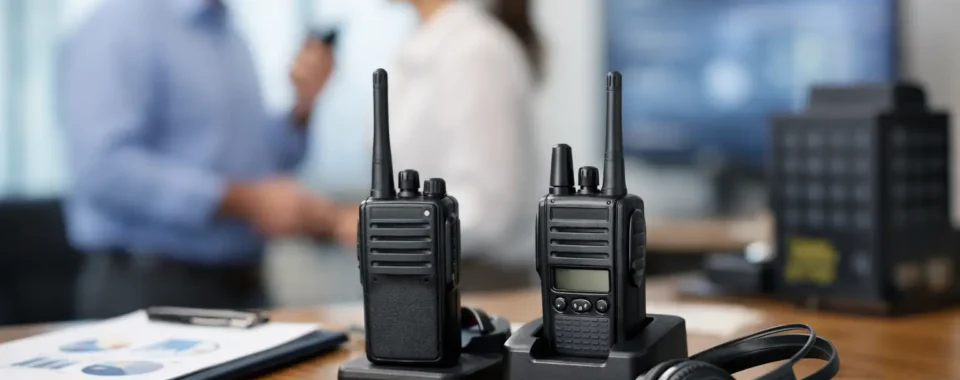
For a single site, conventional business radios may be enough. These work well for warehouses, schools, hotels, farms, manufacturing plants, and private campuses where users stay within a defined area. In these cases, UHF often performs better inside buildings and around obstacles, while VHF can be a better fit for more open outdoor environments. That is a guideline, not a rule. Building materials, terrain, and interference matter.
If coverage needs to extend beyond one property, Push-to-Talk over Cellular can make more sense. PoC radios use cellular data networks to provide wide-area communication without the range limits of traditional radio coverage. For delivery fleets, regional service teams, traveling supervisors, and multi-site operations, that can be a major advantage.
There is a trade-off. Traditional radio systems can keep working without dependence on a cellular carrier, which matters for some critical operations and remote sites. PoC offers broad reach and simple scaling, but it depends on network availability and a service plan. The better choice depends on where your people work and what level of independence your operation requires.
Decide whether you need analog, DMR, or PoC
This is where many buyers get overloaded with terminology. The simpler way to look at it is by operational need.
Analog radio is still useful in some environments because it is familiar, straightforward, and can be cost-effective for basic local communication. But many businesses moving beyond very simple use cases benefit from digital systems.
DMR, or Digital Mobile Radio, is a strong option for organizations that want better audio performance, stronger channel efficiency, improved battery life, and more advanced features than basic analog equipment. It works well for many commercial users that need dependable local or campus-wide communications and may eventually want repeaters, fleet growth, or more structured talk group management.
PoC is different. It is ideal when your footprint is larger than a typical radio system can cover economically, or when you want near-nationwide communication without building out radio infrastructure. If your teams work across a metro area, across several states, or from home base to remote jobsites, PoC can solve a problem that traditional radio often cannot solve without major investment.
Some businesses also end up with a mixed environment. A local DMR system might serve a facility, while PoC units connect managers, drivers, or off-site teams. That kind of hybrid setup can be very practical when you have both site-based and mobile users.
Think about infrastructure before you buy
A radio system is not always just radios and chargers. Depending on your needs, infrastructure may be the difference between patchy communication and a system your team trusts.
If your site has dead zones, heavy concrete construction, steel structures, multiple buildings, or broad outdoor acreage, you may need a repeater, better antenna placement, or a more deliberate system design. If you skip that step and try to fix coverage problems one radio at a time, you usually spend more and get less.
This is also where a site survey or system consultation pays off. Real-world RF conditions are rarely as simple as a product spec sheet suggests. Parking garages, hospitals, schools, industrial sites, and mixed indoor-outdoor properties all create their own communication challenges.
For some operations, infrastructure is minimal. For others, it is the core of the system. The right question is not whether infrastructure sounds expensive. It is whether your team can afford communication gaps during normal operations or emergencies.
Do not ignore compliance and licensing
If you are learning how to choose a business radio system, licensing needs to be part of the conversation early. In the US, many business radio frequencies require FCC licensing. That is not a minor paperwork detail. It affects what equipment you should buy, how it should be programmed, and whether your system is operating legally.
License-free options exist for certain use cases, but they come with limitations. Shared bands can be crowded, power levels may be restricted, and privacy is more limited than some users assume. That may be acceptable for light-duty communication. It is often not the best fit for professional operations that depend on clean, organized channels.
A properly licensed business system usually gives you more control and a better operating structure. It also reduces the risk of interference and compliance issues later.
Match the radios to the users
A good system can still fail if the radios are wrong for the people carrying them.
Field crews often need loud audio, long battery life, durable housings, and controls that can be used with gloves. Hospitality and event teams may prioritize compact form factors, clear audio through earpieces, and a more discreet appearance. Transportation teams may need mobile units in vehicles, GPS visibility, and dependable communication while moving through changing coverage areas.
It is also worth thinking about accessories early. Speaker microphones, surveillance earpieces, multi-unit chargers, spare batteries, and carry cases are not afterthoughts. They shape day-to-day usability. If staff cannot hear clearly or keep units charged through a full shift, system performance drops quickly.
Training matters too. The best business radio system is one your team can use correctly under pressure. If channel plans are confusing or features are buried in menus, expect mistakes.
Budget for total cost, not just upfront price
Cheaper radios can become expensive if they fail early, create confusion, or need constant replacement. At the same time, not every operation needs the most advanced platform available.
Look at total cost over the life of the system. That includes equipment, licensing, accessories, programming, infrastructure, service plans for PoC if applicable, maintenance, and support. A lower upfront price may still be the wrong value if coverage is poor or support is nonexistent.
This is one reason many businesses prefer working with a communications partner instead of buying equipment blindly. A good provider helps avoid overbuying, but also keeps you from underbuilding a system that your operation will outgrow in six months.
At Cogent Radios Group, that practical fit matters more than pushing a single technology. A local campus, a fleet operation, and a rural property can each need a very different answer.
Questions worth answering before you choose
Before you commit, make sure you can clearly answer a few operational questions. Where do users need coverage, including weak spots and future expansion areas? How many people need to talk at once? What happens if communication fails for ten minutes? Do you need local-only communication or wide-area reach? Are you prepared for licensing, and do you want to own infrastructure or use a carrier-backed PoC model?
If those answers are still fuzzy, that is usually a sign to pause and plan before buying. Radio systems work best when they are designed around actual use, not assumptions.
The right business radio system should feel boring in the best way. Calls go through, teams respond quickly, and no one has to think twice about whether the message will get there. That kind of reliability is not an accident. It comes from choosing the system around the work, then building it to hold up on your busiest days.