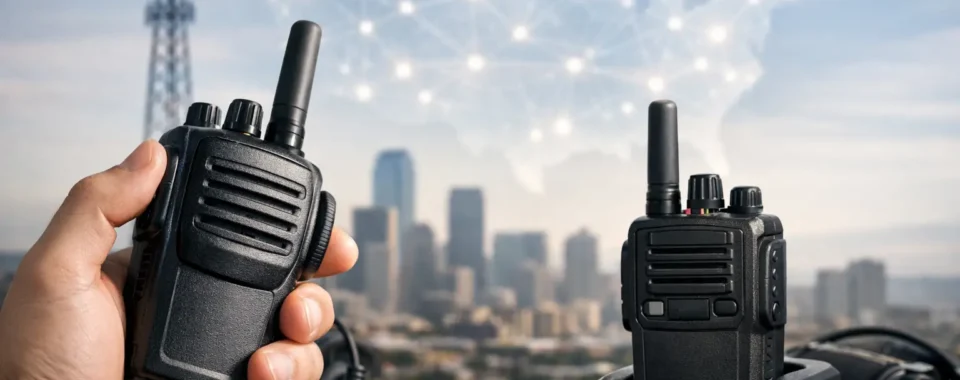

A crew leaves the yard at 5:30 a.m., splits across three counties, and still needs to talk like they are on the same jobsite. That is where nationwide push to talk radios start to make sense. They give teams radio-style communication over cellular networks, so coverage is not tied to the footprint of a local repeater or the limited range of conventional handheld radios.
For many businesses, that changes the conversation from “Can we reach them?” to “What setup makes the most operational sense?” The answer depends on where your people work, how critical uptime is, and whether you need a simple voice tool or a larger communications plan that includes dispatching, GPS, recording, or mixed radio systems.
What nationwide push to talk radios actually are
Nationwide push to talk radios are usually Push-to-Talk over Cellular, often shortened to PoC. They look and feel like two-way radios, but instead of relying only on RF coverage from your own repeaters, they use cellular data and platform servers to connect users over a wide area.
From the user side, the experience is familiar. Press the button, speak, and your group hears the message almost immediately. From the system side, it is very different from traditional land mobile radio. Coverage follows the strength and availability of the cellular network rather than the reach of your radio infrastructure.
That distinction matters. If your team operates across a city, several states, or a dispersed service territory, PoC can often reduce the need for multiple repeaters, licensing coordination, and infrastructure maintenance. If your team works deep indoors, underground, or in areas with poor carrier performance, the trade-off becomes more complicated.
Why businesses choose nationwide push to talk radios
The biggest reason is simple: range. A plumbing company with field techs, a shuttle operator moving between properties, or a construction support team covering multiple projects may need instant group calling without building out a radio network everywhere they go.
PoC is also attractive because deployment is usually faster than a conventional wide-area radio system. Devices can be activated, grouped, and assigned with less infrastructure planning. Many platforms also add practical tools such as location tracking, dispatcher consoles, private calling, emergency alerts, and message history.
Cost can be another factor, but this is where experience matters. Some buyers assume nationwide push to talk radios are always cheaper. Sometimes they are. Sometimes they are not. Monthly service fees, device quality, accessory needs, and platform management all affect total cost. For a small to mid-sized fleet with broad geography, PoC can be very efficient. For a fixed campus with heavy daily traffic, a DMR or other business radio system may still be the better long-term fit.
Where they work best
PoC radios tend to fit operations that are mobile, spread out, and time-sensitive. Delivery fleets, field service teams, event staff, property management groups, security teams, agriculture operations, churches, transportation providers, and regional contractors are common examples.
They also work well when users do not want to think about channels, repeater coverage, or radio zones. A manager can place users into talk groups based on role or geography and adjust those groups as operations change. That flexibility is useful for seasonal workforces, temporary sites, and businesses with rotating teams.
For families, private groups, or community users who need broader-area communication than FRS or GMRS can realistically provide, PoC can also be a practical option. It gives a radio-style user experience without the learning curve of a more technical radio system.
The trade-offs you should understand first
The phrase “nationwide” can be misleading if it is treated as a guarantee. Nationwide push to talk radios are only as usable as the underlying carrier availability, device setup, and network conditions in the places your people actually work.
If a crew spends time in remote valleys, heavy steel buildings, basement levels, or disaster-affected areas where cellular service is weak, PoC may struggle exactly where communication matters most. Conventional radio systems have limits too, but they are not dependent on commercial cellular data in the same way.
There is also the issue of latency. Modern PoC systems are fast enough for most field operations, but they may not feel exactly like a high-performance local radio system. For routine coordination, that is usually acceptable. For highly tactical or fast-moving voice traffic, it may not be.
Battery life, accessory quality, and platform stability matter more than many first-time buyers expect. A cheap device that drops audio, fails after a few months, or uses weak accessories creates frustration quickly. In professional environments, hardware durability is not a luxury item. It is part of system reliability.
Nationwide push to talk radios vs traditional two-way radios
This is not really an either-or question. In many organizations, the best answer is a mix.
Traditional two-way radios are strong where instant local communication, independence from cellular networks, and high durability are priorities. DMR and other business radio platforms are often excellent for campuses, manufacturing sites, warehouses, schools, hospitality properties, and facilities with predictable coverage needs.
Nationwide push to talk radios are strong where the workforce is geographically dispersed and needs broad-area communication without major RF infrastructure. They are often easier to scale across regions and simpler to add to temporary or mobile operations.
A blended approach can be the smartest path. Some businesses use conventional radios on-site and PoC for supervisors, mobile units, or regional managers. Others use gateways or dispatch tools to bridge workflows between systems. That kind of design takes planning, but it can solve real-world coverage gaps without forcing one technology to do every job.
What to look for before you buy
The first question is not brand or price. It is coverage. Test in the actual places your team works, including known trouble spots. Parking structures, service basements, fringe rural areas, and dense commercial buildings tell you more than a carrier map ever will.
The second question is how people will use the radios day to day. A housekeeping team, towing fleet, church security team, and multi-county service company all have different traffic patterns. Some need one main group. Others need layered talk groups, dispatcher oversight, emergency features, or GPS visibility.
The third question is support. Devices are only one part of the system. You may need help with setup, user training, accessory selection, programming, replacement planning, and troubleshooting. That is where working with a communications provider instead of just buying hardware off a shelf can make a real difference.
It is also worth asking whether the platform can grow with you. Today you may need ten radios and one talk group. Next year you may need fifty users, a dispatch position, vehicle chargers, remote worker coverage, and integration with other radio assets.
Common mistakes with PoC deployments
One common mistake is treating PoC radios like generic phones with a speaker mic. Professional users need purpose-built devices, clear audio, solid battery performance, and controls that make sense in the field.
Another mistake is skipping a coverage trial. “It should work” is not a deployment plan. A short real-world test often reveals whether one carrier performs better than another, whether an external mic is needed, or whether a hybrid system would serve the operation better.
A third mistake is ignoring the user group structure. If everyone is dumped into one large talk group, communication gets noisy fast. Good system design keeps conversations relevant and helps teams hear what matters.
When expert guidance matters most
If your organization only needs a handful of radios for straightforward use, setup can be simple. But once you add multiple departments, vehicles, remote staff, dispatch requirements, or coverage concerns, design becomes more important than the device itself.
That is where an experienced communications partner can save time and frustration. A company like Cogent Radios Group can evaluate whether nationwide push to talk radios are the right answer, where they fit alongside DMR or other systems, and how to build something practical for daily operations instead of just checking a feature list.
The best communications system is rarely the one with the most features. It is the one your team will trust at the exact moment they need it, whether that is across town, across the state, or across a busy workday with no room for missed calls. If you start with real coverage, real workflow, and real support, you will make a much better decision.