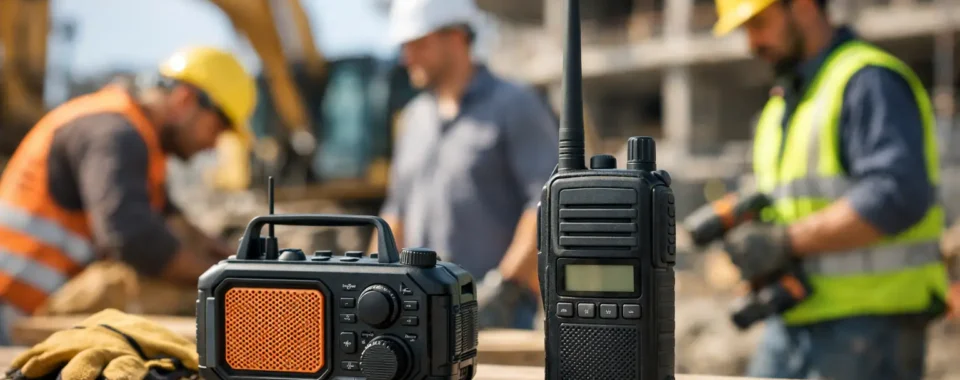

A concrete pour does not wait for a supervisor to walk across the site, and a crane operator cannot rely on a missed cell call. The best radios for construction crews are the ones that deliver clear, immediate communication through steel, equipment noise, changing work zones, and the occasional coverage dead spot. That usually means choosing a communications system, not simply picking the toughest-looking handheld.
For a small crew working on one open site, a straightforward radio setup may be enough. For a general contractor coordinating multiple trades, vehicles, foremen, and sites across a region, the right answer may be Push-to-Talk over Cellular (PoC) or a licensed DMR system with dedicated coverage. The best choice depends on where your people work, how far apart they are, and what happens when a message is missed.
Start With the Jobsite, Not the Radio Catalog
Construction communication has a few challenges that consumer walkie-talkies are not designed to solve. Equipment creates continuous background noise. Steel, concrete, and below-grade areas can weaken radio signals. Crews move between buildings, trailers, laydown yards, and vehicles throughout the day. A system has to fit that reality without turning every call into a repeated transmission.
Before comparing radios, identify the communication paths your crew actually needs. A site superintendent may need to reach every foreman at once. A lift operator may need a private call with a spotter. A dispatcher may need to contact drivers before they enter a congested site. Those are different conversations, and they may require separate talk groups or channels.
Also consider whether the job is temporary or ongoing. It may not make sense to install permanent infrastructure for a short project with reliable cellular service. On a long-term project, a poorly planned radio system can cost more in lost time and safety exposure than a properly designed solution from the beginning.
PoC Radios: Best for Multi-Site and Wide-Area Crews
Push-to-Talk over Cellular radios use 4G LTE or 5G networks, and in some cases Wi-Fi, to provide radio-style calling across a broad service area. Press one button, speak to an individual or group, and receive an immediate response without dialing a phone number. For crews working across town, across a state, or across the country, PoC is often the most practical option.
A PoC radio is particularly useful for contractors with several active projects, mobile supervisors, delivery coordination, or service teams that travel between sites. A project manager can speak with the warehouse, field crew, and office from one device, using defined groups rather than a tangle of phone calls and text messages. GPS location, dispatch functions, emergency alerts, and remote device management may also be available depending on the platform.
The trade-off is straightforward: PoC needs cellular or Wi-Fi coverage. A radio that works perfectly in an open suburban development may struggle in a deep basement, remote excavation, parking structure, or rural area with weak carrier service. Some organizations address this by using PoC for daily wide-area operations and conventional radios for known on-site dead zones.
When evaluating PoC, ask which cellular networks are supported, whether the device uses one carrier or multiple networks, and how it behaves when service drops. Coverage testing at the actual project location is more useful than a coverage map alone.
Licensed DMR Radios: Best for Dedicated On-Site Coverage
Digital Mobile Radio, commonly called DMR, is a strong fit when crews need dependable local communication independent of public cellular networks. A properly licensed and engineered DMR system can provide clear voice calls, individual and group communications, and efficient channel use. It is well suited to large construction sites, industrial facilities, campuses, ports, mines, and projects where radio traffic is continuous.
For a modest site, handheld DMR radios may communicate directly from radio to radio. Larger or more obstructed sites often benefit from a repeater placed at an elevated location. The repeater receives and retransmits signals, extending usable coverage around structures, across a yard, or through areas where direct handheld communication would be inconsistent.
DMR is not a plug-and-play shortcut. Business-frequency operation generally requires an FCC license, frequency coordination, and proper programming. Antenna placement, radio power, terrain, building materials, and interference from nearby users all matter. That planning is precisely what turns a set of radios into a system workers can trust.
DMR may be the better choice when a project includes below-grade work, a large steel structure, or a location where cellular service is uncertain. It also gives an organization greater control over its communications environment. The trade-off is that upfront planning, licensing, and possible infrastructure costs are higher than simply activating cellular radios.
License-Free Radios: Useful, but Usually Limited
FRS radios can be useful for a small crew on a compact, open jobsite. They are easy to obtain, require no individual FCC license, and can work for simple point-to-point coordination. For short-term tasks such as directing a delivery, coordinating a small exterior crew, or keeping contact during an event setup, they can be a reasonable backup tool.
Their limits become clear on larger projects. Shared channels can be busy, privacy is limited, and advertised range figures rarely reflect a jobsite full of concrete, machinery, and metal. FRS radios are not the right primary communications platform for a contractor that depends on reliable calls among multiple teams.
GMRS offers more capability than FRS, including repeater use, but it is licensed for individuals and families rather than commercial business operations. It should not be treated as a substitute for properly licensed business radio service. MURS also has specific operating rules and may be appropriate for certain limited uses, but it is not a catch-all solution for commercial construction communications.
Features That Matter on a Construction Radio
A radio’s feature list matters less than its ability to perform at the point of use. Still, several features deserve close attention when selecting radios for construction crews:
- Audio quality and noise handling: Look for loud, intelligible speakers and compatibility with remote speaker microphones, noise-reducing accessories, or approved headsets. A radio that can be heard beside a generator is more valuable than one with an impressive display.
- Durability rating: Consider the device’s IP rating for dust and water resistance, its ability to handle drops, and the quality of its battery latch and accessory connector. Construction radios should be built for gloves, dirt, vibration, and daily handling.
- Battery strategy: A long stated battery life is useful, but charging practices matter just as much. Multi-unit chargers, spare batteries, vehicle charging, and a clear end-of-shift routine prevent the most common reason radios fail in the field.
- Emergency functions: Emergency buttons, lone-worker alerts, man-down capabilities, and GPS can support safety procedures. These features only help if they are configured, monitored, and included in crew training.
- Channel and group design: Foremen, equipment operators, security, logistics, and emergency coordination should not all compete on one channel. Clear group assignments reduce unnecessary traffic and make urgent calls easier to hear.
If employees work in hazardous locations with flammable gases, dust, or vapors, standard commercial radios may not be acceptable. That environment may require intrinsically safe equipment with the correct certification for the specific hazard classification. This is a safety and compliance decision, not an accessory upgrade.
Build a Radio Plan Around Real Workflows
The right radio system should reflect how work moves through the site. Start by mapping the teams, areas, and communication priorities. Decide which calls need to reach everyone, which should stay within a work group, and who has authority to use emergency channels. Then test coverage before committing to a full deployment.
Training deserves the same attention as the equipment. Workers should know which group to select, how to make a concise call, when to use an emergency function, and what to do when they cannot reach dispatch. Simple radio discipline – identify the person or crew, state the message, release the button – keeps busy channels usable.
A managed system also makes it easier to add temporary workers or subcontractors without creating confusion. Radios can be assigned by role, talk groups can be adjusted as project phases change, and lost devices can be replaced or remotely managed where the platform supports it.
When a Hybrid System Makes Sense
Many contractors do not need to choose only one technology. A hybrid approach can be effective: PoC radios for management, fleet, and multi-site coordination, with licensed DMR radios covering a large project or challenging local area. The systems can serve different operational needs while giving supervisors a more complete communications plan.
Cogent Radios Group helps organizations evaluate these decisions based on actual site conditions, coverage needs, licensing requirements, and long-term operating costs. The goal is not to put the most features in a worker’s hand. It is to make sure the right person can be heard when timing, safety, and production depend on it.
Before the next project mobilizes, test communication where the work will happen: inside the structure, at the far end of the yard, below grade, and from every vehicle route. A few hours of field testing can prevent months of avoidable radio frustration.