
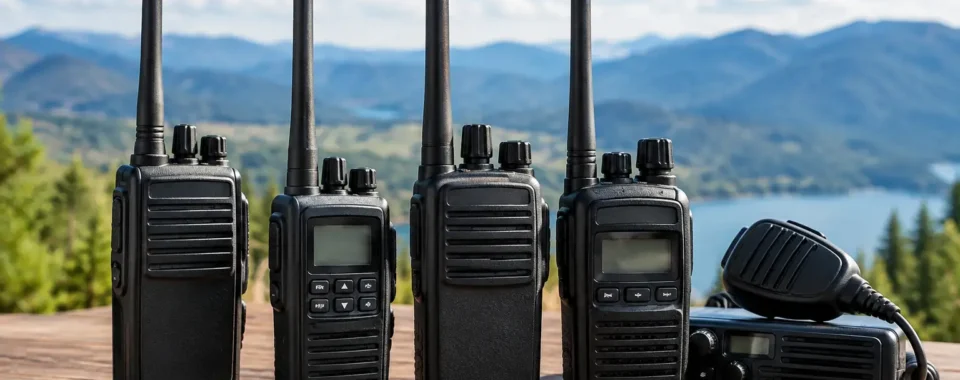

A handheld GMRS radio is convenient until the vehicle becomes the center of your operation. Then a properly installed mobile unit changes the experience: more transmit power, a better antenna, clearer audio, and controls that remain usable while you are working. The best GMRS mobile radios are not necessarily the ones with the longest feature list. They are the radios that fit your coverage plan, vehicle, antenna installation, and the way your people actually communicate.
For a family convoy, a compact 20- to 25-watt radio may be all that is needed. A large property, ranch, event operation, or off-road group may benefit from 50 watts, repeater capability, and a higher-gain antenna mounted where it can perform. GMRS requires an FCC license, but no individual test, and one license covers the holder’s immediate family. For business use, however, GMRS is not a substitute for a properly licensed commercial radio system. It is intended for personal and family communications, not communications in connection with business activities.
What Makes the Best GMRS Mobile Radios Different?
A mobile radio’s advertised wattage matters, but it is only one piece of the system. Antenna placement, coax quality, terrain, buildings, and whether you can use a repeater usually have a greater effect on usable range than a small difference in transmit power.
Look first for a GMRS-certified radio. Certification matters because GMRS radios must meet FCC equipment requirements. A radio marketed as dual-band amateur equipment may be technically capable of transmitting on GMRS frequencies, but that does not make it lawful to use there.
The right mobile radio should also have a clear display, a real external speaker option, programmable memory channels, CTCSS and DCS tone support, and simple controls. If the radio will be used in a work truck, tractor, side-by-side, or equipment trailer, prioritize buttons and menus that can be operated without a manual in hand. For a permanent installation, a detachable control head can be especially useful when dashboard space is limited.
7 GMRS Mobile Radios Worth Considering
These radios serve different jobs. Rather than treating this as a one-size-fits-all ranking, consider which design best matches your installation and operating needs.
1. Wouxun KG-1000G Plus
The Wouxun KG-1000G Plus is a strong choice for serious GMRS users who want high power, repeater capability, and a feature-rich mobile platform. Its 50-watt output on the main GMRS channels, cross-band receive functions, detachable faceplate, and extensive channel programming make it well suited to vehicles and fixed stations.
The trade-off is complexity. This is not the radio to buy solely because it has the most settings. It is best for users who will take time to program channels, configure tones correctly, and install a quality antenna system. It can be an excellent central radio for a property or group that uses local repeaters.
2. Midland MXT575
The Midland MXT575 combines a 50-watt GMRS mobile radio with a remote-mount microphone control head. The main radio body can be tucked under a seat or behind a dash panel, while the display and controls stay in the hand microphone. That design is particularly practical in newer vehicles where available dash space is scarce.
It is a sensible choice for overlanding, farm vehicles, and family travel where a clean installation matters. The microphone-based interface will not suit everyone, especially users who prefer a traditional front-panel radio with a larger display, but its space-saving format solves a real installation problem.
3. BTECH GMRS-50V2
The BTECH GMRS-50V2 is built for users who want a conventional mobile-radio form factor with 50-watt capability and broad programming flexibility. It supports GMRS repeater channels, has a readable color display, and offers front-facing controls that are familiar to anyone accustomed to vehicle-mounted two-way radios.
This radio fits well in a truck, base station, or utility vehicle where there is room for a standard chassis. Its value is in its combination of power and practical controls, not in being the smallest option. Plan the installation carefully, including power wiring and speaker placement, to get the best results.
4. Radioddity DB25-G
The Radioddity DB25-G is a compact 20-watt GMRS mobile radio that makes sense when space, budget, or installation simplicity is the priority. It is often a better fit than a 50-watt model for a commuter vehicle, a small cab, or users who primarily need dependable local communication.
Twenty watts paired with a properly mounted exterior antenna can outperform a handheld by a dramatic margin. The limitation is that it has less transmit-power reserve for difficult terrain or distant repeater access. For close-range property use and vehicle-to-vehicle communications, that may not matter at all.
5. Rugged Radios GMR25
The Rugged Radios GMR25 is designed with powersports and off-road communication in mind. Its compact footprint and accessory ecosystem make it attractive for side-by-sides, race vehicles, and trail rigs where mounting, vibration resistance, and headset integration are central concerns.
Before choosing a powersports-focused radio, confirm that the available mounting hardware, antenna options, and audio accessories match your vehicle. An excellent radio is still frustrating if the microphone routing is awkward or the antenna is mounted too low behind a roofline or cage structure.
6. Midland MXT275
The Midland MXT275 is a 15-watt option with controls integrated into the microphone. It is less powerful than the MXT575, but it remains a capable upgrade from a handheld for local use. Its small main body works well when a full-size radio is impractical.
This model is a good match for users who want a clean, reversible installation in an SUV, pickup, or recreational vehicle. It is not the best choice for a wide-area repeater plan, but it can be exactly right for campgrounds, convoys, property coordination, and short-distance travel communications.
7. Wouxun KG-XS20G Plus
The Wouxun KG-XS20G Plus offers a compact 20-watt GMRS mobile format with a traditional control face. It appeals to operators who want more direct access to the radio than a microphone-controlled design provides, without stepping up to the size and cost of a high-power unit.
For small fleets of personal vehicles or community users who need consistent programming and straightforward operation, this type of radio can be a practical middle ground. It has enough capability for repeater use while remaining easier to place in a tight vehicle interior.
Match the Radio to the Antenna and Installation
A 50-watt radio connected to a poorly located antenna is money left on the table. For most vehicles, the best antenna location is high and as close to the center of the metal roof as practical. That position provides a more balanced radiation pattern than a low fender mount, bumper mount, or antenna blocked by cargo, roof racks, and body panels.
Permanent NMO mounts generally provide a durable, low-loss solution for vehicles that will keep the radio long term. Magnetic mounts are useful for temporary installations and testing, but they require careful cable routing and should not be treated as equally durable. On fiberglass, plastic, or aluminum-bodied vehicles, antenna grounding and ground-plane considerations deserve extra attention.
Power wiring is equally important. For a higher-power mobile radio, run appropriately sized positive and negative leads directly to the battery, using fuses close to the battery connection. Avoid relying on accessory sockets for a 50-watt installation. Poor power connections can cause voltage drop, noise, and intermittent transmit problems that look like radio failures.
Repeater Access Changes the Equation
If your group has access to a local GMRS repeater, the best radio may be the one that makes repeater programming and day-to-day operation simple. Confirm the repeater’s output frequency, input frequency, access tone, and any owner permission requirements before programming it. Hearing a repeater does not automatically mean you are authorized to use it.
Repeaters can extend practical communications well beyond simplex vehicle-to-vehicle range, especially across rolling terrain or around large properties. They cannot overcome every coverage problem. Dense urban structures, deep valleys, and poorly placed antennas still create limitations. A site survey and a few real-world test drives are more valuable than range claims printed on a box.
Buy for the Communication Problem You Actually Have
Choose a compact 15- to 25-watt mobile if your goal is reliable local communication with a clean installation. Choose a 50-watt radio when you need stronger simplex performance, regular repeater use, or a fixed base station with a well-designed antenna. If several people will operate the system, consistency matters more than chasing every available feature.
At Cogent Radios Group, we see the best results when the radio, antenna, installation, and operating plan are considered together. A GMRS mobile radio should make communication easier when conditions are noisy, terrain is uneven, and people need an answer the first time they call.