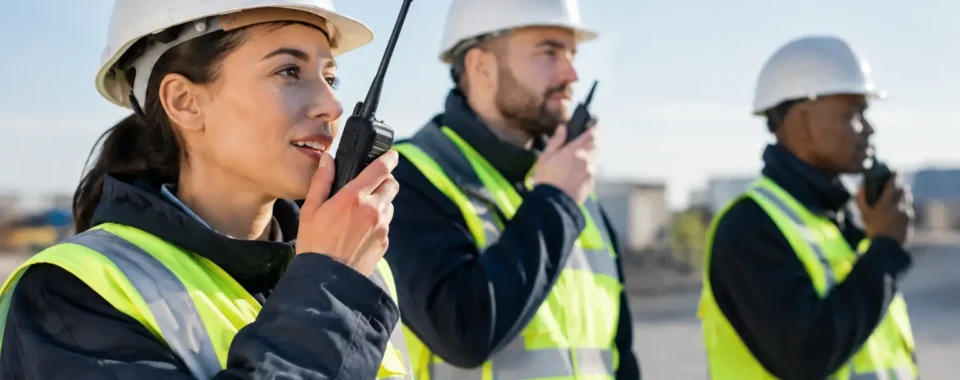

A driver leaves the yard, a supervisor moves between buildings, and a technician heads two counties away. If each person needs to reach the rest of the team with one button press, PoC radios can solve a problem that traditional short-range radios cannot: keeping a group connected well beyond the limits of a local repeater or direct radio range.
Push-to-Talk over Cellular, often shortened to PoC, combines the familiar operation of a two-way radio with cellular data and Wi-Fi connectivity. The user presses the PTT button, speaks, and reaches an individual, a defined workgroup, or a larger organization through a managed service. For many operations, that means nationwide communication without building a wide-area radio network.
That does not make PoC the right answer for every site or every team. The best choice depends on where people work, what happens when cellular service is weak, how groups need to be organized, and whether the system must support voice only or broader dispatch functions.
How PoC Radios Work in the Field
A PoC radio looks and operates much like a professional handheld radio. It typically has a dedicated push-to-talk button, a loud front-facing speaker, a large display or simple control layout, and a battery designed for a full shift. Instead of transmitting on an RF channel directly to nearby radios or through a local repeater, it sends voice traffic through a cellular network or Wi-Fi connection.
That network connection changes the practical coverage model. A maintenance manager in one city can speak to a delivery driver in another. A regional security team can use one talkgroup while assigned sites maintain their own private groups. A dispatcher can see selected devices, place calls, or coordinate staff without everyone being within the same radio footprint.
Most PoC platforms support one-to-one private calls, group calls, emergency alerts, device location, and user or group management. Capabilities vary by device and service plan, so it is worth confirming what is included rather than assuming every radio has every feature enabled.
For the person using it, the experience should remain simple: select the correct channel or group, press the button, speak clearly, and release. That familiar workflow is a major reason teams can adopt PoC quickly, especially when they are replacing phones, text threads, or a mix of incompatible radio systems.
Where PoC Radios Make the Most Sense
PoC is particularly useful when a team is mobile, spread across a broad territory, or operating at several locations. Fleet and logistics operations are a natural fit because drivers may move far beyond the range of a conventional on-site radio system. Dispatch can communicate with a workgroup immediately instead of calling individual phones or waiting for a text response.
Hospitality and property management teams can also benefit when they manage multiple buildings, campuses, or properties. A manager can maintain separate groups for housekeeping, engineering, security, and supervisors while retaining the ability to make an all-team announcement when needed.
Construction contractors, utilities, field service companies, event teams, agricultural operations, and regional service organizations often face a similar issue: people are not always close enough for conventional handheld radios, but they need faster and more accountable communication than consumer mobile phones provide.
PoC can also be a practical complement to an existing DMR or analog radio system. For example, staff working within a facility may use local two-way radios for immediate on-site communication, while traveling supervisors and remote crews use PoC to remain part of the wider operation. A mixed system can be more sensible than forcing one technology to handle every environment.
The Coverage Question Comes First
The phrase “nationwide coverage” is useful, but it should not be mistaken for coverage everywhere. PoC radios depend on available cellular data or Wi-Fi. If a work area has poor carrier coverage, no service, a congested network, or heavily shielded indoor spaces, call quality and availability may suffer.
This is the first question to answer before choosing equipment: where do your people actually work? Map regular routes, remote job sites, underground areas, warehouses, parking structures, and interior rooms with dense concrete or steel. A device may perform very well across most of a service territory yet be the wrong tool for a basement mechanical room or a rural area with limited cellular service.
Some organizations address this by selecting devices or plans that use more than one carrier, by testing service at critical locations, or by pairing PoC with conventional radio coverage for known dead zones. Wi-Fi can improve indoor performance where it is reliable and properly managed, but it should be tested under normal operating conditions rather than only from an office desk.
If communications must continue during a local carrier outage or in areas without cellular and Wi-Fi access, a licensed land mobile radio system, satellite solution, or another backup method may be required. The right answer is often a layered communications plan, not a single device type.
PoC Radios Versus Cell Phones and Traditional Two-Way Radios
A cell phone can make a call almost anywhere there is service, but it is not built around fast group coordination. Calling several people takes time. Texting creates delays, and a busy crew may not see a message promptly. A PoC radio provides immediate group voice communication with a dedicated button and no need to unlock a screen, search contacts, or establish a separate call.
Traditional two-way radios remain the stronger choice for many local, high-traffic, or coverage-critical operations. They can operate directly radio-to-radio or through dedicated infrastructure and do not depend on commercial cellular service. They are often preferred for a facility, campus, manufacturing floor, or remote area where an organization needs direct control over coverage.
The trade-off is infrastructure and operating range. Extending conventional radio coverage across a large region can require repeaters, towers, licensing, engineering, and ongoing maintenance. PoC avoids much of that local infrastructure by using existing carrier networks, but introduces recurring service costs and dependence on those networks.
Neither approach is automatically better. A local business with all staff inside one industrial site may get more value from DMR. A service company with crews across several states may find PoC far more practical. Organizations with both needs may use each system where it performs best.
What to Evaluate Before You Deploy PoC Radios
Start with the work, not the device catalog. Determine who needs to talk, which groups need privacy, how often calls occur, and whether supervisors need location information or dispatch tools. A clear communication plan prevents the common mistake of putting everyone into one oversized talkgroup where critical traffic gets buried.
Next, evaluate the radio itself. Commercial users should look at audio volume in noisy environments, battery life across a real shift, glove-friendly controls, charging options, accessory compatibility, and environmental ratings appropriate to the job. A lightweight device may be ideal for hospitality staff, while a field crew may need a larger unit with a higher-capacity battery and a remote speaker microphone.
Also consider administration. Someone must be able to add users, remove former employees, assign talkgroups, manage devices, and respond when a radio is lost. The service platform should match the organization’s size and workflow. A small team may need simple group calling, while a multi-location operation may need dispatch visibility, user permissions, and reporting.
Finally, test before committing to a full rollout. Use representative staff, actual vehicles, normal work routes, and the places where communication matters most. Ask whether the audio is understandable around equipment, whether the radio stays connected where employees spend time, and whether users can operate it without slowing down. A short field trial reveals far more than a specification sheet.
A Practical Rollout Makes the Difference
PoC radios work best when talkgroups are designed around real decisions. A dispatch group, a supervisor group, and separate operational groups are usually more useful than a single channel shared by every employee. Establish plain-language calling practices, train users on emergency functions, and make sure each employee understands which group to select before transmitting.
Charging and accountability deserve the same attention. Radios should have assigned chargers, a process for reporting damage, and a clear handoff procedure for shared devices. For fleet operations, vehicle chargers and approved mounting arrangements can reduce dead-battery problems that appear halfway through a shift.
Cogent Radios Group helps organizations evaluate PoC alongside DMR and other professional radio options, because the best communications system is the one that still works when the team is busy, spread out, and under pressure.
Before replacing an existing system, put the proposed solution in the hands of the people who will rely on it. Their routes, buildings, noise levels, and response requirements will tell you whether PoC belongs at the center of your communications plan or serves best as part of a broader radio strategy.