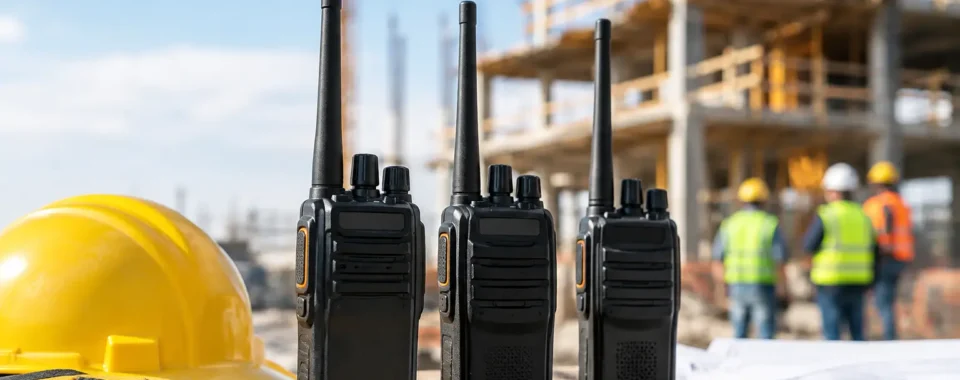

A foreman cannot wait for a phone call to connect while a concrete pour is underway, a crane operator needs a clear instruction the first time, and a superintendent needs to reach several crews without tying up one channel. The best DMR radios for construction solve those day-to-day communication problems with dependable voice quality, useful coverage options, and hardware built for dust, weather, and hard use.
For most construction operations, a professional DMR system is a better fit than consumer walkie-talkies. Digital Mobile Radio supports clearer audio at the edge of coverage, more efficient use of licensed spectrum, and features such as individual calling, text messaging, emergency alerts, and multiple talkgroups. The right radio, however, depends as much on the jobsite and system design as it does on the radio model.
What Makes a DMR Radio Right for Construction?
Construction teams need radios that work in loud, changing environments. A device that performs well in a quiet warehouse may fall short beside heavy equipment, through reinforced concrete, or across a developing site with changing elevations.
Start with the physical build. Look for a commercial-grade housing, a strong accessory connector, and an IP rating suited to the exposure crews will face. IP67 or IP68 protection is valuable for crews working outdoors in rain, mud, and dust. An IP54 or IP55 radio may be appropriate for indoor finishing work or light-duty applications, but it is not the same choice for excavation, roadwork, or utility construction.
Audio is equally important. High-output speakers, digital noise suppression, and quality remote speaker microphones help users hear over engines, generators, wind, and backup alarms. A radio with excellent specifications is of little value if workers remove it from their belt because they cannot hear it.
Battery planning deserves close attention. A nominal 12-hour shift often becomes a longer day when travel, setup, or overtime is involved. Select a battery that can comfortably cover the full operating period, then establish a charging routine with spare batteries or multi-unit chargers. For large crews, a battery-management process prevents a small oversight at the charging station from becoming a safety issue in the field.
Best DMR Radios for Construction by Jobsite Need
There is no single best radio for every contractor. The best choice changes with crew size, site geography, noise level, exposure, and whether the system needs to support one project or several locations.
For everyday crews: Motorola R2
The Motorola R2 is a practical option for contractors that need a straightforward commercial DMR handheld for routine crew coordination. It is suited to many general construction, maintenance, and facilities applications where users need clear digital voice, dependable battery life, and simple controls without the cost of a feature-heavy flagship radio.
This type of radio works well for smaller sites using direct radio-to-radio communication or a basic licensed repeater. It is a sensible starting point when the priority is replacing inconsistent consumer radios with a serviceable professional fleet. Before standardizing on it, confirm the environmental rating, battery option, frequency band, and accessory requirements for the actual crew.
For demanding outdoor work: Motorola R7
For high-noise, high-exposure environments, the Motorola R7 is often a strong candidate. Its audio capabilities and commercial-grade construction make it well suited to heavy civil work, industrial construction, utilities, and larger sites where workers may be around machinery all day.
The R7 is not the lowest-cost path, and not every crew needs its expanded feature set. It earns its place when audio intelligibility, weather resistance, larger battery options, and long-term fleet support are priorities. A contractor running multiple projects may also benefit from its capacity to support more advanced programming and fleet-management practices.
For a durable value-focused fleet: Hytera HP682
The Hytera HP682 is worth considering when a contractor needs a compact, durable DMR portable with strong battery performance and modern digital features. It can be a good fit for building trades, site supervisors, security personnel, and subcontractor coordination where a lighter radio is appreciated but commercial protection is still required.
As with any radio platform, make sure the specific configuration supports the features you plan to use. Some functions can depend on programming, compatible accessories, firmware, or system design. A careful review before purchase is preferable to discovering that a desired calling or safety feature was not included in the original deployment.
For harsh environments and specialized fleets: Icom F3400D Series
The Icom F3400D series is another professional option for teams that place a high value on environmental protection, audio performance, and durable field equipment. Depending on the model and configuration, this class of radio can fit demanding construction, utility, and industrial environments.
It is especially worth evaluating when a company already uses Icom equipment, needs compatibility with an existing licensed system, or prefers a particular accessory ecosystem. The best fleet decision is rarely about brand preference alone. It should account for service availability, replacement-radio planning, programming support, and the ability to keep the whole crew on a consistent platform.
Coverage Comes Before the Radio Model
A common mistake is to select powerful handheld radios and assume they will cover any project. Handheld power helps, but terrain, steel, concrete, elevation, and building layout have a greater effect on real-world performance than most buyers expect.
For a small open site, radio-to-radio operation may be enough. On a multi-story build, a sprawling campus, a quarry, or a project with substantial steel and concrete, a properly placed repeater can make the difference between occasional contact and reliable coverage. A repeater receives a transmission and retransmits it from a better location, extending usable range and improving access for teams on different sides of the project.
DMR also offers two time slots on a single 12.5 kHz channel. In practical terms, that can allow two separate conversations or talkgroups to share one licensed channel. A construction manager might assign one talkgroup to site operations and another to security, logistics, or a separate work zone. This is useful, but it requires sound programming and clear radio discipline. Too many talkgroups can confuse users just as quickly as too few channels can create congestion.
Do Not Overlook FCC Licensing and Frequency Planning
Most business DMR operations in the United States use FCC-licensed frequencies. Licensing protects your operation from operating on inappropriate frequencies and helps establish a coordinated, lawful communication plan. It also gives your organization more control than relying on unlicensed consumer-band devices in a crowded area.
Frequency selection should be planned around the site, the expected duration of the project, nearby radio users, and whether the radios will move to future jobs. UHF is commonly favored around buildings and dense jobsite structures, while VHF can be advantageous in more open terrain. Neither band is automatically better in every situation.
A qualified communications provider can help with frequency coordination, licensing support, coverage assessment, radio programming, repeater selection, and installation. This is particularly valuable when radios are used for safety-related coordination, crane operations, traffic control, or multiple active crews.
Features Construction Teams Should Specify Up Front
The right feature list should be driven by operating procedures, not a checkbox comparison. At minimum, most professional construction fleets should consider emergency buttons, worker identification, scan capability, priority channels, programmable buttons, and high-capacity batteries.
Lone-worker and man-down functions may be appropriate for isolated work, confined spaces, or after-hours personnel, but only when the response process is clearly defined. A radio alert is useful only if someone is assigned to receive it and act. GPS can help dispatchers locate mobile supervisors or vehicles, although it adds cost and may not provide useful location data inside every structure.
Accessories deserve the same scrutiny as the radio. A noise-canceling remote speaker microphone, surveillance-style earpiece for a superintendent, or heavy-duty headset for equipment operators can improve communications substantially. Use approved accessories that match the radio’s environmental protection requirements. An inexpensive accessory with a weak connector can become the point of failure.
A Better Buying Process for Construction Radio Fleets
Before choosing radios, map the work areas, identify the noisiest locations, count the groups that need to communicate independently, and determine who needs to talk to whom. Include supervisors, gate personnel, equipment operators, delivery coordination, and emergency contacts. Then test coverage where the work actually happens, not just from the office trailer.
It also helps to decide whether the radios are a short-term project tool or part of a long-term company fleet. A temporary site may call for a simple programmed portable-radio package. A contractor with projects across several counties may need repeaters, standardized templates, spare equipment, and ongoing programming support. Cogent Radios Group can help translate those operational requirements into a practical DMR design rather than simply selecting radios from a catalog.
The best construction radio is the one crews can hear, carry, and use correctly on the hardest day of the project. Start with the jobsite, build the coverage plan around it, and choose equipment that your team can rely on long after the first pour or first framing day is complete.